
Digital Transformation 2.0 for Executive Leaders is a new approach that fixes what has been broken in traditional transformation strategies for over a decade: siloed initiatives, unclear financial impact, dashboard overload, cultural resistance, and lack of predictive clarity regarding whether investments will actually deliver results.
Executives today are under intense pressure to modernize:
- Boards demand digital maturity.
- Shareholders want margin expansion.
- Customers expect seamless experiences.
- Employees want tools that remove friction and clarify priorities.
AI is accelerating all of this — while simultaneously making the transformation landscape more confusing.
Most organizations attempt “digital transformation” the same way they attempted quality programs, Lean initiatives, and ISO compliance: as projects, tactics, and technology purchases. But transformation is not a technology problem. It is a business system problem.
Digital Transformation 2.0 reframes the challenge:
- You don’t transform by installing technology —
- you transform by upgrading the system of management that governs how work is done, measured, and improved.
This page introduces a systemized approach to transformation that combines the Integrated Enterprise Excellence (IEE) methodology, AI-enabled analytics, and predictive metrics to guide execution, funding, prioritization, and cultural alignment.
Why Traditional Digital Transformation Fails
Despite billions spent annually on transformation efforts, most organizations fail to reach their intended outcomes. Studies consistently show failure rates of 70–90%.
| FAILURE SYMPTOM | ROOT CAUSE |
| Projects don’t scale | No enterprise governance mechanism |
| Automation creates chaos | Unstable underlying processes |
| AI tools produce noise | Reported metric fomats can’t provide a predictive statement for a process response |
| Leaders cannot see impact | Dashboards show data, not truth |
| Culture resists change | Incentives tied to siloed success |
Transformation fails not because the technology is weak — but because the enterprise operating system is weak.
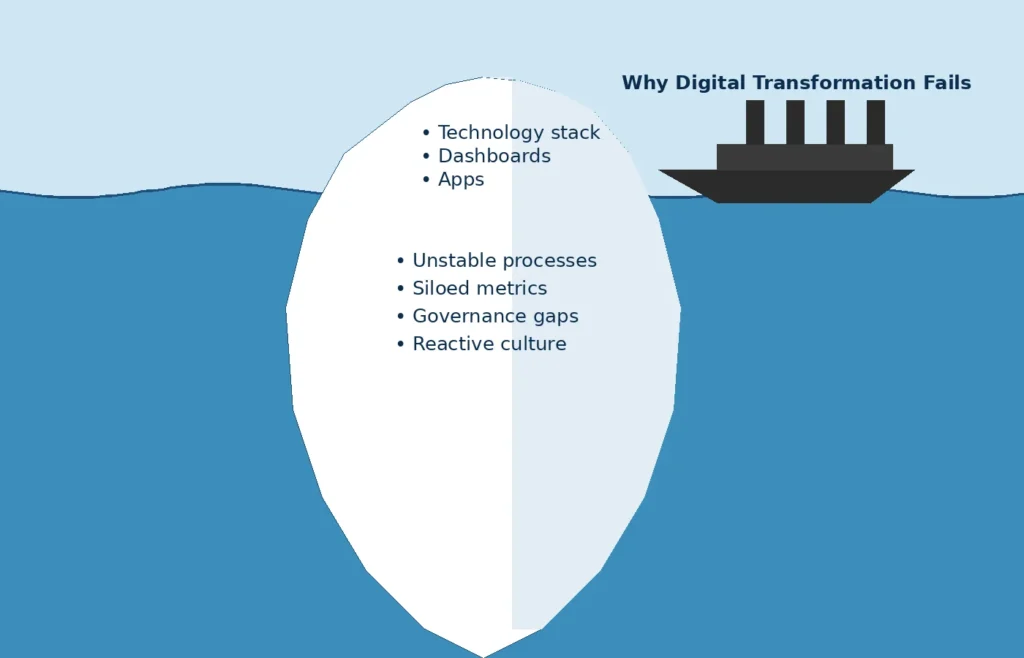
Introducing Digital Transformation 2.0: A System Instead of a Project
Digital Transformation 2.0 creates a repeatable operating system for modernization — not a one-time initiative.
THE CORE SHIFT
| Traditional Approach | Digital Transformation 2.0 |
| Start with tools and projects | Start with system-level clarity |
| Dashboards → after-the-fact | Predictive metrics → leading indicators |
| Automation for efficiency | Automation for enterprise capability |
| IT owns transformation | Executive leadership owns system |
| Focus on adoption | Focus on financial confidence |
Enterprise Digital Transformation Roadmap
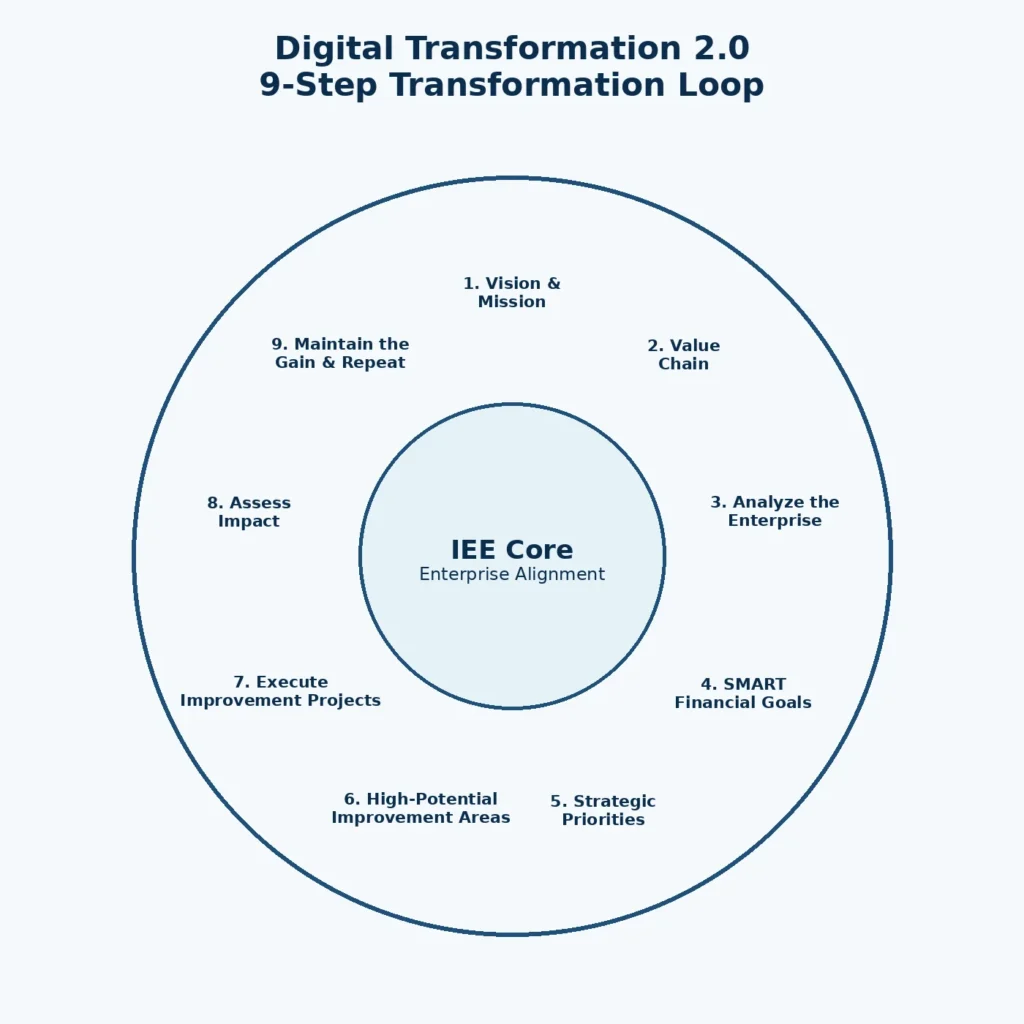
Digital Transformation 2.0 uses a 9-Step Enterprise Roadmap aligned to the Integrated Enterprise Excellence method.
- Clarify Enterprise Purpose, Value Model & Constraints
- Create a Digital Value Chain — See Everything at Once
- Stabilize Core Processes — Stop firefighting before modernizing
- Install Predictive Performance Metrics (30,000-foot-level)
- Prioritize Modernization Using Financial Lift Probability
- Develop AI-Enabled & Automation-Ready Workflows
- Build a Governance Cadence that Replaces Dashboard Chaos
- Scale Improvements — Convert wins into capabilities
- Close the Loop — Transformation Becomes the Operating System
Result:
Executives move from technology decision fatigue to system-level clarity, where the right investments become obvious.
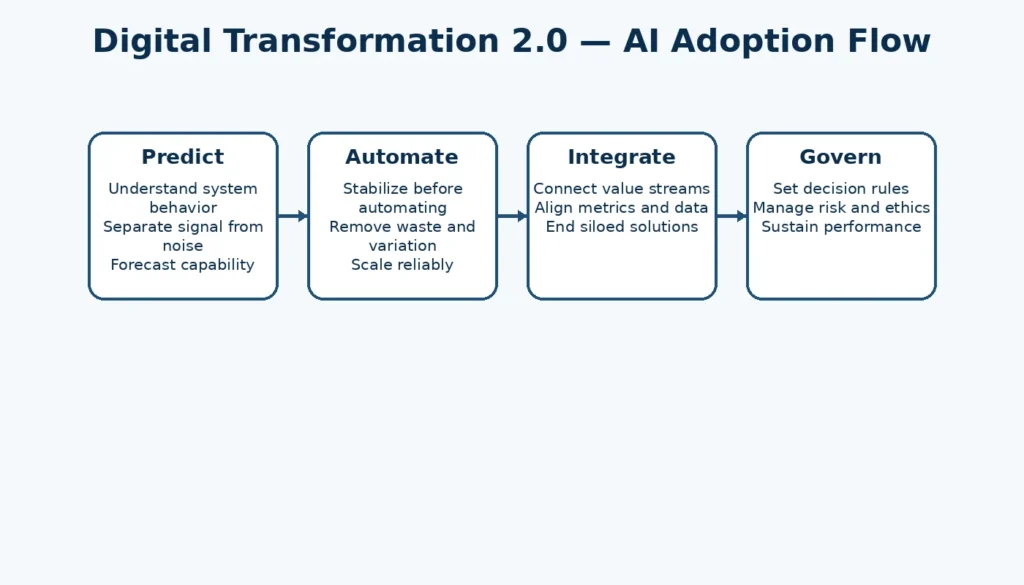
AI-Enabled Business Transformation Framework
AI does not fix a broken system. It accelerates failure in a broken system.
Digital Transformation 2.0 treats AI as a capability amplifier, not a solution in itself.
The Framework
- Predict → Automate → Integrate → Govern
- Predict with statistical truth (IEE metrics)
- Automate stable workflows
- Integrate data with purpose, not volume
- Govern through executive cadence
AI Adoption Pillars
| Pillar | Executive Question |
| Process Stability | Is the process predictable enough to automate? |
| Data Integrity | Are we modeling noise or truth? |
| Governance | Who is accountable for capability drift? |
| Scaling | Does this create enterprise learning or hero projects? |
AI success is not model accuracy — it is capability reliability.
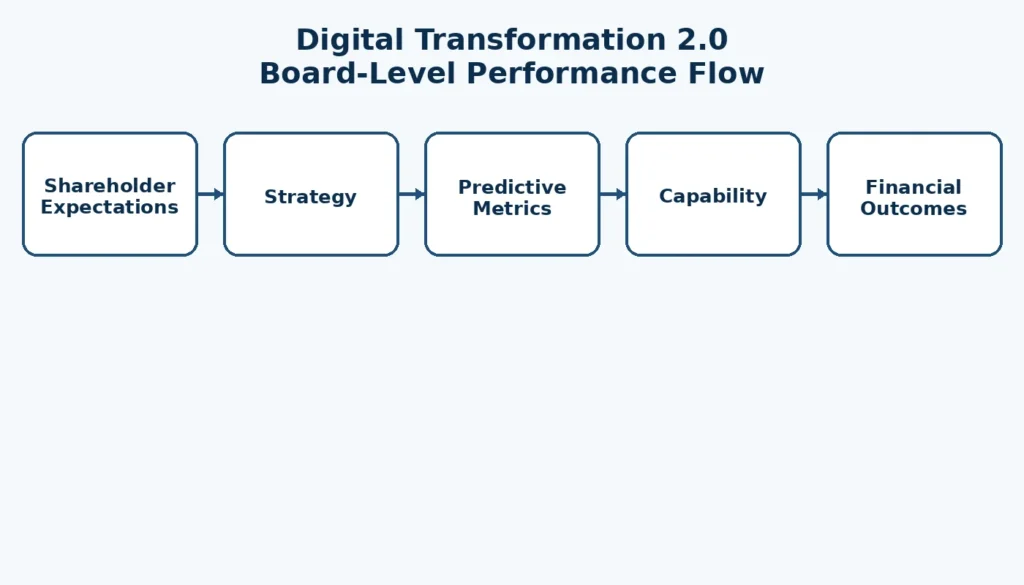
Digital Transformation Governance Model
This is where Digital Transformation 2.0 becomes non-negotiable.
Executives require a governance cadence that eliminates:
- whack-a-mole meetings
- endless dashboard reviews
- firefighting disguised as strategy
- the illusion of performance caused by color-coded KPIs
Governance Cadence Components
- Monthly stability review (predictive analytics)
- Quarterly strategy recalibration
- Annual economic model restructuring
- Dynamic budgeting tied to IEE metrics
- Board reporting designed for truth, not optics
This governance model acts as the immune system for transformation.
Predictive Performance Metrics for Transformation
Your existing KPI dashboards are likely lying to you — not intentionally, but structurally.
Dashboards show changes.
They don’t tell you if the change matters.
30,000-Foot-Level Metrics (IEE)
A predictive metric answers three questions:
- Is the process stable?
- Can we predict future performance?
- Is the performance acceptable?
If the answer to #1 is no, every dashboard discussion is noise.
This creates a radical shift:
Decision making moves from reactive interpretation → statistical clarity
Why this matters for digital transformation
If executives are modernizing the wrong parts of the system — because metrics mislead — technology becomes expense, not capability.
This is why the first transformation is measurement.

The red-yellow-green dashboard shown in the above figure (an actual company r-y-g scorecard) indicates several improvements over time when a red color (unsatisfactory response) transitioned to a green color (statisfactory response) for the following time period.
However this 30,000-foot-level chart in a digital transformation 2.0 system indicates nothing has changed and there has been a 32.6% non-confirmance rate over the this time r-y-g time period.
From the 30,000-foot-level chart, a predictive assessment of 32.6% implies that about 1/3 of the time there will be a red signal (non-conformance) unless something were done to improve the proceess. This report proves more informative direction than firefighting the period red signals that are simple noise response changes within the system.
A 30,000-foot-level report my initially appear complex to interpret; however it is easier to determine the appropriate action or non-action to take by simply reading the statement at the botton of the report.
Schedule a video meeting with Forrest to see how one of your KPIs datasets can be viewed in a 30,000-foot-level format to gain insight that has not been seen before with your red-yellow-green or table of numbers reporting.
📌 Schedule a 30-minute Transformation Strategy Session (https://smartersolutions.com/schedule-zoom-session/)
If you prefer email, contact me at forrest.breyfogle@smartersolutions.com
Executive Use Cases
| Industry | Result |
| Healthcare | EHR + workflow automation → reduction in unseen rework → stable care cycle times |
| Manufacturing | Predictive AI maintenance → fewer false alerts → lower cost of capital |
| SaaS/Tech | Data governance + metrics → improved investor reporting → higher valuation multiple |
| Finance | Risk analytics integration → governance adherence → regulatory confidence |
Transformation works when it becomes a capability engine, not a project list.
What Makes Digital Transformation 2.0 Different
- Starts with enterprise purpose
- Eliminates dashboard noise with predictive metrics
- Scales using a governance operating system
- Prioritizes financial lift instead of tech adoption
- Integrates AI after stability, not before
This is not a consulting methodology.
This is a management system upgrade.
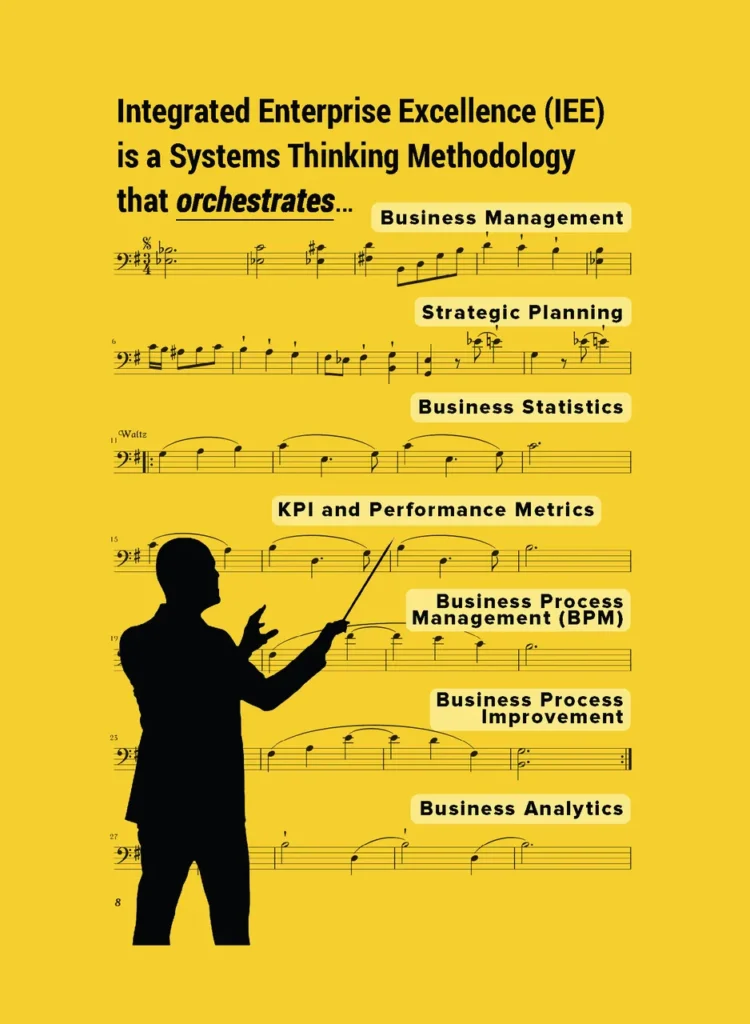
The IEE system is a Digital Transformation 2.0 for Executive Leaders approach that orchestrates the business.
Next Step
If your digital transformation feels like a cost center instead of a confidence engine — we should talk.
📌 Schedule a 30-minute Transformation Strategy Session (https://smartersolutions.com/schedule-zoom-session/)
➡️ If you prefer email, contact me at forrest.breyfogle@smartersolutions.com