Lean Six Sigma Black Belt Reimagined: Smarter KPI Integration for Sustainable Results
Discover why traditional Lean Six Sigma Black Belt training often fails to deliver lasting results. Learn how Smarter Solutions’ IEE approach integrates KPI performance for sustainable business improvement.
Lean Six Sigma Black Belt: Why Many Certifications Fall Short
Lean Six Sigma Black Belt certification is one of the most sought-after credentials in the world of process improvement. It promises tools to reduce waste, increase efficiency, and solve problems through DMAIC (Define, Measure, Analyze, Improve, Control).
However, despite thousands of certified professionals, most organizations struggle to sustain improvements or link those improvements to meaningful business outcomes.
Why?
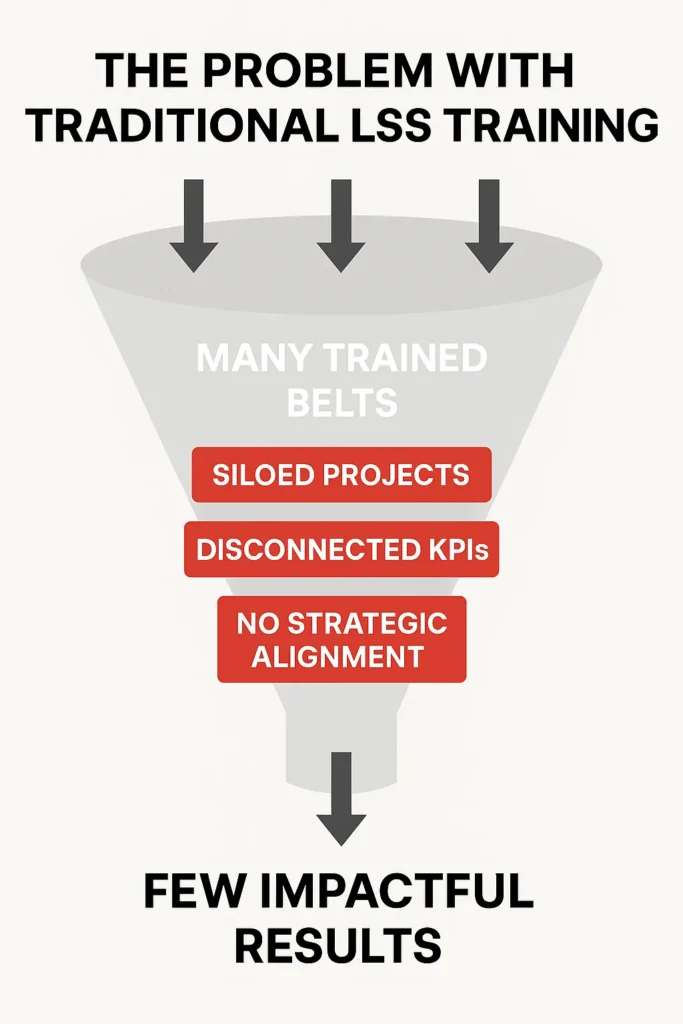
Because traditional Lean Six Sigma methods focus on projects, not systemic business transformation.
The Hidden Pain: When Lean Six Sigma Doesn’t Deliver
Organizations that invest heavily in Lean Six Sigma certifications often encounter a series of frustrating outcomes:
Projects that don’t link to strategic priorities
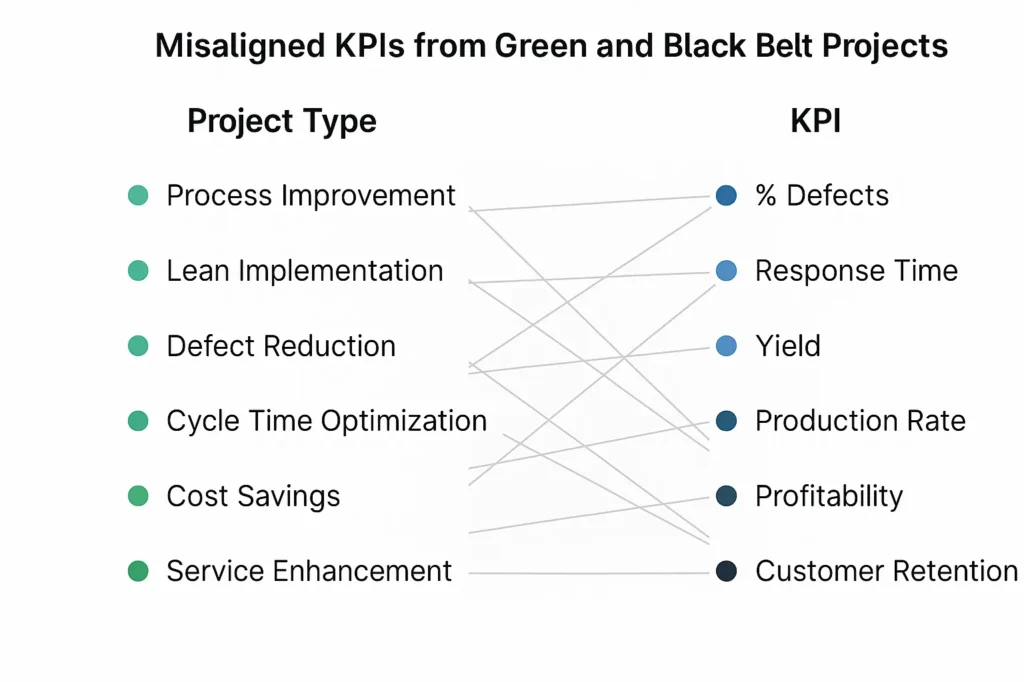
Disjointed KPIs that don’t reflect true business success
Green and Black Belts unsure where to start or what metrics to impact
Leadership disengagement once certification goals are met
In other words, many Lean Six Sigma Black Belts become problem solvers without a compass—armed with tools but lacking a clear direction tied to enterprise success.
The Root Cause: A Disconnect Between Training and Enterprise Needs
The Lean Six Sigma training model emphasizes tools (e.g., control charts, hypothesis testing) but neglects the integration of business management systems, KPIs, and strategic alignment.
As a result:
Improvement efforts often chase low-hanging fruit, not what matters most
Reported results are local and temporary
Leaders cannot see the impact on top-line or bottom-line success. Because of this Lean Six Sigma implementations can be abandonded or significantly downsized.
IEE: A Smarter Path for Lean Six Sigma Black Belts
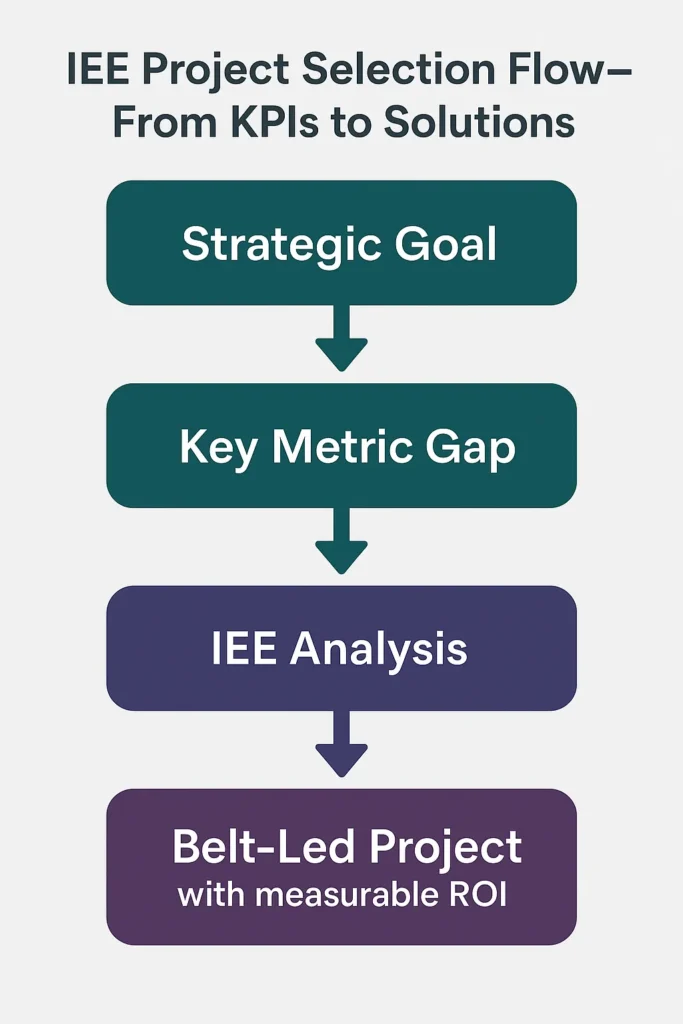
Smarter Solutions’Integrated Enterprise Excellence (IEE)methodology reframes Lean Six Sigma from isolated projects into a systemic, metrics-driven journey.
Eliminate the subjectivity of red/yellow/green scorecards
Drive improvement that leadership understands and values
30,000-Foot-Level Metrics: The Missing Link in LSS Training
The heart of IEE is in redefining how performance is measured.
Unlike conventional KPIs , which often lag and mislead (and is an elephant in the room that is not discussed), IEE introduces30,000-foot-level reporting—a high-level statistical view of a process over time. This avoids overreacting to noise and helps detect real trends – statistically.
The above 30,000-foot-level report assess both process stability and provides a predictive process capability statement (at the bottom of the report) when a process response is stable – in words that everyone can easily understand.
The above 30,000-foot-level report shows a reduction in the customer disatisfication rate to about 0.089 after process improvement was made about 8/1/2017 (time when 30,000-foot-level chart was staged). If this disatisfication rate is still too high, there is a need for further process improvement.
This method:
Separates common cause vs special cause variation
Helps identify predictable performance patterns
Links process metrics directly to enterprise goals
You can create a 30,000-foot-level chart for any process output response (e.g., for a Black Belt improvement project) using a free-30,000-foot-foot-level creation app.
Real-World Impact: What Organizations Are Achieving with IEE
Before IEE:
Projects were selected based on hunches or availability of resources
Executives ignored belt-led initiatives due to lack of relevance
Process control was erratic and unmeasurable
After IEE:
Black Belts propose projects based on quantifiable business needs
Executives see improvement tied to true KPIs, like cost of poor quality, customer churn, or inventory turns
Belts become trusted partners, not just project leaders
KPI Examples that Matter in an IEE-Enhanced Lean Six Sigma Program
Traditional training may focus on generic metrics like defect rates or cycle time. But those alone don’t excite stakeholders.
IEE-trained professionals track metrics that matter, including:
Profit contribution per value stream
Time from lead to close in sales
First-pass yield with customer satisfaction overlays
Forecast vs actual cash flow
Days inventory outstanding by category
Each of these is selected not from a template but from a systemic evaluation of organizational strategy.
Why Lean Six Sigma Black Belt Certification Alone Isn’t Enough Anymore
It’s easy to find Lean Six Sigma certification programs that promise a belt in 5 weeks or less.
But ask yourself:
Are your lean six sigma black belts and lean six sigma green belts solving the right problems?
Can you see the business impact of their work?
Are your leaders engaged in process improvement?
If the answer is “no,” the problem isn’t your people—it’s the system they’re in.
IEE offers a proven methodology to close that gap.
Lean Six Sigma + IEE = Sustainable Results
When Lean Six Sigma is paired with IEE, organizations gain:
✅ Project selection that aligns with enterprise KPIs ✅ Tools to evaluate project impact with statistical rigor ✅ A performance measurement system executives can trust ✅ A culture where belts speak the language of business strategy
This transforms Lean Six Sigma from a certification checkbox to a driver of long-term business excellence.
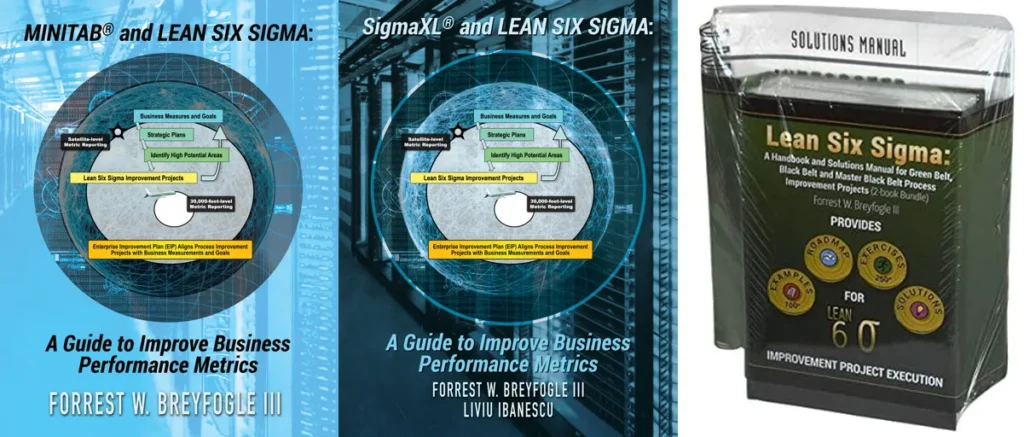
Lean Six Sigma Black Belt and Lean Six Sigma Green Belt Reimagined Resource Books
The following books are resources for creating an IEE system so that the best improvement lean and six sigma projects are selected and executed.
Management 2.0: Discovery of Integrated Enterprise Excellence (Management and Leadership System 2.0 Book 1): This book (also available as an audiobook) is written in an easy-to-understand novel format that provides practitioners and managers with a next-generation system for enhancing digital transformation efforts in an organization.
Leadership System 2.0: Implementing Integrated Enterprise Excellence (Management and Leadership System 2.0 Book 2): This book (also available as an audiobook) continues the novel format story initiated in Management 2.0. This book provides an easy-to-understand character dialog on how to implement Deming’s management philosophy and deliver a system for managing the needs of ISO 9000, Baldrige award criteria, and Shingo Prize criteria all at one time through the IEE business management system.
The following books are resources for efficiently executing IEE identified improvement projects so that the project’s 30,000-foot-level metric is enhanced.
We use cookies on our website to give you the most relevant experience by remembering your preferences and repeat visits. By clicking “Accept All”, you consent to the use of ALL the cookies. However, you may visit "Cookie Settings" to provide a controlled consent.
This website uses cookies to improve your experience while you navigate through the website. Out of these, the cookies that are categorized as necessary are stored on your browser as they are essential for the working of basic functionalities of the website. We also use third-party cookies that help us analyze and understand how you use this website. These cookies will be stored in your browser only with your consent. You also have the option to opt-out of these cookies. But opting out of some of these cookies may affect your browsing experience.
Necessary cookies are absolutely essential for the website to function properly. This category only includes cookies that ensures basic functionalities and security features of the website. These cookies do not store any personal information.
Any cookies that may not be particularly necessary for the website to function and is used specifically to collect user personal data via analytics, ads, other embedded contents are termed as non-necessary cookies. It is mandatory to procure user consent prior to running these cookies on your website.