
Freefall: A Reckoning for Boeing focuses considerable attention on Boeing’s leadership, corporate culture, quality concerns, and decisions associated with financial and production pressures. The documentary raises an important question that deserves further consideration: What kind of management system could help prevent an organization from repeatedly making decisions that contribute to serious operational and quality problems?
We previously examined these issues in “Boeing Quality Control Failures: AI Enabling BPM Model for Resolution,” which describes how an Integrated Enterprise Excellence (IEE) business management system could provide greater visibility into Boeing’s manufacturing quality performance and help direct improvement efforts to the processes that need them most.

Identifying management failures is important. But identifying what went wrong does not by itself create a system that prevents recurrence. Boeing needs a management approach that remains effective through changes in executives, economic conditions, production pressures, and corporate priorities.
Netflix Boeing Documentary Highlights a Problem That Goes Beyond Boeing
The Netflix Boeing documentary should be relevant to executives far beyond the aerospace industry. An organization can have talented employees, sophisticated technology, extensive procedures, quality departments, and thousands of performance measurements and still make poor enterprise-level decisions.
One reason is that large organizations are often managed as collections of functional silos. Finance, manufacturing, engineering, quality, and supply-chain functions can each pursue their own objectives without adequately considering the effect on the overall enterprise.
An effective business management system needs to evaluate the organization as an interconnected system rather than as independently managed functions.
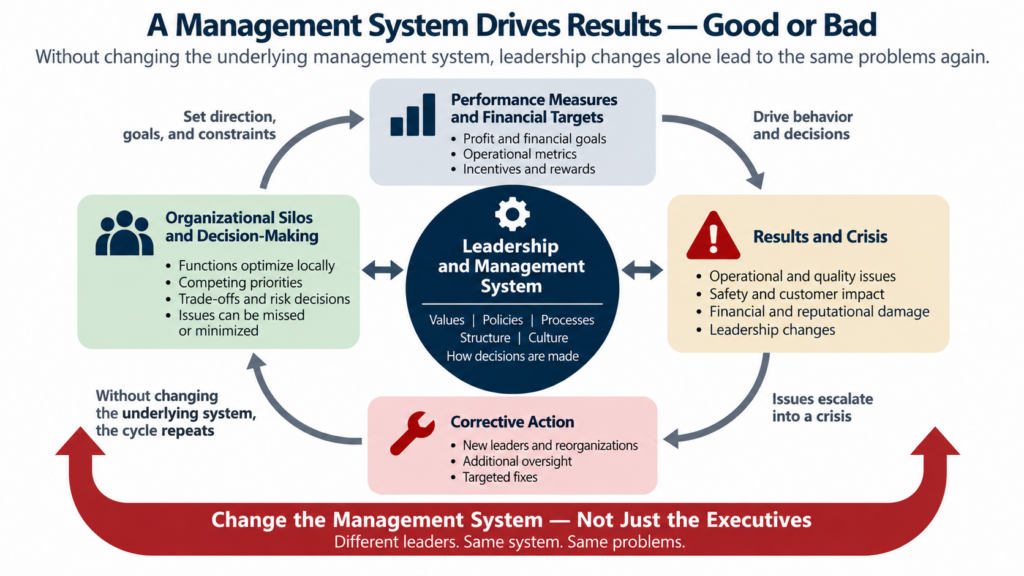
Boeing Management Failures Require More Than Changing Executives
The Boeing management failures described in discussions surrounding the company understandably lead to questions about senior leadership. Leadership matters enormously, but changing executives does not necessarily change the system through which the company is managed.
New leaders can inherit the same performance measures, financial targets, incentives, organizational silos, and decision-making practices as their predecessors.
An earlier Smarter Solutions article, “Boeing’s Manufacturing Problems: An Integrated Enterprise Excellence (IEE) Solution,” examined how Boeing’s manufacturing problems could be addressed through an enterprise-wide management system rather than through isolated corrective actions.
Internal Link to Earlier Boeing Manufacturing Article: An earlier Smarter Solutions article, “Boeing’s Manufacturing Problems: An Integrated Enterprise Excellence (IEE) Solution,” examined how Boeing’s manufacturing problems could be addressed through an enterprise-wide management system rather than through isolated corrective actions.
Without changing the underlying management system, an organization can repeatedly move from crisis to corrective action to another crisis. A sustainable solution requires changing the system rather than repeatedly responding to its symptoms.
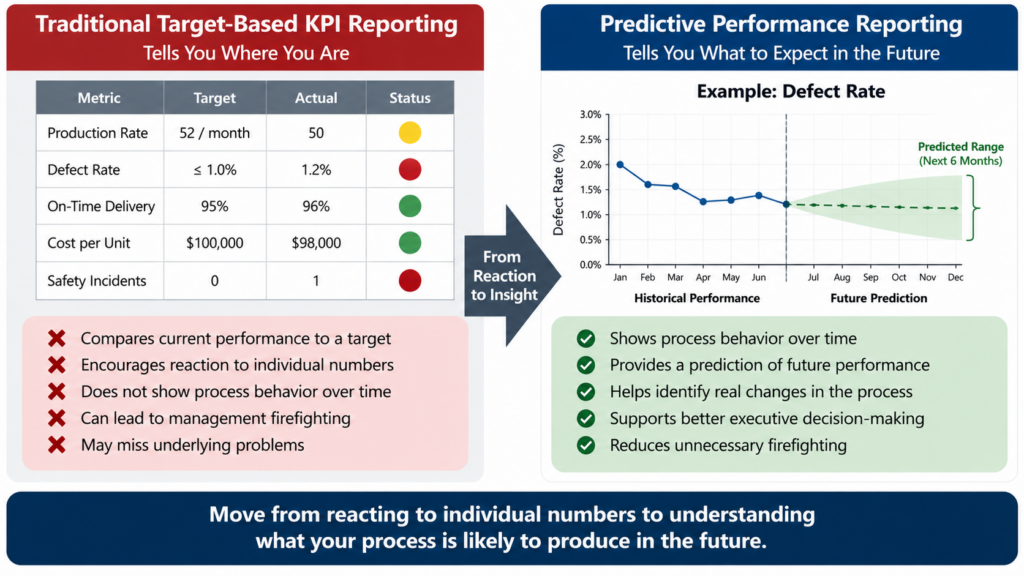
Boeing Quality and Safety Problems Show the Danger of Managing to the Numbers
The Boeing quality and safety problems illustrate an important weakness in traditional performance management: excessive emphasis on meeting numerical targets.
Financial goals, production objectives, delivery schedules, and cost targets are necessary. Problems arise when achieving these numbers becomes more important than understanding the processes that generate them.
Management should not simply ask, “Did we meet the target?”
A more useful question is: “What is this process predictably capable of producing in the future, and is that performance satisfactory?”
This distinction is fundamental to Integrated Enterprise Excellence (IEE) and its use of 30,000-foot-level predictive performance reporting.
Traditional scorecards frequently compare current performance with a target and display the result as red, yellow, or green. Such reporting may appear precise, but it can encourage executives to react to individual data points rather than understand the underlying process.
A predictive metric provides a different perspective. It examines performance over time, determines whether the process is stable, and, when appropriate, provides a prediction statement describing what the process can be expected to produce in the future.
For an organization such as Boeing, this distinction can be extremely important. Executives need to know not only whether a particular quality, production, delivery, cost, or safety metric met its target this month, but whether the underlying process is behaving consistently and what that process is likely to produce in the future.
Traditional scorecards frequently compare current performance with a target and display the result as red, yellow, or green. Such reporting may appear precise, but it can encourage executives to react to individual data points rather than understand the underlying process.
A predictive metric provides a different perspective. It examines performance over time, determines whether the process is stable, and, when appropriate, provides a prediction statement describing what the process can be expected to produce in the future.
For an organization such as Boeing, this distinction can be extremely important. Executives need to know not only whether a particular quality, production, delivery, cost, or safety metric met its target this month, but whether the underlying process is behaving consistently and what that process is likely to produce in the future.
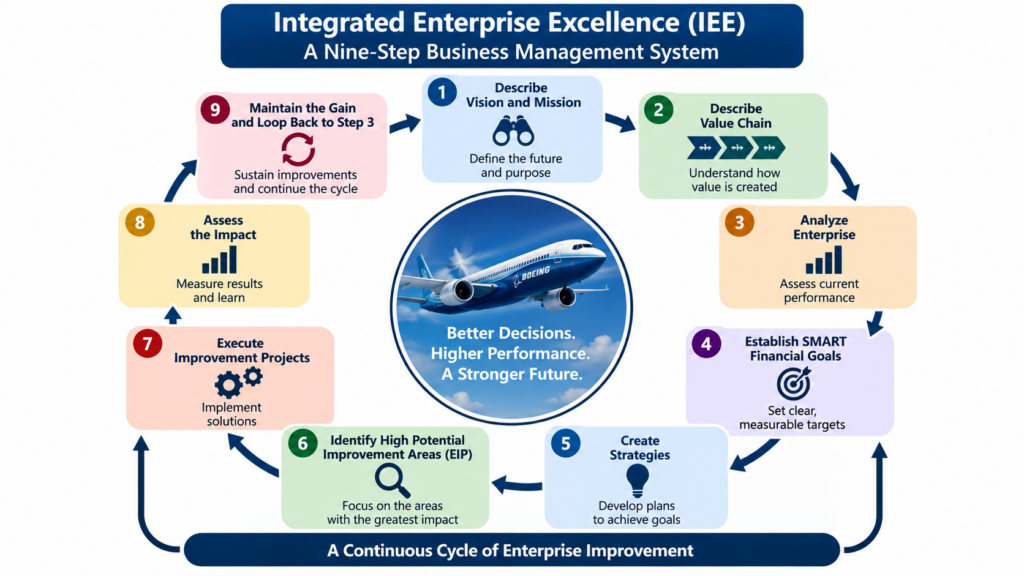
Boeing Business Management System Should Provide a Long-Lasting Framework
A Boeing business management system should do more than respond to the latest quality problem, investigation, production issue, or leadership change. It should provide a lasting framework connecting strategy, financial objectives, operations, quality, predictive performance measurements, and improvement efforts.
Integrated Enterprise Excellence (IEE) provides such a framework through its nine-step business management system. Rather than managing through disconnected scorecards, arbitrary targets, functional silos, and isolated improvement projects, IEE provides a structured approach for determining how the enterprise is performing, where improvement is needed, and which actions should provide the greatest enterprise benefit.
The nine steps are:
- Describe Vision and Mission
- Describe Value Chain
- Analyze Enterprise
- Establish SMART Financial Goals
- Create Strategies
- Identify High Potential Improvement Areas (EIP)
- Execute Improvement Projects
- Assess the Impact
- Maintain the Gain and Loop Back to Step 3
The importance of this approach is that improvement projects are not selected simply because someone identifies a problem, a metric turns red, or management launches another improvement initiative. Improvement activities should be connected to the needs of the enterprise and selected because they are expected to improve overall business performance.
This creates a closed-loop management system. Enterprise performance is evaluated, strategies are established, high-potential improvement areas are identified, improvement projects are executed, results are assessed, and the organization then returns to enterprise analysis to determine what should happen next.
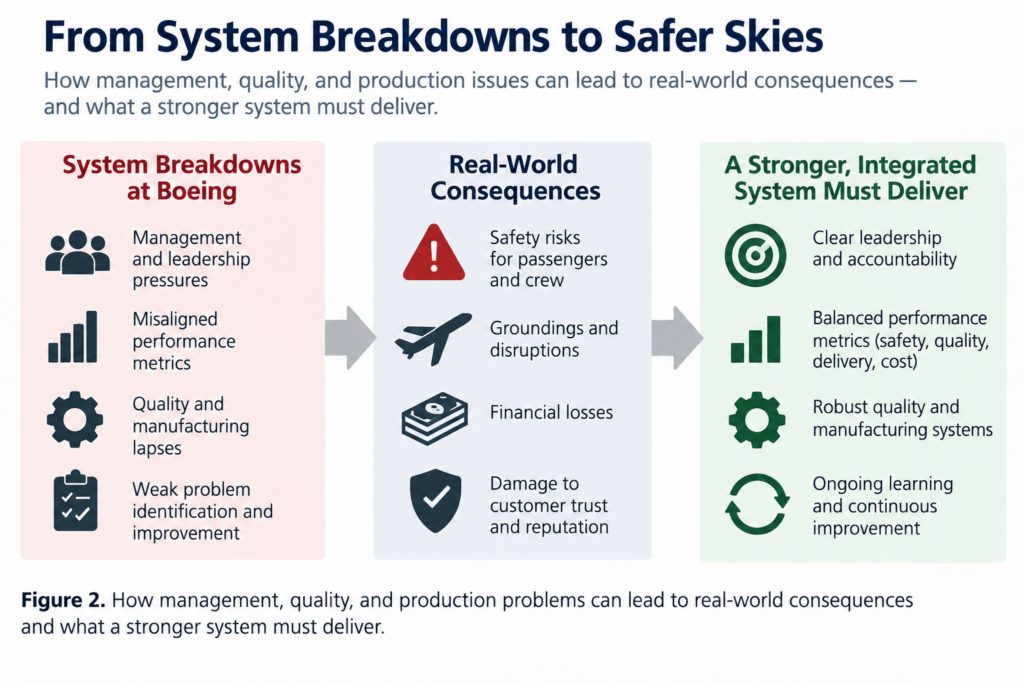
Boeing’s Problems Illustrate Why Quality Cannot Be Managed Separately
Quality should not operate as an isolated department responsible for finding problems after they occur. Quality performance is an outcome of the overall system through which products are designed, suppliers are managed, work is performed, schedules are established, decisions are made, and performance is measured.4
This enterprise perspective is also discussed in Quality Management System 2.0, which explains why quality must be integrated into the overall business management system rather than treated primarily as a separate compliance or inspection function.
The same is true for safety.
If production, financial, engineering, supplier, quality, and safety decisions are managed independently, executives may receive extensive information without receiving the enterprise-level insight needed to make the best decisions.
An integrated business management system should make these relationships visible.
This does not mean eliminating financial goals, production schedules, quality measures, or functional accountability. It means placing them within an enterprise framework so that local decisions do not unintentionally damage overall performance.
Boeing Needs Predictive Performance Metrics, Not Just More KPIs
Organizations today rarely suffer from a shortage of data. They often suffer from a shortage of useful information.
Adding more KPIs to an executive dashboard does not necessarily improve decision-making. In fact, large numbers of red-yellow-green scorecards can increase management firefighting because every unfavorable comparison can appear to demand corrective action.
Predictive performance metrics provide a different management perspective.
Instead of asking whether the latest value is above or below an arbitrary target, leadership can determine whether the process has fundamentally changed and what level of performance the process is predictably capable of producing.
This approach can help distinguish between routine process variation and signals that something has actually changed.
That distinction matters because reacting to routine variation can consume management resources without improving the process. Conversely, a stable process that consistently produces an unacceptable level of performance requires fundamental improvement even if individual monthly values occasionally meet their targets.
The objective is not simply better charts. The objective is better executive decision-making.
What Other Organizations Can Learn from Boeing
The lessons from Boeing extend far beyond aerospace.
Executives in manufacturing, healthcare, financial services, technology, logistics, and other industries face many of the same management-system challenges: functional silos, conflicting objectives, pressure to achieve short-term targets, large numbers of KPIs, and improvement projects that are not clearly connected to enterprise priorities.
Organizations should therefore ask several fundamental questions:
- Are our performance measures helping us understand what our processes will produce in the future?
- Are improvement projects selected because they will benefit the enterprise, or because someone has a problem that attracts management attention?
- Do our financial and operational objectives work together, or can one function achieve its goals at the expense of another?
- Does our management system provide continuity when executives change?
- Are we managing the enterprise as an interconnected system?
These questions are relevant whether an organization manufactures aircraft, provides healthcare, develops software, manages a supply chain, or delivers professional services.
A Better Management System Is the Sustainable Solution
Freefall: A Reckoning for Boeing provides another opportunity to examine the consequences of management decisions, organizational culture, quality problems, and production pressures.
But the most valuable lesson should not be limited to identifying who made particular decisions or which executive should have acted differently.
The more important question is how an organization can establish a management system that consistently encourages better decisions.
Changing leaders can be necessary. Correcting quality problems can be necessary. Revising procedures can be necessary. Adding oversight can be necessary.
None of these actions, however, substitutes for an integrated management system.
The objective should be to create a system in which enterprise goals, predictive performance metrics, strategy, operations, quality, and improvement efforts work together.
That is the type of management framework that can survive leadership changes and continually direct attention toward improving the performance of the enterprise as a whole.
For Boeing—and for organizations learning from Boeing’s experience—the sustainable solution is not another isolated initiative.
The sustainable solution is a better business management system.
Related Smarter Solutions Articles
This article builds upon several previous Smarter Solutions discussions of Boeing and enterprise management. Readers interested in exploring these issues further can review our earlier articles on Boeing quality-control failures, Boeing manufacturing problems, and approaches for addressing enterprise-wide management and performance issues.
- Boeing Quality Control Failures: AI Enabling BPM Model for Resolution
- Boeing’s Manufacturing Problems: An Integrated Enterprise Excellence (IEE) Solution
- Management Failures Caused Boeing Door Plug Incident
These articles, together with the Integrated Enterprise Excellence methodology, provide a broader framework for considering how organizations can move from reacting to problems toward creating a management system designed to prevent recurring problems and improve enterprise performance.
About Integrated Enterprise Excellence
Integrated Enterprise Excellence (IEE) is a nine-step business management system developed to help organizations move beyond traditional scorecards, organizational silos, and disconnected improvement initiatives.
IEE integrates enterprise analysis, strategy creation, predictive performance metrics, and process improvement so that improvement activities are selected and executed based on their expected benefit to the enterprise as a whole.
Smarter Solutions, Inc. provides resources, software, books, training, coaching, and consulting related to Integrated Enterprise Excellence and 30,000-foot-level predictive performance reporting.
Move from Reactive Management to an Integrated Business Management System
The Boeing experience demonstrates why organizations need more than additional KPIs, isolated improvement projects, or changes in leadership. They need a management system that connects strategy, predictive performance metrics, improvement priorities, and day-to-day decision-making.
Artificial intelligence now provides another powerful opportunity to improve enterprise decision-making—but AI should not operate independently of the management system that determines what the organization is trying to accomplish.
“The objective is not simply to correct Boeing’s latest problem.
The objective is to establish a management system that makes better decisions and sustained enterprise improvement the way the organization is managed.”
Could Your Organization Benefit from a More Integrated Business Management System?
Boeing’s experience provides lessons for any organization. When financial objectives, operational performance, quality, strategy, and improvement efforts are managed as separate activities, leaders may not see emerging problems until they become significant business issues.
Integrated Enterprise Excellence (IEE) provides executives with a structured approach for connecting these activities into one enterprise management system. The objective is not simply to react more effectively to problems, but to create a system that helps leadership identify where improvement is needed and make decisions that benefit the enterprise as a whole.
If your organization is struggling with disconnected KPIs, competing functional objectives, recurring operational problems, or improvement efforts that do not produce measurable business results, schedule a complimentary 30-minute discussion with Forrest Breyfogle to explore whether the IEE approach could benefit your organization.