
Enterprise architecture best practices are essential for organizations striving to connect strategy, process, and performance. However, many enterprises continue to operate in silos, relying on outdated scorecards and reactive problem-solving. The result? Wasted resources, misaligned goals, and inconsistent financial outcomes.
Smarter Solutions’ Integrated Enterprise Excellence (IEE) methodology introduces a breakthrough approach to enterprise architecture—one that links process metrics, performance reporting, and strategic execution in a predictive, system-oriented manner. This approach not only aligns all business functions but also makes AI integration far more effective and meaningful.
Enterprise Architecture Framework
A robust enterprise architecture framework provides the structure needed to align an organization’s strategy with its operations. Traditional frameworks, however, often fall short because they focus heavily on documentation and governance rather than predictive insight and process linkage.
With IEE, Smarter Solutions redefines what an enterprise architecture framework can achieve. Central to this innovation is the use of 30,000-foot-level metrics. These reports provide a high-level view of process performance using statistically valid data rather than subjective red-yellow-green scorecards or static tables of numbers.
Anyone can easily create these reports using Smarter Solutions’ free 30,000-foot-level app. Simply input a process output attribute or continuous response (normal or log-normal data) from your Excel spreadsheet, and the app automatically generates a 30,000-foot-level chart. This chart not only displays process stability and predictability but also offers a future-performance prediction statement.
When these predictions are undesirable, it signals the need for business process optimization within the related process. This enables organizations to act on data-driven insights rather than react to lagging indicators.
In essence, this enterprise architecture framework turns data into a strategic asset. It ensures that every part of the organization operates with alignment, transparency, and purpose—a foundation that supports not only improved decision-making but also more meaningful AI implementation.
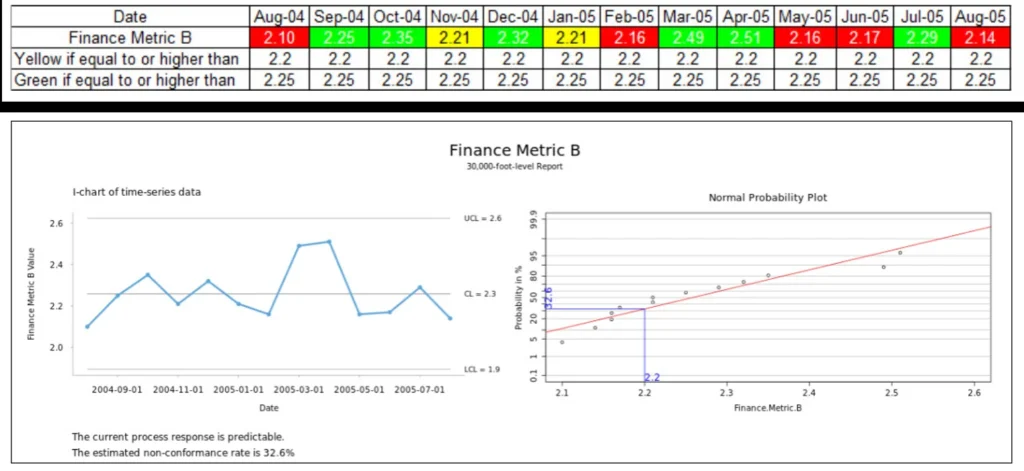
To show the benefits of 30,000-foot-level reporting, let’s consider the red-yellow-green scorecard of Finance B (top chart)that was reported in an organization and its 30,000-foot-level report alternative (bottom chart).
Traditional scorecards are meant to prompt actions—or, in some cases, deliberate non-actions—based on what the data show at a specific point in time.
Ideally, those actions or decisions would always be the most effective ones. In practice, however, this rarely happens because the way information is presented in typical red-yellow-green scorecards can be misleading or incomplete.
When a metric turns red, the usual reaction is to “send someone out to fix it.” This quick response often occurs without understanding whether a true process change is needed or whether the variation is simply part of the system’s natural behavior. As a result, teams spend time fighting fires rather than improving the process.
Now consider looking at the same dataset through a 30,000-foot-level chart. The individual-value graph on the left shows that, despite many reactive actions, the metric has not improved over time. The data pattern indicates that the process output is stable and predictable—no real change has occurred.
The right-hand chart in the 30,000-foot-level report provides a probability distribution of that stable process. In this example, the normal curve fits well, allowing for a predictive statement about expected future performance if nothing changes. From this, we can estimate that approximately 33% of future outcomes will fall below the 2.2 threshold.
At the bottom of the 30,000-foot-level report, this forecast is expressed as a process capability or non-conformance statement—an objective summary that quantifies what to expect going forward.
This perspective completely reframes the improvement strategy. Instead of repeatedly responding to random red signals, the organization can recognize that common-cause variation is driving the instability and that a targeted process improvement initiative is warranted—particularly if that 33% non-conformance level is unacceptable.
For someone new to the 30,000-foot-level view, the format might initially seem unfamiliar. Yet, once understood, it actually makes decision-making far clearer. It helps leaders quickly distinguish between processes that are stable versus unstable and determine when intervention is justified.
If a process is stable but producing undesirable predictions, that’s the signal to launch a structured process optimization effort. Conventional red-yellow-green scorecards never provide this insight—they simply flag symptoms without revealing whether true improvement is possible or necessary.
Enterprise Architecture Software
An effective enterprise architecture best practices system must be supported by scalable technology. Smarter Solutions’ Enterprise Performance Reporting System (EPRS) software enables organizations to manage and update 30,000-foot-level reports daily across the entire enterprise.
This enterprise architecture software integrates all levels of process data into one cohesive system. Each output metric (Y) is linked directly to the process inputs (Xs) that drive it, following the fundamental relationship Y = f(X). When a predictive Y-output statement indicates an undesirable response there is a need for process improvement. The IEE system also provides a roadmap for efficiently make this process improvement, includng a clickable Lean Six Sigma DMAIC roadmap.
The software’s structure supports continuous improvement through visibility, accountability, and automation. Moreover, it lays the groundwork for AI integration, allowing organizations to leverage machine learning to pinpoint where and how to make process improvements that truly impact bottom-line performance.
This integration of data, processes, and AI makes EPRS not just software, but a critical enabler of enterprise architecture best practices in the digital era that puts together the piece of an Enterprise Architecture.

Enterprise Architecture as Strategy Book
True enterprise architecture best practices demand both strategic and cultural transformation. Smarter Solutions’ approach is detailed in the novel-written books Business Management 2.0 and Leadership System 2.0.

These books go beyond the mechanics of process improvement. They describe how organizations can transition from firefighting and short-term thinking to predictive management and strategic alignment. This transformation builds an enterprise architecture that minimizes waste, enhances customer satisfaction, and improves profitability.
The methodologies described in these books enable leaders to design systems that:
- Link strategy and execution through data-driven management.
- Embed performance predictability into every process.
- Drive sustainable financial gains through intelligent system design.
Just as the renowned Enterprise Architecture as Strategy framework emphasizes the alignment between IT and business processes, IEE extends this concept further—ensuring that operational metrics directly inform strategic decision-making. Through IEE, organizations can make enterprise architecture a living, breathing system that continuously adapts and evolves.
Enterprise Architecture Consulting Services
Even with the best frameworks and software, the path to excellence requires experience and guidance. That’s where enterprise architecture consulting services from Smarter Solutions, Inc. make the difference.
Founded in 1992 by Forrest W. Breyfogle III, Smarter Solutions has been at the forefront of transforming how organizations think about measurement, improvement, and strategic alignment. Through hands-on consulting, the team helps organizations design and implement an enterprise architecture best practices framework that leads to what we call the 3 Rs of Business:
- Doing the Right things,
- Doing them Right,
- At the Right time.
By embedding the IEE system into an enterprise architecture, organizations establish a data-driven foundation that not only improves internal efficiency but also drives enterprise-wide financial optimization. The results are measurable, sustainable, and scalable.
These enterprise architecture consulting services empower organizations to:
- Identify system constraints through predictive analytics.
- Prioritize process improvement opportunities based on financial impact.
- Enable a culture where every employee understands their role in organizational success.
This consulting framework goes beyond compliance and best practice checklists. It helps organizations architect a business system that continuously evolves, guided by data, collaboration, and innovation.
The Future of Enterprise Architecture Best Practices
When enterprise architecture best practices are supported by the Integrated Enterprise Excellence system, organizations move beyond the limitations of reactive management. They develop an enterprise that is agile, predictive, and financially focused.
This approach also enhances the effectiveness of AI in business, as demonstrated in the recorded keynote presentation Implementing AI in Business: Reducing AI Implementation Risks. With an IEE-based architecture, AI tools gain context from accurate, process-linked, predictive metrics—ensuring that machine learning initiatives are directed toward meaningful, profitable outcomes.
The combination of predictive metrics, aligned strategy, and AI insights establishes a self-correcting enterprise architecture. It continuously identifies what needs improvement, where to act, and how those actions influence long-term success.
In short, Smarter Solutions’ Integrated Enterprise Excellence transforms enterprise architecture best practices from a static documentation exercise into a living system that guides decisions, accelerates improvement, and boosts the bottom line.
Summary and Next Steps
Organizations that embrace Smarter Solutions’ IEE-based enterprise architecture best practices gain a clear competitive edge. They connect strategic intent with measurable operational results, leverage AI effectively, and build a foundation for lasting success.
If you’re ready to create an enterprise architecture that unites people, processes, and technology for real financial impact, contact Smarter Solutions, Inc. today.