
An Enterprise Performance Management Framework should help an organization create predictability, clarity, accountability, and sustainable financial success.
Yet in most companies today, the “framework” consists of a loose collection of dashboards, siloed KPIs, subjective red-yellow-green charts, and improvement projects that rarely translate into meaningful, lasting enterprise-level impact.
These organizations work hard, but do not consistently improve. They report metrics but do not predict outcomes. They fix symptoms but not systems. And despite having countless software tools, they still firefight the same problems month after month.
At Smarter Solutions, Inc, after more than thirty years of guiding organizations across industries, the pattern is clear: companies do not fail because they lack effort, talent, or data—they fail because they lack a true Enterprise Performance Management Framework that links metrics, processes, behaviors, accountability, and strategy into one coherent system.
The Integrated Enterprise Excellence (IEE) methodology solves this by giving organizations a way to run the business through predictive metrics and system thinking rather than dashboard reaction.
This page explains—using a conversational tone—how your organization can finally build an Enterprise Performance Management Framework that delivers predictable, enterprise-wide, financially meaningful results.
This page highlights the pain organizations face when they don’t adopt a systemic framework—and the organizational benefits that come from adopting a system that truly works.
Many of these challenges stem from misunderstanding performance data, as explained in our discussion of predictive performance metrics and executive decision clarity.
Business Continuity Management System
A business continuity management system is typically associated with risk plans, emergency procedures, and crisis responses. But real continuity has a deeper requirement: predictability. If leadership cannot predict how processes will perform tomorrow, they cannot ensure continuity, resilience, or strategic stability.
Unfortunately, most organizations rely on reporting structures that provide the illusion of understanding rather than true predictive insight.
The Problem with Traditional Business Scorecards such as Red-yellow-green dashboards, monthly summaries, variance-to-target charts, and trend arrows create noise, not clarity. They encourage reactive thinking such as:
- “Why is this red?”
- “What went wrong last month?”
- “Who is responsible for this number?”
- “What happened last Tuesday that caused this spike?”
These questions initiate firefighting—not continuity. They shift attention away from the business system and toward individual events. A strong business continuity management system must eliminate subjective reactions and provide objective, predictive understanding.
IEE’s 30,000-Foot-Level Reporting Improves Continuity, as illustrated in the following figure that compares the reporting (actual company data )of a red-yellow-green scorecard with a 30,000-foot-level report’
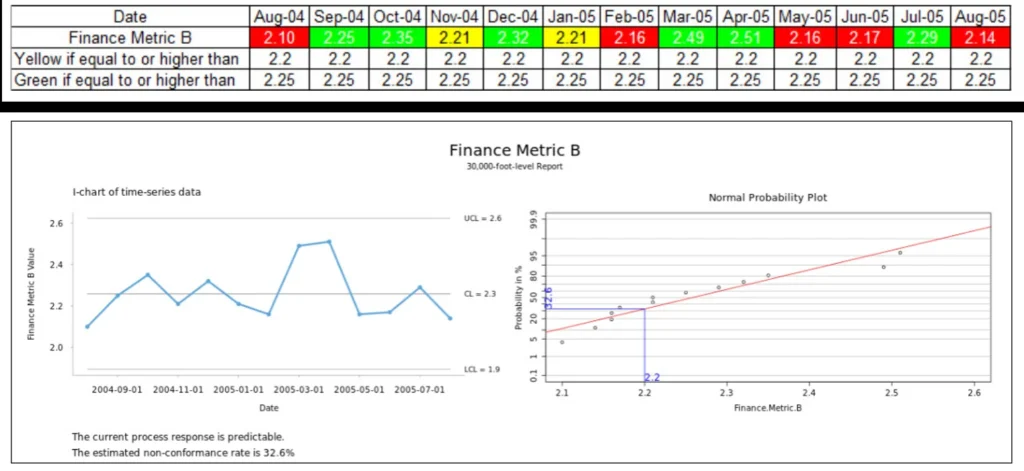
In the red-yellow-green display (top graphic), a red indicator signals that someone must step in and take corrective action.
In contrast, the lower graphic—a 30,000-foot-level report—shows something different. The individuals chart on the left, using the exact same data, reveals that the process is actually stable.
The probability plot on the right further clarifies the situation: it shows that roughly 32.6% of the results are expected to fall below 2.2, which is the threshold represented by the red category.
This projected rate of performance is summarized at the bottom of the 30,000-foot-level chart.
If this predicted outcome is unacceptable, the process must be improved.
And if improvement efforts truly change the process, the individuals chart will display a clear staging effect, and the updated lower non-conformance rate will be reflected at the bottom of the report.
IEE replaces traditional scorecards with 30,000-foot-level predictive metrics that reveal:
- Whether a process is stable or unstable
- Whether changes in results reflect true improvement
- Whether results are predictable
- What the future performance level is likely to be
- Whether corrective action is actually needed
Anyone Can Create These Predictive Charts for their situation using a free 30,000-foot-level reporting app that allows anyone to paste in data, analyze stability, and generate predictive charts.
This improves continuity by reducing firefighting, increasing proactive planning, improving long-term visibility, and creating enterprise-wide predictability.
Business Management System Software
A strong Enterprise Performance Management Framework must be supported by effective business management system software. Many organizations struggle because their systems—BI tools, ERP, CRM, spreadsheets—are disconnected.
IEE’s Enterprise Performance Reporting System (EPRS) software connects:
- Predictive enterprise metrics
- Process maps
- Accountability structures
- Improvement tracking
- Financial impact
EPRS becomes the nerve center of organizational performance, enabling AI to finally provide meaningful insights because metrics are stable, predictive, and connected to their processes.
Management System Business
A true management system business ensures everyone does the Right things, in the Right way, at the Right time—the 3 Rs of business. A system that orchestrates the business.

Without a system enforcing this, organizations fall into:
- Silos
- Firefighting
- Project overload
- Conflicting priorities
- Leadership frustration
IEE fixes this by connecting strategy, metrics, processes, and improvement to enterprise-wide financial benefit.
Learning Management Systems For Businesses
A learning management system for businesses must teach employees:
- How to interpret predictive metrics
- How to think systemically
- How to avoid firefighting
- How to improve processes predictably
The books —Business Management 2.0 and Leadership System 2.0—provide the foundation for learning how to run the business as a system.
Business Management 2.0 teaches why traditional reporting fails and how predictive thinking transforms results.
Leadership System 2.0 teaches executives how to align the organization and build a sustainable management culture.
Conclusion and Next Step
An IEE-based Enterprise Performance Management Framework delivers:
- Predictive clarity
- Enterprise-wide alignment
- Reduction in firefighting
- AI-ready structure
- Sustainable financial results
IEE, EPRS, and your learning structure provide what organizations have always needed: a practical, executable way to run the business as a system.
Let’s have a conversation to discuss how your organization could benefit from these techniques!