
This online Master Black Belt offering helps experienced improvement leaders move beyond project execution to connect Lean Six Sigma, predictive performance metrics, strategic improvement selection, and enterprise-level business management. The course builds on the legacy two-week University of Texas live program and extends it through LearnDash pre-work, readings, videos, quizzes, applied exercises, and coaching discussions.
Lean Six Sigma Master Black Belt online training from Smarter Solutions is designed for professionals who want more than advanced statistical tools or another certificate. This training teaches how to apply Lean Six Sigma within the Integrated Enterprise Excellence (IEE) business management system so performance metrics, improvement projects, leadership discussions, and enterprise financial outcomes are connected in a structured way.
The program is intended for people who need to lead, coach, and guide organizational improvement at a higher level: Master Black Belt candidates, experienced Black Belts, operational excellence leaders, business improvement managers, quality leaders, and executives who want a more effective deployment model.
This course puts together the pieces:


Rather than treating Lean Six Sigma as a collection of projects, the course shows how to identify the right metrics to improve, create predictive 30,000-foot-level reports, select improvement work that benefits the enterprise as a whole, and use an enhanced DMAIC roadmap to execute and sustain improvement.

| Schedule a discussion with Forrest Breyfogle to determine whether this online Master Black Belt training is a good fit for your organization or professional development needs. |
What Makes This Master Black Belt Training Different?
- It goes beyond “just doing projects” and teaches how improvement work should connect to enterprise performance.
- It addresses common Lean Six Sigma deployment problems, including scorecards that look positive while business results do not improve.
- It teaches predictive 30,000-foot-level reporting so participants can separate routine process noise from signals that need action.
- It integrates strategic planning, value-chain thinking, KPI selection, project selection, DMAIC execution, and sustainment.
- It includes LearnDash pre-work, readings, videos, quizzes, app-based exercises, and coaching discussions that promote application rather than passive learning.
Who Should Consider This Master Black Belt Certification Training?
- Experienced Lean Six Sigma Black Belts who want to become stronger enterprise-level improvement leaders.
- Continuous improvement and operational excellence professionals who are responsible for coaching others.
- Quality, process improvement, and business transformation leaders who need better KPI reporting and project selection.
- Organizations that want Lean Six Sigma to improve the big picture instead of creating disconnected local projects.
- Professionals who want to learn how IEE, predictive metrics, and an enhanced DMAIC roadmap can work together.
| Course Element | Description |
| LearnDash pre-work modules | Participants complete structured readings, videos, quizzes, and exercises before live coaching sessions. |
| Live coaching sessions | The online structure supports discussion, questions, application, and interpretation of course concepts. |
| Applied metric reporting exercises | Participants create and interpret 30,000-foot-level reports using example data and organizational-style situations. |
| Project and enterprise application | Participants learn how to connect improvement work to value chains, KPIs, Enterprise Improvement Plans, and an enhanced DMAIC roadmap. |
| Certification pathway | Certification can be tied to demonstrated application of the concepts through an improvement project and project report, as appropriate for the engagement. |
Course Content Overview
The LearnDash course content is organized around pre-work for coaching meetings. The topics below summarize the online course structure without listing every quiz question or internal note.
- Meeting 1:Integrated Enterprise Excellence ( IEE) foundations and advocacy: Management 2.0; Smarter Solutions website resources; process performance and KPI tracking; Management 2.0 webinar; John Daly advocacy concepts.
- Meeting 2: Control charting, capability, AQL, and 30,000-foot-level introduction: IEE Volume III chapters on control charting and process capability; Process Capability Analysis 2.0; AQL issues; quality assurance inspection; introduction to the 30,000-foot-level metric reporting app.
- Meeting 3: Continuous data without subgroups: Management 2.0 chapters 8-9; 30,000-foot-level reporting for continuous data; app examples; process improvement; non-normal distributions; hands-on exercises with example datasets.
- Meeting 4: Continuous data with subgroups and attribute data: Management 2.0 chapters 10-16; subgroup reporting; attribute failure rates; infrequent failures; Pareto analysis; dataset creation; comparison of 30,000-foot-level reporting with current reporting.
- Meeting 5: Leadership system and predictive KPIs: Leadership System 2.0; IEE Volume II; positive metrics with poor business performance; why change performance reporting; predictive KPI examples.
- Meeting 6: Value chains, EPRS, and project selection: Leadership System 2.0 chapters 5-6; IEE Volume II chapters 6-9; IEE value-chain thinking; EPRS business management software; selecting improvement projects; chart type selection and dataset creation.
- Meeting 7: Enhanced DMAIC and improvement tools: Leadership System 2.0 chapters 7-10; IEE Volume II chapters 10-13; clickable DMAIC roadmap; Kaizen; IEE Volume III chapters covering DMAIC tools, control charting, probability plots, hypothesis testing, DOE, Lean tools, pilot testing, and control.
- Meeting 8: Leadership reporting, patents, and final test: Leadership System 2.0 chapters 11-14; metric reports that lead to better behaviors; creation of an IEE DMAIC project; patent-related enterprise reporting concepts; final IEE training test.
- Meeting 9: Application session: Discussion of readings, IEE DMAIC roadmap enhancements, value-chain drill-downs, 30,000-foot-level metric report-outs, project baseline data, and an Enterprise Improvement Plan presentation.
Key Learning Outcomes
- Explain why traditional red-yellow-green scorecards and table-of-numbers reports often encourage reaction-based management.
- Create and interpret 30,000-foot-level reports for continuous data, subgrouped data, attribute data, and infrequent failures.
- Use predictive performance statements to determine when process improvement is needed versus when point-to-point explanation is wasteful.
- Connect value-chain metrics, strategic goals, and Enterprise Improvement Plans so project selection benefits the enterprise as a whole.
- Apply an enhanced IEE DMAIC roadmap that integrates Lean tools, statistical thinking, capability analysis, hypothesis testing, DOE, pilot testing, and control planning.
- Coach others in the difference between managing the Y’s and improving the X’s in the relationship Y=f(X).
- Communicate and advocate for improvement ideas so leaders, process owners, and stakeholders understand why change is needed now.
What Participants Work With
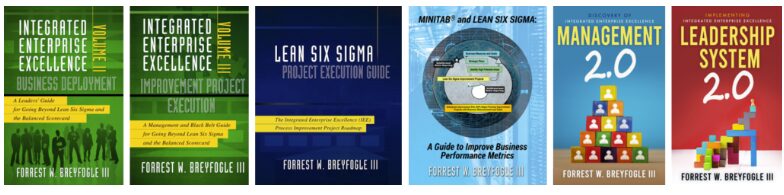
- Management 2.0 and Leadership System 2.0 readings.
- Integrated Enterprise Excellence Volume II and Volume III concepts.
- Smarter Solutions articles, webinars, and videos.
- EPRS-metrics / 30,000-foot-level reporting app exercises.
- Example datasets and participant-created data files.
- PowerPoint comparisons of current reporting versus 30,000-foot-level reporting.
- An IEE DMAIC improvement project and Enterprise Improvement Plan concepts.
Legacy of the University of Texas Live Program
This online offering builds on the earlier two-week live Master Black Belt program that was facilitated through the University of Texas Cockrell School of Engineering. That live program included two separate training weeks, Minitab-based analysis, project coaching, reference texts, instructional materials, CEU documentation, and a project-based certification path. The current LearnDash version preserves the important learning intent while making the training easier to consume through online pre-work and coaching sessions.
Representative Participant Feedback
- A healthcare continuous improvement participant described the University of Texas / Smarter Solutions course as exactly what they were looking for, because it made Master Black Belt learning relevant to business needs rather than “NASA-level” statistics.
- A public-school technology manager said Forrest helped connect Lean Six Sigma concepts back to business processes in a school division, creating true relevance.
- A healthcare consultant described the methodology as practical and effective, with the potential to be a game-changer in pursuing improvement goals.
- A manufacturing production manager said the course changed how they approached analysis and opportunities for improvement.
Schedule a discussion with Forrest Breyfogle to determine whether this online Master Black Belt training is a good fit for your organization or professional development needs.