
In today’s fast-paced, data-driven business landscape, traditional management information systems (MIS) have become essential tools for collecting, storing, and reporting organizational data. These systems—whether based on enterprise software platforms like SAP, Oracle, or Microsoft Dynamics—are designed to centralize information and provide reporting visibility to management teams. However, while powerful in functionality, most management information systems lack a crucial element: the ability to guide leadership in using that data to drive strategic improvement and long-term organizational success.
That’s where Management Information Systems 2.0, powered by the Integrated Enterprise Excellence (IEE) methodology, comes into play.
The IEE system is not a replacement for your current MIS infrastructure—it is a smart, integrative enhancement. It overlays your existing technology with a structured, analytics-based methodology that links metrics to strategy, improvement initiatives, and financial outcomes. IEE transforms the role of your management information system from a passive data warehouse into an active enabler of sustainable business excellence.
The Limitation of Traditional Management Information Systems
Most businesses already invest heavily in management information systems that provide basic operational visibility. These systems can generate an endless variety of reports—performance dashboards, trend charts, departmental KPIs, and red-yellow-green status indicators. However, these visualizations often tell only part of the story.
Common issues with traditional management information systems include:
- Siloed Metrics: Each department tracks its own KPIs with little connection to enterprise-wide goals.
- Lack of Predictive Insight: Most MIS reports are backward-looking, not forward-driving.
- Poor Project Selection Guidance: The system may show where performance is lagging, but it doesn’t indicate which improvement initiatives will yield the greatest return.
- Overreliance on Arbitrary Thresholds: Traditional dashboards use fixed red-yellow-green indicators without statistical justification, leading to misinterpretation and overreaction.
The result? Leaders are inundated with data but left without clear, actionable insights.
The IEE System: A Strategic Extension to Any MIS
The Integrated Enterprise Excellence (IEE) system was designed to resolve the shortcomings of traditional management information systems. IEE introduces a structured, step-by-step framework that transforms data into decisions and metrics into meaningful business outcomes.

IEE can be integrated with any management information system, enabling organizations to:
- Track performance using 30,000-foot-level process metrics, which are statistically sound and easy to interpret.
- Link performance metrics to enterprise financials and customer satisfaction, creating true line-of-sight visibility from operations to strategy.
- Select improvement projects based on objective need and strategic impact, not just symptom-based problem-solving.
- Utilize a free online clickable Lean Six Sigma DMAIC roadmap (Define-Measure-Analyze-Improve-Control)for process improvement, providing teams with a guided journey from problem identification to solution implementation.
Whereas a conventional MIS reports “what” is happening, IEE helps uncover why it’s happening and how to fix or enhance it in a way that benefits the enterprise as a whole.
Key IEE Benefits When Integrated with a Management Information System
Organizations that combine their existing management information system with the IEE methodology realize immediate and long-term advantages, including:
1. Enterprise Alignment
IEE breaks down silos by connecting department-level metrics to enterprise-wide objectives. Every improvement effort is prioritized based on its potential to impact the organization’s strategic goals—something that traditional MIS platforms are not inherently built to do.
2. Process Behavior Visibility
With IEE’s 30,000-foot-level process behavior charts, organizations move beyond simplistic R-Y-G indicators. These charts show whether processes are stable, trending, or in need of attention—using statistically valid interpretations. This prevents overreaction to normal variability and helps identify true opportunities for improvement.
3. Smarter Improvement Project Selection
IEE replaces the common “chasing fires” mentality with a data-driven method for selecting improvement projects. Each initiative is assessed based on its impact on high-level goals, eliminating wasted effort on low-value or isolated fixes. This leads to faster ROI and increased confidence in improvement efforts.
4. Integrated Roadmap and Communication Tools
IEE provides an actionable Define-Measure-Analyze-Improve-Control (DMAIC) roadmap that integrates seamlessly with your management information system. This roadmap is clickable and online, making it easy for cross-functional teams to stay aligned and communicate effectively throughout the improvement lifecycle.
5. Enhanced Culture of Operational Excellence
By embedding IEE practices into daily operations through your existing MIS, employees and leaders adopt a shared language and consistent method for interpreting data, solving problems, and measuring success.
Compatible with Your Current Technology Stack
A major advantage of the IEE system is that it does not require a rip-and-replace of your current MIS platform. Instead, it is designed to complement and extend your existing software tools—whether you use cloud-based dashboards, on-premise ERP systems, or a combination of multiple applications.
IEE’s structure is tool-agnostic. It can pull and analyze data and present it in a format that provides context and guidance—not just numbers. Your existing data infrastructure remains intact, but the way you use that data becomes dramatically more effective.
Realizing the Vision of Management Information Systems 2.0
Management Information Systems 2.0 is not just a software upgrade—it’s a strategic evolution in how businesses use data to drive results. The combination of a robust management information system with the IEE methodology results in a smarter, leaner, and more impactful approach to enterprise performance management that orchestrates the components of a business.

Whether you’re an operations manager, process improvement leader, or executive decision-maker, this integrated approach allows you to:
- Monitor performance in with statistically relevant insights
- Align initiatives with strategic financial goals
- Foster collaboration across departments and functions
- Prioritize actions that will move the needle, not just patch problems
This transformation is especially important in a time when businesses are expected to do more with less. The days of isolated Six Sigma projects, unlinked KPIs, and reactive management are over. With Management Information Systems 2.0, powered by IEE, your organization gains a modern performance management model built for today’s challenges and tomorrow’s opportunities.
Take the Next Step
If your organization already uses a management information system, you’re halfway there. The next step is integrating IEE to unlock its full potential. The IEE methodology and its supporting tools—like the free clickable DMAIC roadmap and the Enterprise Performance Reporting System (EPRS)—can be quickly integrated into your current environment.
Ready to evolve from basic reporting to strategic insight? Let’s discuss how IEE could enhances your current systems and delivers the clarity, alignment, and results your business needs.
Management Information Systems and Business Analytics: Driving Smarter Decisions with IEE Integration
Organizations increasingly rely on management information systems and business analytics to make data-driven decisions. However, traditional MIS frameworks often fall short of delivering actionable insights that align with long-term business goals. This is where the Integrated Enterprise Excellence (IEE) system from Smarter Solutions creates a distinct advantage, offering an intelligent layer of interpretation and strategy over any existing MIS infrastructure.
Most management information systems (MIS) provide dashboards and reports derived from data warehouses or operational systems, but they often lack context. Business leaders receive an overwhelming amount of data, KPIs, and performance metrics that may look promising on paper, yet fail to drive impactful action. When these systems operate in silos, analytics efforts become disconnected from enterprise-wide strategic planning and improvement initiatives.
The IEE approach bridges this gap by embedding analytics into a broader enterprise performance management system. It enhances how MIS data is not just presented, but interpreted and used for strategic improvement. Through IEE’s 30,000-foot-level metrics reporting methodology, data from MIS platforms are transformed into time-series insights that distinguish between routine variation and special-cause signals. This clarity empowers organizations to avoid reactive firefighting and instead focus on systemic improvements that affect big-picture outcomes.
Moreover, the synergy between management information systems and business analytics becomes most effective when supported by a methodical project selection framework. IEE provides such a framework. It enables organizations to prioritize improvement efforts based on alignment with financial goals, customer satisfaction, and operational excellence. Rather than relying on gut instinct or isolated departmental goals, leaders can use IEE’s analytics structure to quantify business pain points and target high-leverage opportunities.
Smarter Solutions’ IEE system is particularly valuable for companies already using ERP, CRM, or BI tools. These platforms generate vast amounts of data—but without a proven methodology like IEE, this data remains underutilized. By integrating with existing MIS platforms, IEE doesn’t replace your current technology stack; instead, it augments its value. Your dashboards and KPIs remain, but they are now supported by a system that guides when and how to take action.
IEE also advances how business analytics are applied across functions. In many companies, analytics lives within IT or data science teams, disconnected from executive strategy. With IEE, business analytics becomes part of the operational DNA, accessible and understandable by leadership and frontline teams alike. This democratization of insight ensures that improvement projects are not only initiated but also sustained with measurable ROI.
Ultimately, integrating management information systems and business analytics through IEE enables organizations to make smarter, faster, and more confident decisions. It replaces superficial reporting with clarity, shifts improvement from reactive to proactive, and aligns analytics with strategy in a repeatable, scalable way.
To explore how your organization can elevate its MIS and analytics investments, Smarter Solutions offers a free IEE software app—a starting point to experience firsthand how data can drive transformative performance improvement.
Management Information Systems Book Resources for a Smarter MIS 2.0 Implementation
If you’re searching for a management information systems book that goes beyond traditional theory and into the practical application of analytics, metrics, and improvement project selection, the Integrated Enterprise Excellence (IEE) series from Smarter Solutions is a must-read. These books offer readers a structured roadmap for achieving measurable success through a modernized MIS 2.0 framework—an enhancement to legacy management information systems.
Unlike conventional MIS textbooks that stop at system architecture and data reporting, the IEE book series explores how to leverage information systems to drive actionable improvement projects that positively impact financials, customer satisfaction, and operational excellence. The foundational concepts of IEE and its transformative role in upgrading MIS capabilities are introduced through a novel-based learning format and expanded through detailed technical guides that ensure successful implementation.
Novel-Format Introduction to MIS 2.0 and the IEE System
The best place to begin your journey with MIS 2.0 is with two engaging titles that blend storytelling with business strategy:

- Management 2.0: Discovery of Integrated Enterprise Excellence (Management and Leadership System 2.0 Book 1): This novel-formatted management information systems book introduces readers to the challenges of traditional MIS frameworks and how organizations often become stuck in metric reporting that lacks context or strategic alignment. Through a relatable business narrative, readers discover how the IEE methodology transforms these systems into tools for real business improvement. This book is also available as an audiobook, making it easy to absorb these powerful concepts on the go.
- Leadership System 2.0: Implementing Integrated Enterprise Excellence (Management and Leadership System 2.0 Book 2): The second novel in the series dives into the actual implementation of the IEE system. It highlights how leaders can use IEE to prioritize initiatives, manage enterprise-wide performance, and embed analytics into a continuous improvement culture. Like its predecessor, this book is also available in audiobook format and continues the compelling story while delivering practical, actionable insights.
In-Depth Guides for MIS 2.0 Execution
For readers who want to go deeper into technical implementation and execution strategies, several companion books provide step-by-step methodologies for embedding IEE into any MIS platform:
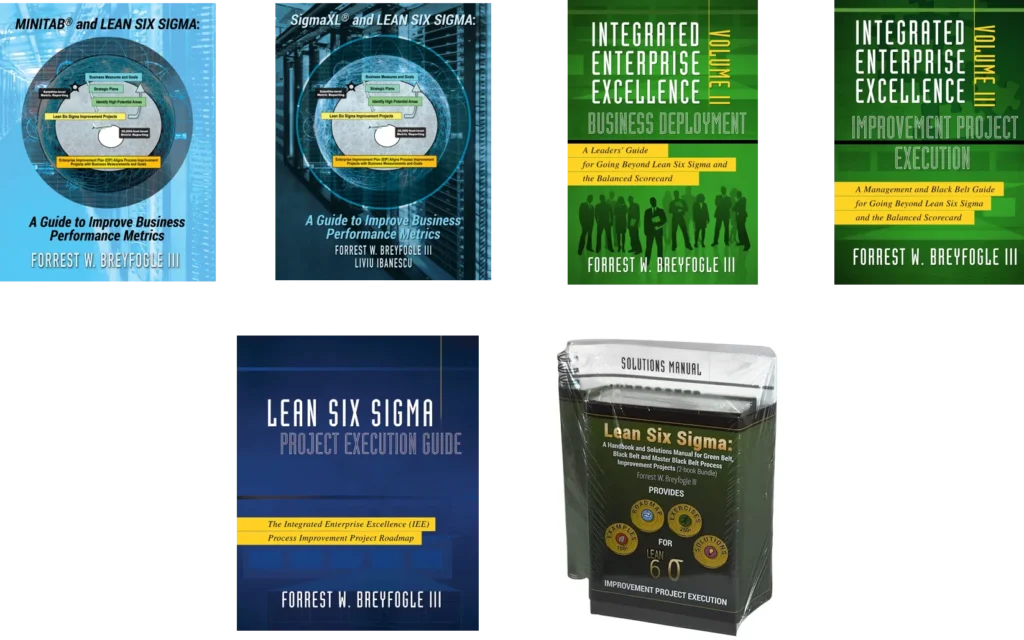
- Minitab® and Lean Six Sigma: A Guide to Improve Business Performance Metrics: This book offers detailed instructions on how to integrate Lean Six Sigma tools with IEE concepts using Minitab®. It provides statistical methods and performance metric analysis that enable smarter data-driven decisions.
- SigmaXL® and Lean Six Sigma: A Guide to Improve Business Performance Metrics: A parallel resource to the Minitab® guide, this version uses the SigmaXL® software and similarly aligns with IEE methods to improve KPI reporting and improvement project success.
- Integrated Enterprise Excellence, Vol. II – Business Deployment: This management information systems book focuses on enterprise-wide strategy deployment. It guides leaders through the design of a measurement and improvement system that aligns with organizational goals, going far beyond the balanced scorecard.
- Integrated Enterprise Excellence, Vol. III – Improvement Project Execution: This volume presents a roadmap for executing improvement projects that are aligned with enterprise metrics, offering a solution to the common failure of disjointed project selection processes.
- Lean Six Sigma Project Execution Guide: The Integrated Enterprise Excellence (IEE) Process Improvement Project Roadmap: This book presents the unique 30,000-foot-level reporting and DMAIC project roadmap that ensures improvement efforts are statistically sound and strategically beneficial.
- Lean Six Sigma: A Handbook and Solutions Manual – 2-Book Bundle: Designed for Green Belts, Black Belts, and Master Black Belts, this comprehensive bundle serves as a reference and training tool for applying the IEE system within Lean Six Sigma deployments. Over 100 examples and 250 exercises are provided in this lean Six Sigma handbook.
The Smarter Choice for MIS Professionals
These titles together provide a comprehensive suite of management information systems book resources that bridge theory with actionable practices. Whether you’re an executive, analyst, MIS professional, or improvement team leader, these books enable a transition to MIS 2.0 with Integrated Enterprise Excellence—turning your systems of record into systems of strategic transformation.
Management Information Systems Software: A Smarter Way with EPRS Integration
When organizations search for effective management information systems software, they are often overwhelmed with options that provide surface-level dashboards, KPI reporting, and data visualization. However, these features alone rarely translate into strategic insight or sustainable performance improvement. Smarter Solutions offers a new generation of MIS capability through its Enterprise Performance Reporting System (EPRS)—a software solution built around the Integrated Enterprise Excellence (IEE) framework.

Traditional management information systems software is often disconnected from organizational strategy. While many platforms provide reports and scorecards, they fail to address whether those metrics are truly actionable or aligned with enterprise goals. Worse, many MIS dashboards encourage siloed interpretations of success, leading to disconnected departmental efforts that don’t benefit the big picture.
Smarter Solutions’ EPRS software bridges this critical gap, transforming traditional MIS functionality into a powerful enterprise-wide performance management and improvement system. EPRS is not just a reporting platform—it is a decision-support system that drives continuous improvement across all levels of the organization.
What Makes EPRS a Smarter Management Information Systems Software?
EPRS distinguishes itself from conventional MIS tools by embedding the IEE methodology, which promotes 30,000-foot-level reporting, strategic alignment, and data-driven improvement project selection. Rather than tracking isolated metrics or reacting to red-yellow-green status indicators, EPRS users gain a time-series view of process behavior—helping leaders distinguish between common-cause and special-cause variation.
This approach eliminates misleading reporting that often results in wasted effort and confusion. Instead of chasing short-term fluctuations, EPRS focuses attention on meaningful trends that require action. This makes the software ideal for executives, operational leaders, and improvement professionals who want facts-based insight to guide long-term strategy.
Key Benefits of EPRS as MIS Software
- Strategic Alignment: EPRS helps organizations link their metrics, analytics, and improvement efforts directly to high-level goals such as profitability, customer satisfaction, and compliance. This ensures that improvement activities deliver measurable ROI.
- Improvement Project Prioritization: With built-in tools for identifying where to improve, EPRS supports smarter selection of Lean Six Sigma and other continuous improvement initiatives—eliminating the guesswork and politics that often drive project decisions.
- Enhanced Visibility and Accountability: The software enables organization-wide transparency by connecting functional-level metrics with strategic KPIs. This promotes accountability at all levels and ensures that actions at the front line roll up to organizational objectives.
- No Need to Replace Existing Systems: EPRS is designed to integrate with your current IT stack. It complements existing ERP, CRM, or BI tools by transforming raw data into actionable insights without requiring a full system overhaul.
- User-Friendly and Scalable: Whether you’re a small organization or a global enterprise, EPRS is scalable and accessible. Its interface is designed for both leadership and technical teams, promoting widespread adoption.
Next Steps: MIS 2.0 Starts Here
If your organization is ready to evolve beyond static dashboards and move toward intelligent, actionable management information systems software, the EPRS platform from Smarter Solutions is the answer.
Built on decades of process improvement expertise, it provides the tools and methodology needed to make metrics meaningful—and improvement sustainable.
Learn more about MIS 2.0 or request a demonstration of how EPRS can elevate your MIS strategy.
Contact us today to schedule a free consultation session.
If you do not see a suitable time in the Schedule a Meeting link below, email Forrest at forrest.breyfogle@smartersolutions.com.