
AI decision governance provides executives with a structured way to ensure that artificial intelligence supports the priorities of the enterprise rather than becoming another collection of disconnected technology initiatives.
Organizations are rapidly adopting AI to analyze data, identify opportunities, automate activities, and recommend actions. The potential is enormous. But an important management question is often overlooked:
How does leadership know that AI is recommending the right things for the business?
An AI system can generate an impressive recommendation while still optimizing the wrong objective. It can identify an improvement opportunity that produces little financial benefit. It can also encourage action based on metrics that fluctuate naturally rather than indicate a meaningful change in performance.
The challenge is therefore larger than implementing AI successfully.
Executives need a management system that determines where AI should be applied, what information AI should evaluate, and how its recommendations should be connected to enterprise objectives.
That is the role of AI decision governance.
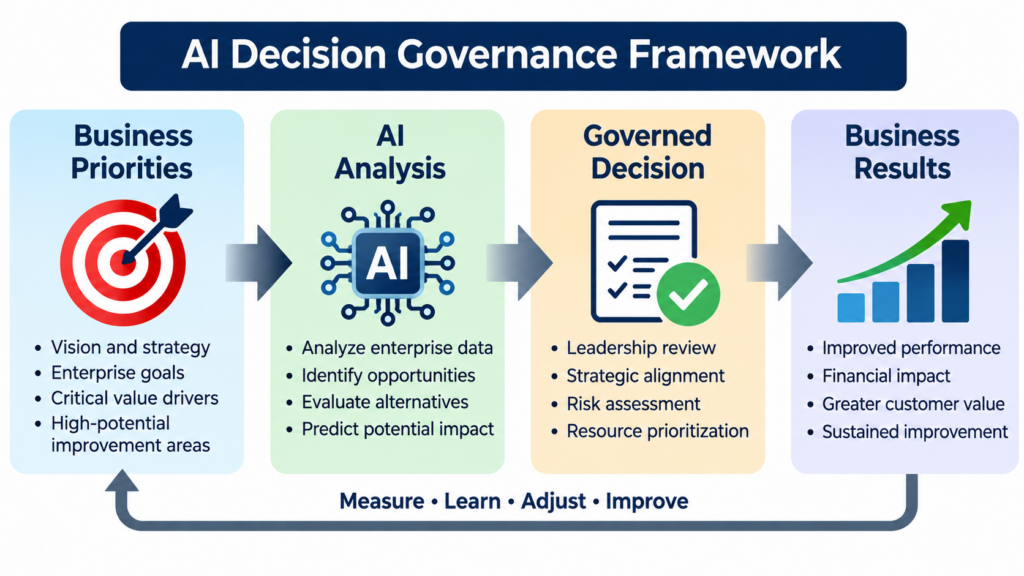
AI Strategic Alignment Connects Technology to Business Needs
AI strategic alignment begins by asking a business question before asking a technology question.
Instead of starting with: Where can we use AI?
Leadership should start with: What does the organization need to accomplish, and where are the greatest opportunities for improving enterprise performance?
This distinction is critical.
An organization may have dozens—or hundreds—of potential AI projects. Without an enterprise framework for prioritization, the projects receiving attention may simply be those that are easiest to implement, technologically interesting, or promoted most effectively.
This is also why AI-generated improvement opportunities need to be evaluated before resources are committed. See why AI can recommend projects—but they may not be the right projects for the enterprise.
Integrated Enterprise Excellence (IEE) provides another approach. Strategies and improvement activities are developed from an analysis of the enterprise and its performance rather than from isolated project ideas.
AI can then become an enabler of the strategy instead of becoming the strategy itself.
This strategic alignment becomes more effective when artificial intelligence operates within an integrated management framework. Learn more about how to integrate AI into a business management system.
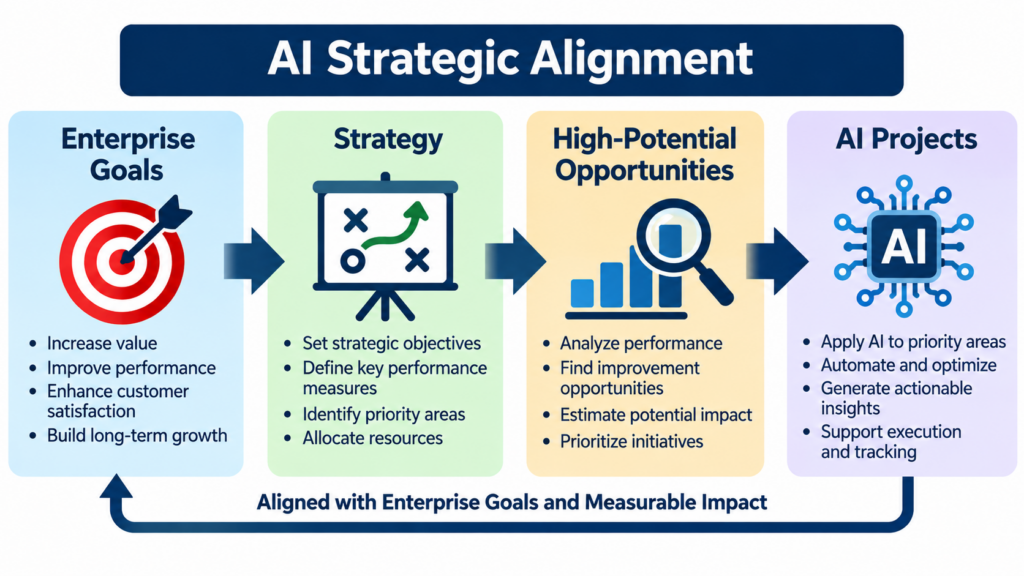
AI Management Oversight Requires More Than a Dashboard
AI management oversight should provide executives with evidence that AI-supported decisions are producing meaningful business results.
Traditional management reporting frequently presents red-yellow-green scorecards, comparisons with arbitrary targets, and snapshots of the latest reporting period.
These reports can create unnecessary reactions to normal variation.
An executive might see a KPI turn red and initiate corrective action even though the underlying process has not fundamentally changed. AI trained to respond to the same signals could reinforce this behavior—only faster.
A better approach is to provide AI with information that distinguishes between routine variation and signals of meaningful change.
This is one reason 30,000-foot-level predictive performance reporting is important. The objective is not merely to describe what happened last month. It is to understand how the process is performing and what its performance indicates about the future.
A predictive performance measurement system helps management distinguish routine variation from signals that warrant action and provides a more meaningful foundation for AI-supported decisions.
AI recommendations can then be evaluated within a more meaningful management context.
AI Performance Measurement Should Focus on Outcomes
AI performance measurement needs to answer a straightforward question: Did the AI-supported action improve the enterprise?
Completing an AI project is not the same as achieving a business result.
Organizations can successfully install software, automate activities, build models, and create sophisticated dashboards without generating meaningful financial or operational improvement.
Management therefore needs to connect AI initiatives to measurable outcomes.
Those outcomes might include improved delivery performance, reduced defects, shorter cycle times, increased capacity, improved customer retention, or better financial performance.
The important point is that the measurement should evaluate the result of the process, not simply the completion of the AI initiative.
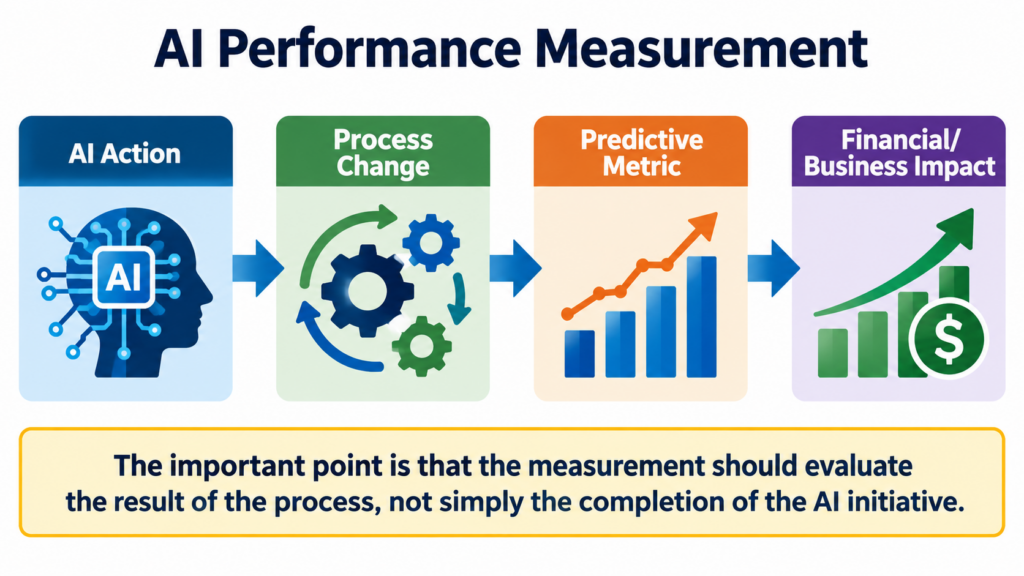
When appropriate, the financial impact should also be assessed. This provides executives with a way to distinguish interesting AI applications from AI applications that materially improve the business.
AI Continuous Improvement Framework Creates a Closed-Loop System
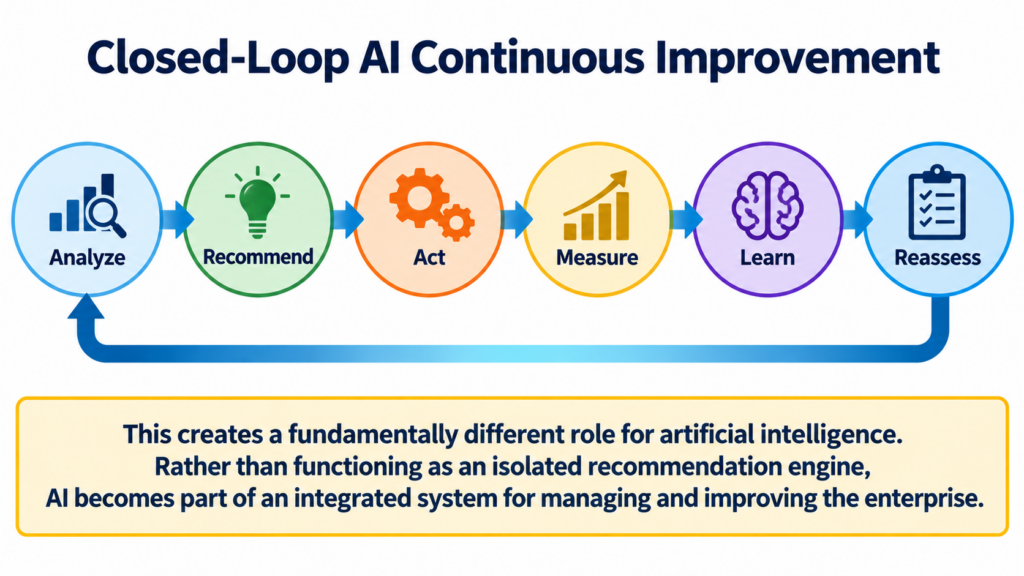
An AI continuous improvement framework should not end when AI recommends an action.
There needs to be a closed-loop process: Analyze → Recommend → Act → Measure → Learn → Reassess
Suppose AI identifies a process as an improvement opportunity. Management should first determine whether the opportunity aligns with enterprise strategy and whether improving it is likely to have a meaningful impact.
After an improvement is implemented, performance should be evaluated statistically.
Did the process actually change?
Did the improvement remain in place?
Did the change produce the expected business or financial benefit?
The answers become new information that can be incorporated into future decision-making.
This creates a fundamentally different role for artificial intelligence. Rather than functioning as an isolated recommendation engine, AI becomes part of an integrated system for managing and improving the enterprise.
An integrated business management system provides the broader structure for connecting these improvement activities with strategy, predictive measures, project selection, and financial results.
From AI Implementation to AI-Enabled Management
The competitive advantage from AI may ultimately come from something other than having the most AI tools.
It may come from having a better management system within which AI operates.
AI can process enormous quantities of information and identify relationships that people might overlook. But management still needs a framework for establishing priorities, evaluating recommendations, measuring results, and determining what should happen next.
Integrated Enterprise Excellence provides that structure by connecting strategy, performance measurement, improvement selection, execution, and evaluation into one system.
The objective should not simply be to make AI smarter.
The objective should be to make the enterprise’s decision-making system smarter.
Next Steps
If your organization is investing in artificial intelligence, consider asking a different question:
Is AI being integrated into a management system that ensures its recommendations lead to measurable enterprise improvement?
Smarter Solutions’ Integrated Enterprise Excellence approach provides a structured framework for connecting AI, predictive performance reporting, strategy, and improvement efforts.
Learn how Integrated Enterprise Excellence can help your organization move from isolated AI initiatives to an AI-enabled business management system.
You can schedule a video meeting session with me through the link https://smartersolutions.com/schedule-zoom-session/