
AI-Enabled Total Quality Management builds on decades of Total Quality Management (TQM) practices that have helped organizations improve products, services, and processes. Yet many companies continue to experience recurring quality problems, excessive rework, delivery delays, and customer dissatisfaction.
Artificial intelligence now offers powerful capabilities for detecting patterns, identifying emerging problems, and supporting operational decisions.
But adding AI to an existing quality program does not automatically create better business results.
AI-enabled Total Quality Management requires more than advanced analytics. It requires an integrated approach that connects quality, business strategy, process performance, and improvement priorities.
Integrated Enterprise Excellence (IEE) provides a framework for making those connections.
In the following video, Total Quality Management 2.0: Why AI Alone Cannot Fix Quality Problems, I explain why traditional quality improvement initiatives often fall short and how artificial intelligence, systems thinking, and Integrated Enterprise Excellence can work together to achieve sustainable business results.
The following discussion expands on these concepts and explains how organizations can move beyond isolated quality improvements to an integrated management system that delivers measurable enterprise-wide results.
How AI in Quality Management Changes Traditional TQM
Traditional Total Quality Management emphasizes customer satisfaction, employee involvement, process improvement, and leadership commitment.
These principles remain important. However, organizations now have access to substantially greater volumes of operational data and more sophisticated analytical capabilities.
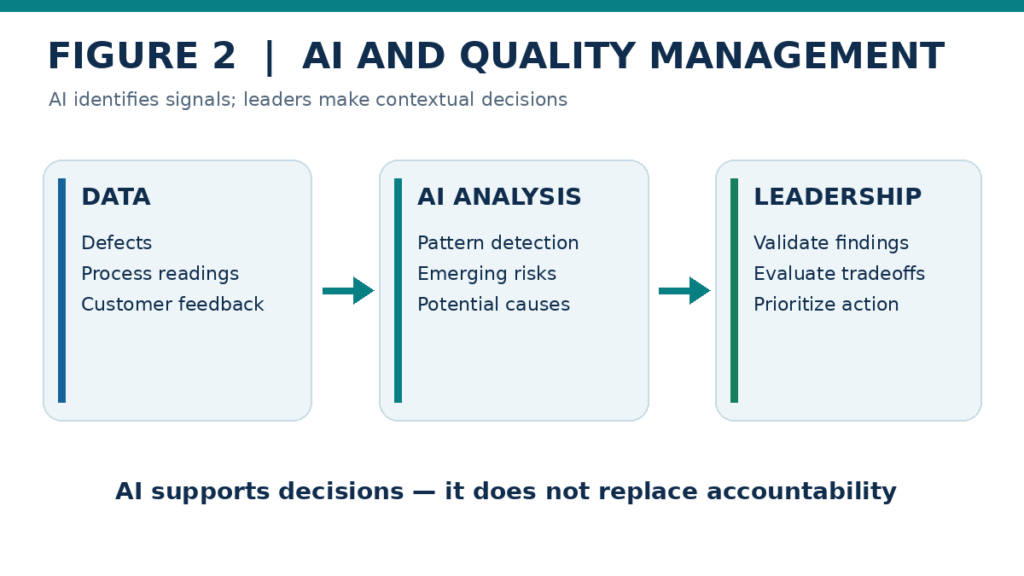
AI in quality management can help organizations identify patterns that may be difficult to recognize through conventional reporting.
For example, AI can support:
- Detection of unusual process conditions.
- Identification of potential equipment failures.
- Analysis of customer complaints and recurring issues.
- Recognition of relationships among process variables.
- Prioritization of potential quality risks.
Consider a manufacturer that collects thousands of production measurements daily.
An AI model might identify combinations of temperature, equipment settings, and material characteristics associated with increased defect rates.
This information could help engineers investigate emerging quality problems before substantial losses occur.
However, identifying a statistical relationship does not necessarily establish its cause.
Management must still evaluate the evidence, validate the model, and determine whether a proposed action makes business sense.
AI-enabled Total Quality Management should strengthen management decisions rather than automate decisions without adequate business context.
[INSERT FIGURE 2 — AI AND QUALITY MANAGEMENT]
The American Society for Quality provides additional resources on quality management principles and practices that organizations can use when evaluating their quality improvement approaches.
Why Continuous Quality Improvement Often Falls Short
Continuous quality improvement is a fundamental principle of TQM.
Organizations commonly pursue improvement through Lean, Six Sigma, corrective action programs, employee suggestions, and other structured methodologies.
Traditional improvement approaches, including Lean and Six Sigma, can produce significant local improvements, but these efforts do not necessarily improve overall enterprise performance unless they are strategically aligned.
However, an important limitation occurs when organizations optimize individual departments without evaluating their effects on overall enterprise performance.
Consider a manufacturing operation that increases equipment utilization by 15 percent.
Management might celebrate the achievement as a major productivity improvement.
But what happens if higher production volumes also create excess inventory, increase storage costs, or lengthen customer delivery times?
The manufacturing department may have improved its reported efficiency while the enterprise experienced an unfavorable financial outcome.
This illustrates a fundamental problem with local optimization.
Continuous quality improvement must be evaluated in the context of the entire business value chain.
Organizations should examine how changes in one process influence upstream suppliers, downstream operations, customer experiences, and financial results.
AI can accelerate the identification of improvement opportunities. However, without an enterprise-wide management framework, AI may simply help organizations optimize the wrong activities more efficiently.
[INSERT FIGURE 1 — THE LOCAL OPTIMIZATION TRAP]
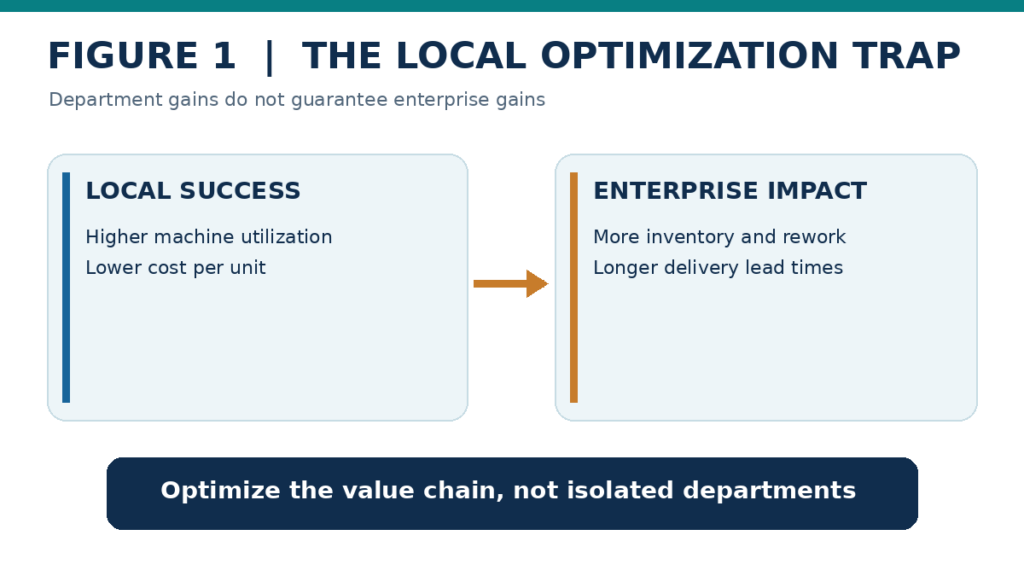
The objective of AI-enabled Total Quality Management should therefore be sustainable improvement in the overall business, not merely better departmental indicators.
Building an Integrated Quality Management System with AI-Enabled TQM
A quality management system should do more than document procedures, track corrective actions, and prepare an organization for audits.
It should help leadership understand whether business processes are performing predictably and whether improvement activities support strategic objectives.
An effective quality management system connects operational performance with executive decision-making.
An effective quality management system should incorporate predictive performance measurement to determine whether processes are stable and what level of performance can be expected in the future.
This requires several important capabilities.
- Strategic alignment: Quality objectives should support the organization’s broader business priorities. Improvement initiatives should address problems that matter to customers, financial performance, and long-term competitiveness.
- Enterprise value chain understanding: Leaders should understand how processes interact across functional boundaries. A change that improves one department should be evaluated for its effect on the overall system.
- Predictive performance measurement: Traditional scorecards frequently compare recent results against targets. Although this can be useful, it may not adequately distinguish routine process variation from meaningful performance changes. A more informative approach evaluates process behavior over time and establishes what future performance can reasonably be expected if the underlying process remains unchanged.
- Disciplined improvement selection: Organizations should select improvement projects based on their expected enterprise impact. The loudest complaint or most unfavorable dashboard indicator is not necessarily the best improvement opportunity.
- Management accountability: Quality improvement must become part of the organization’s ongoing management and governance activities. It should not depend exclusively on isolated projects or periodic management campaigns.
ISO 9001 provides internationally recognized requirements for a quality management system, while an integrated enterprise management approach can extend beyond compliance to address organizational performance and strategic results.
Integrated Enterprise Excellence provides a structured approach for connecting quality improvement initiatives with enterprise strategy, predictive performance reporting, and financial outcomes.
The Integrated Enterprise Excellence approach
Integrated Enterprise Excellence provides a structured framework that connects these capabilities.
IEE integrates strategic objectives, enterprise value chain analysis, predictive performance measurements, and improvement project selection.
AI can enhance this framework by accelerating data analysis, identifying emerging issues, and supporting the evaluation of potential improvement opportunities.
[INSERT FIGURE 3 — THE INTEGRATED IEE SYSTEM]
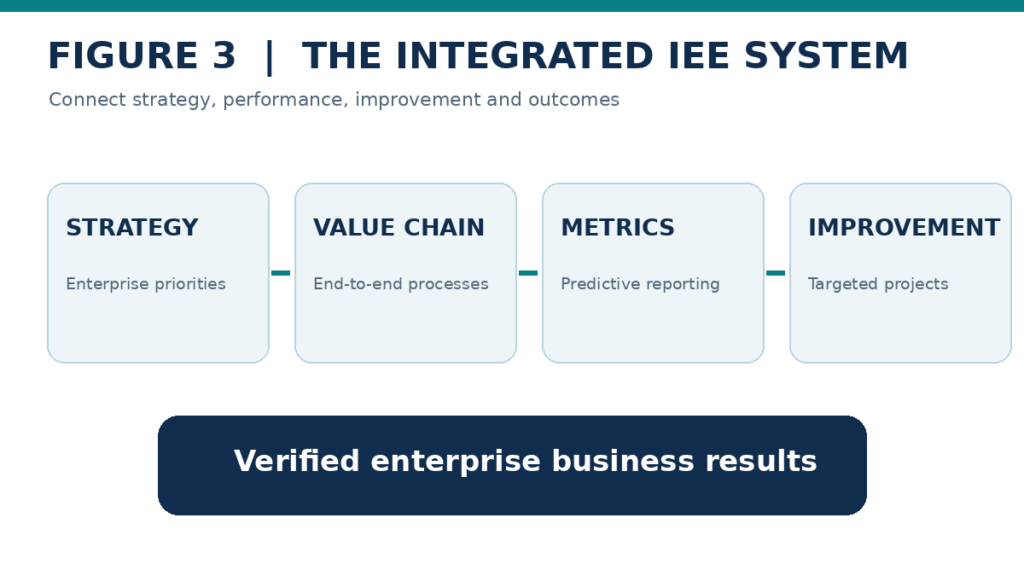
The objective is to make quality management part of how the enterprise operates rather than a separate initiative competing for management attention.
Using Predictive Quality Analytics to Verify Results
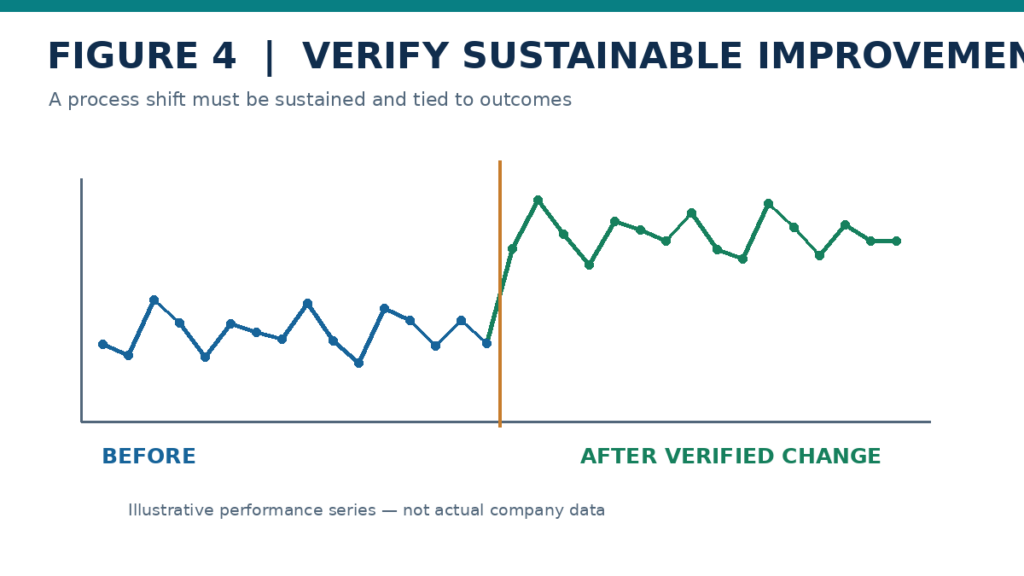
One of the most important questions in quality improvement is whether a proposed change actually produced a sustained improvement.
A temporary reduction in defects does not necessarily indicate that a process has fundamentally changed.
Similarly, a favorable monthly result does not automatically demonstrate that a corrective action was effective.
Predictive quality analytics can help organizations evaluate performance over time, identify unusual process behavior, and establish expectations for future outcomes.
However, statistical analysis must be applied appropriately.
For example, a process behavior chart can help distinguish routine variation from signals indicating that the underlying process may have changed.
When a meaningful change is detected, the organization should investigate its causes and evaluate whether the improvement can be sustained.
AI may assist by analyzing larger datasets and identifying potentially relevant process conditions.
Nevertheless, a statistical model should not be treated as proof of improvement without appropriate validation.
[INSERT FIGURE 4 — VERIFY SUSTAINABLE IMPROVEMENT]
Connecting quality improvements to financial results
Verifying improvement also requires examining its business consequences.
For example, a successful quality initiative might contribute to:
- Lower scrap and rework costs.
- -Reduced warranty claims.
- Improved delivery reliability.
- Lower inventory requirements.
- Increased customer retention.
- Greater operating capacity.
These benefits should be evaluated using appropriate operational and financial evidence.
Where possible, management should distinguish verified benefits from projected savings or improvements that have not yet been realized.
This is an essential distinction between completing a quality improvement project and demonstrating measurable enterprise value.
The Future of AI-Enabled Total Quality Management Is Enterprise-Wide
Total Quality Management remains relevant because its fundamental principles address enduring organizational challenges.
Customer focus, process understanding, leadership commitment, and continuous improvement are just as important today as they were before the emergence of modern AI.
What has changed is the availability of advanced analytical technologies.
The future of Total Quality Management requires an integrated enterprise management approach that connects process improvement, predictive metrics, strategic objectives, and financial results.
AI-enabled Total Quality Management creates an opportunity to combine these technologies with disciplined systems thinking and enterprise management.
But AI should not become another isolated initiative.
Without strategic alignment, predictive performance measurement, and verified improvement outcomes, organizations risk investing in sophisticated technology without achieving corresponding business benefits.
Integrated Enterprise Excellence offers an approach for connecting these essential elements.
The goal is not simply to improve individual quality measures.
The goal is to create a business management system that consistently identifies, prioritizes, and verifies improvements that matter to the enterprise.
Watch the video: Total Quality Management 2.0: Why AI Alone Cannot Fix Quality Problems
Discover how AI-enabled Total Quality Management can help organizations connect quality improvement with strategic objectives, predictive performance measurement, and verified business results.
Learn More About Integrated Enterprise Excellence
Smarter Solutions helps organizations apply Integrated Enterprise Excellence to improve performance measurement, strategic alignment, and enterprise-wide improvement.
If your organization is experiencing recurring quality problems, disconnected improvement initiatives, or uncertainty about the financial benefits of AI investments, an integrated approach may provide a better path forward.
Contact Forrest Breyfogle
Founder, Smarter Solutions, Inc.
Email: [email protected]
Phone: 512-695-4424