
Organizations frequently celebrate the number of AI projects launched, software applications deployed, or employee hours saved. These accomplishments may demonstrate activity, but they do not necessarily establish measurable improvements in profitability, customer satisfaction, delivery performance, or operational effectiveness.
The fundamental problem is often not the AI technology itself. It is the absence of an integrated business management system that connects AI investments to strategic priorities, predictive performance metrics, and verified enterprise outcomes.
The Integrated Enterprise Excellence (IEE) methodology provides a framework for addressing this challenge.
Watch the video: Why AI Projects Fail to Deliver Measurable Business Results
Why AI Projects Fail to Deliver Measurable Business Results
Many organizations manage AI initiatives as technology projects rather than business improvement investments.
An AI initiative may successfully automate a task, accelerate a report, or reduce the time required to complete an activity. However, these accomplishments do not automatically translate into improved enterprise performance.
Consider an organization that introduces AI to accelerate production scheduling. The scheduling process becomes faster, but the overall manufacturing operation continues to experience the same delivery delays.
The AI application may be functioning exactly as intended. Nevertheless, the business has not resolved its underlying performance constraint.
Executives need to distinguish between successful technology implementation and successful business improvement.
The appropriate question is not simply whether an AI project worked.
It is whether the AI initiative produced a measurable and sustainable improvement in the organization’s financial or operational performance.
AI Project ROI Measurement: Moving Beyond Activity Metrics
Traditional AI project reporting often emphasizes implementation milestones and estimated productivity gains.
Common examples include the number of AI applications deployed, hours saved, employees trained, and tasks automated.
These measurements can provide useful implementation information, but they should not be confused with verified business results.
For example, an AI application might save employees hundreds of hours each month. However, unless those hours are translated into increased capacity, reduced costs, improved service, or another measurable outcome, the organization may not realize the anticipated financial return.
Effective AI project ROI measurement should establish a connection between the investment and the business results it is intended to influence.
An effective AI investment evaluation should be part of an integrated Business Management System 2.0 that connects strategic objectives, operational performance, and financial outcomes.
Executives should identify the expected operational or financial benefit before authorizing the initiative, establish a credible performance baseline, and evaluate whether the expected improvement actually occurred.
Local AI Optimization vs Enterprise Performance: Understanding the Difference
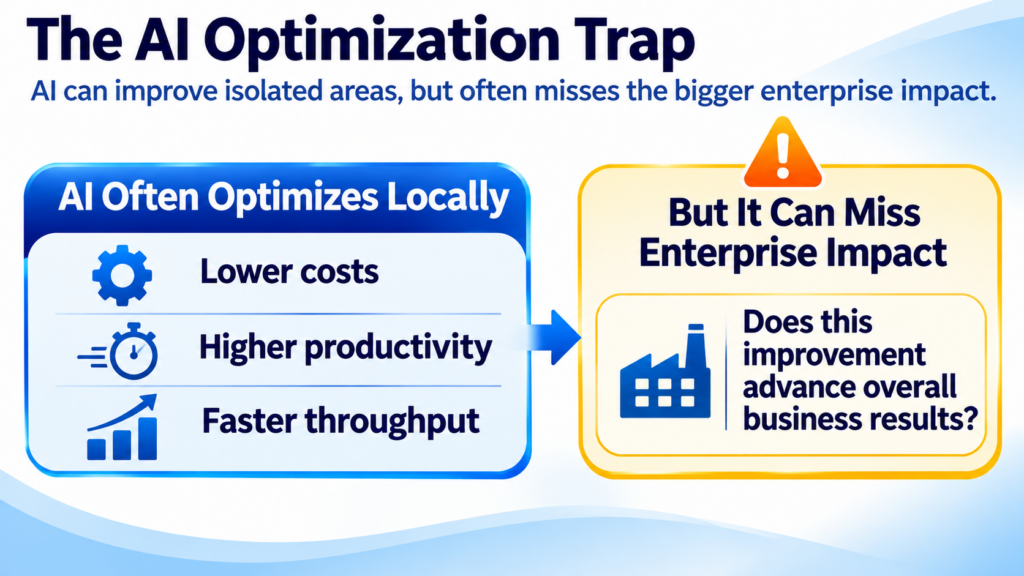
One of the most significant risks associated with AI implementation is improving an individual activity without improving the overall business.
An organization might use AI to optimize inventory management, customer service, production scheduling, or workforce allocation.
Each application may demonstrate impressive local efficiency gains.
However, an improvement in one functional area can have little effect on enterprise results—or even create unintended consequences elsewhere.
For example, an AI-driven inventory reduction initiative may lower inventory holding costs while increasing stockouts and damaging customer delivery performance.
The local improvement appears successful, but the overall business outcome may be unfavorable.
Integrated Enterprise Excellence addresses this challenge by viewing the organization as an interconnected system.
Rather than selecting improvement projects solely because individual departments can demonstrate attractive benefits, IEE emphasizes enterprise-level performance and strategic alignment.
This enterprise-wide perspective is central to Operational Excellence 2.0, which emphasizes improving overall business results rather than optimizing individual departments in isolation.
Predictive Performance Metrics for AI: Understanding What the Data Really Shows
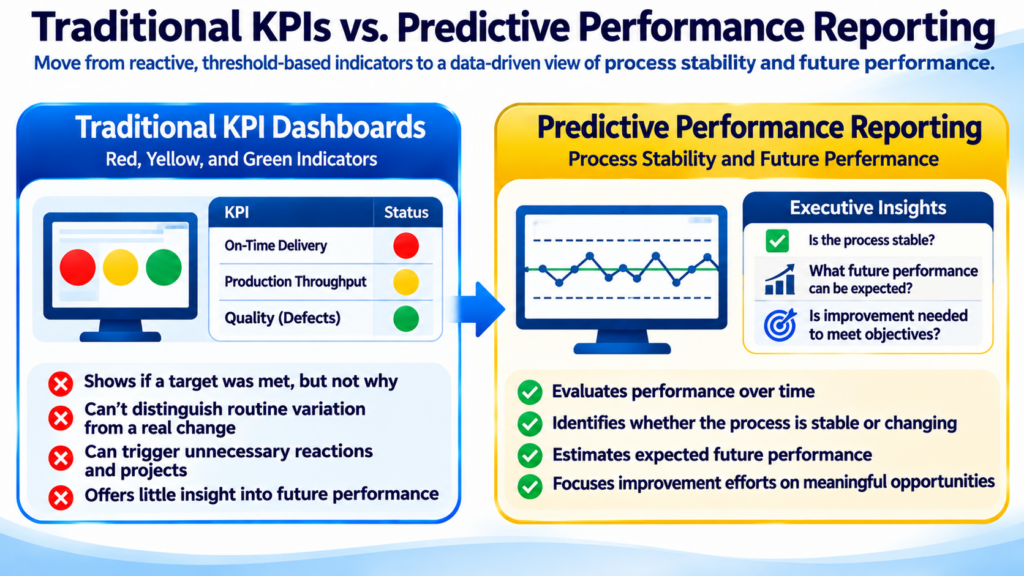
Traditional executive dashboards often compare current performance against targets using red, yellow, and green indicators.
Although these displays can communicate whether a target was achieved, they frequently provide limited insight into the underlying behavior of a process.
A metric may be red one month and green the next without any fundamental change in the process.
Similarly, a reported improvement following an AI implementation may simply reflect ordinary process variation.
IEE’s 30,000-foot-level performance reporting approach evaluates process behavior over time, distinguishing routine variation from evidence of meaningful change.
When a process is stable, its historical behavior can be used to estimate its future performance expectations, assuming the underlying conditions remain comparable.
This approach helps executives understand whether an AI initiative has changed the performance of a process and whether the expected results are likely to continue.
For a more detailed explanation of process stability, performance expectations, and executive decision-making, see Smarter Solutions’ guide to Predictive Performance Metrics.
Predictive performance metrics for AI therefore provide a stronger foundation for investment evaluation than isolated before-and-after comparisons.
AI Business Impact Verification: Connecting Technology to Enterprise Results
Organizations need a systematic way to verify that AI investments are delivering their intended business benefits.
This requires more than documenting project completion or reporting estimated savings.
AI business impact verification should begin with a clearly defined business problem and a measurable performance objective.
The organization should then establish the current process behavior, identify the improvement opportunity, and determine how the proposed AI initiative will address the underlying performance issue.
Following implementation, performance should be monitored to determine whether a meaningful change has occurred.
Financial and operational results should be evaluated together to avoid declaring success based on a single favorable indicator.
It is also important to recognize that a performance improvement occurring after AI implementation does not automatically establish that AI caused the improvement. Other operational changes and external influences must be considered.
AI initiatives should also be evaluated for reliability, trustworthiness, and organizational risk. The National Institute of Standards and Technology (NIST) AI Risk Management Framework provides complementary guidance for managing risks associated with the development and use of artificial intelligence.
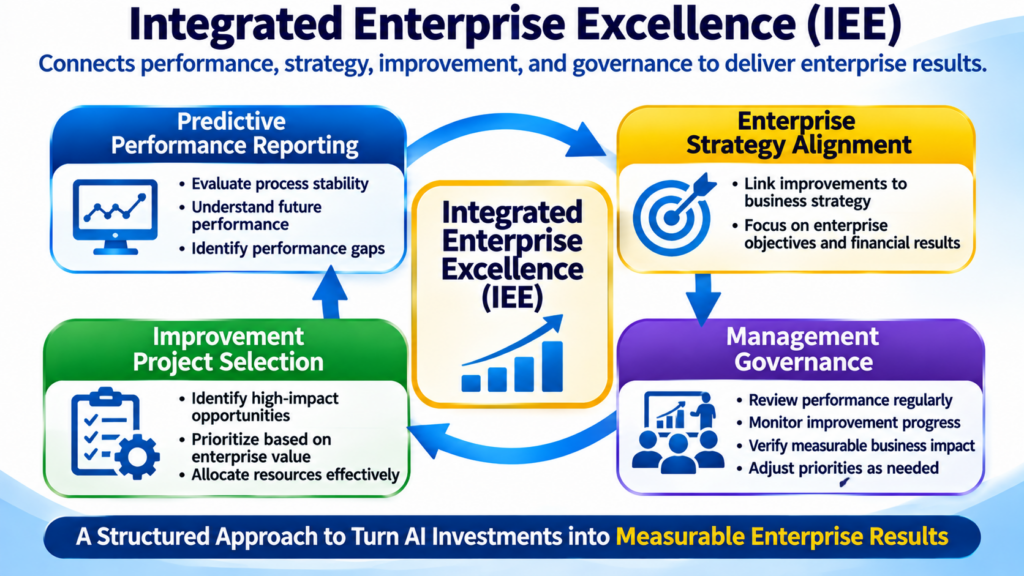
The Integrated Enterprise Excellence methodology provides a management framework that connects these activities through strategic alignment, predictive reporting, and the selection and governance of enterprise improvement projects.
How Integrated Enterprise Excellence Changes AI Investment Decisions
The central challenge for executives is not deciding whether artificial intelligence has potential.
It is determining where AI investments should be made, how those investments support enterprise priorities, and how their actual business impact will be evaluated.
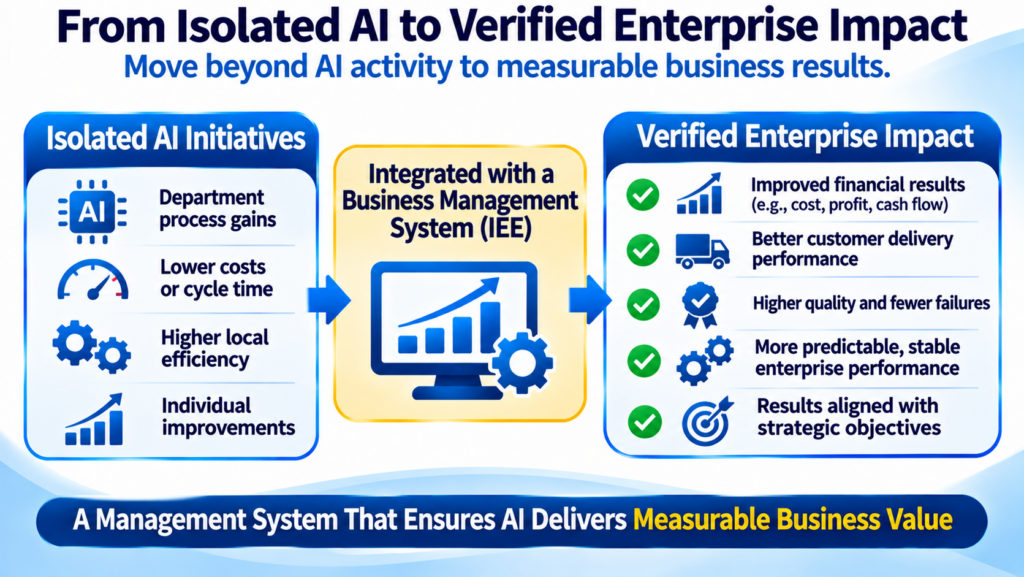
An IEE-based approach connects strategic objectives, value-chain performance, predictive metrics, and improvement project selection within an integrated management system.
This helps organizations move away from isolated technology initiatives toward business-driven improvement investments.
Rather than asking departments to identify as many AI opportunities as possible, executives can first identify where enterprise performance needs to improve.
This approach also supports Digital Transformation 2.0, where technology investments are guided by business needs and expected enterprise outcomes rather than technology adoption alone.
AI can then be evaluated as one potential solution alongside process redesign, operational changes, and other improvement approaches.
This distinction is important because not every business problem requires artificial intelligence.
The OECD’s work on artificial intelligence also emphasizes the importance of effective governance to realize AI benefits while managing associated risks. Organizations should therefore consider both the business value and governance requirements of proposed AI investments.
The objective should always be improved enterprise performance—not technology adoption for its own sake.
Conclusion: Measure Business Improvement, Not AI Activity
AI investments should ultimately be judged by their contribution to sustainable financial and operational improvement.
The number of AI projects launched, tools deployed, or hours saved may provide useful information, but these measures alone do not establish enterprise success.
Executives need a management system that connects strategic priorities, process performance, improvement investments, and verified business outcomes.
Integrated Enterprise Excellence provides a structured approach for making those connections.
The real measure of AI success is not how much artificial intelligence an organization uses. It is how effectively the organization improves its business performance.
Discuss Your Organization’s AI Performance Challenges
Are your organization’s AI initiatives producing measurable business results—or primarily generating activity reports?
Smarter Solutions can help you explore how predictive performance metrics and Integrated Enterprise Excellence can support better executive decisions and enterprise improvement priorities.
Contact:
Forrest Breyfogle
Founder, Smarter Solutions, Inc.
512-695-4424