
Integrating AI into your business management system is the ultimate key to shifting your artificial intelligence strategy from a tech experiment into a driver of predictable economic value.
Many companies dive headfirst into the technology trap. They buy software, launch siloed projects, and celebrate the deployment of an application without ever asking how it affects the bottom line.
True digital transformation starts with the business, not the technology.
Before writing a single line of code or signing a software license, leadership must identify strategic gaps, pinpoint process constraints, and define the exact problems that need solving .
Only then can AI serve its true purpose: optimizing the enterprise system.
Business-driven AI initiatives
When organizations treat algorithms as isolated tools, they inherit a fragmented landscape of tech projects that fail to move the needle on high-level goals.
Transitioning to business-driven AI initiatives means reversing your deployment sequence.
Instead of asking what an AI tool can do, start by analyzing your current operational realities. Identify the specific performance gaps that limit your financial results.
When AI is deployed to solve a pre-identified systemic bottleneck, its analytical power is instantly harnessed to generate meaningful corporate value rather than localized novelties.
Integrated Enterprise Excellence framework
To successfully connect technology with day-to-day operations, organizations require a structured architectural blueprint (1:04). The Integrated Enterprise Excellence framework (IEE) provides this missing link.
IEE acts as a governance layer that binds your core business objectives, strategies, and process improvements into a singular, unified management ecosystem.
Instead of letting machine learning models run wild in functional silos, the IEE governance model ensures that AI-generated data directly informs leadership decisions and supports your overarching corporate strategy.
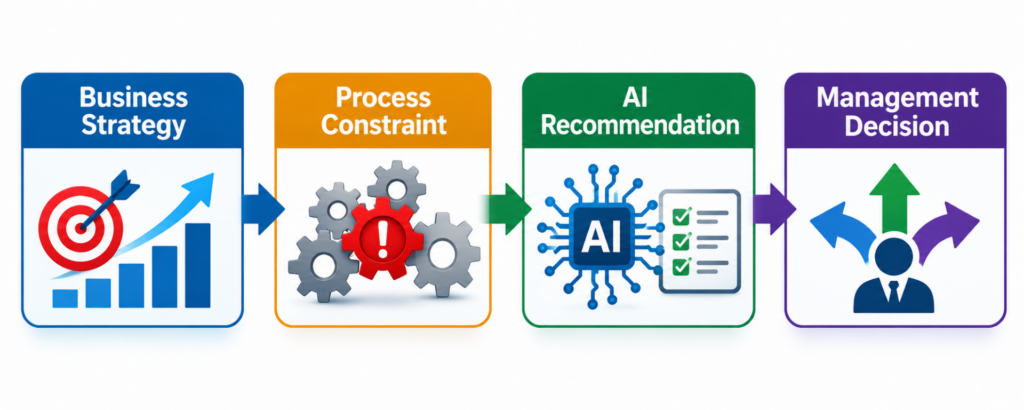
Predictive performance measures
Deploying an algorithm is not the same thing as achieving a verifiable business improvement. To understand if your systems are genuinely getting better, you must utilize predictive performance measures (1:43).
Standard corporate dashboards often rely on lagging metrics that only show past failures. Advanced business management systems use statistical performance tracking to filter out routine, everyday operational noise from true, systemic changes.
This data clarity allows management to verify if an AI intervention actually altered the underlying process and created stable, positive future outcomes.
Closed-loop management system
Maximizing your return on technology investments requires building a closed-loop management system (2:02). Isolated IT projects provide static answers, but an enterprise requires continuous adaptation.
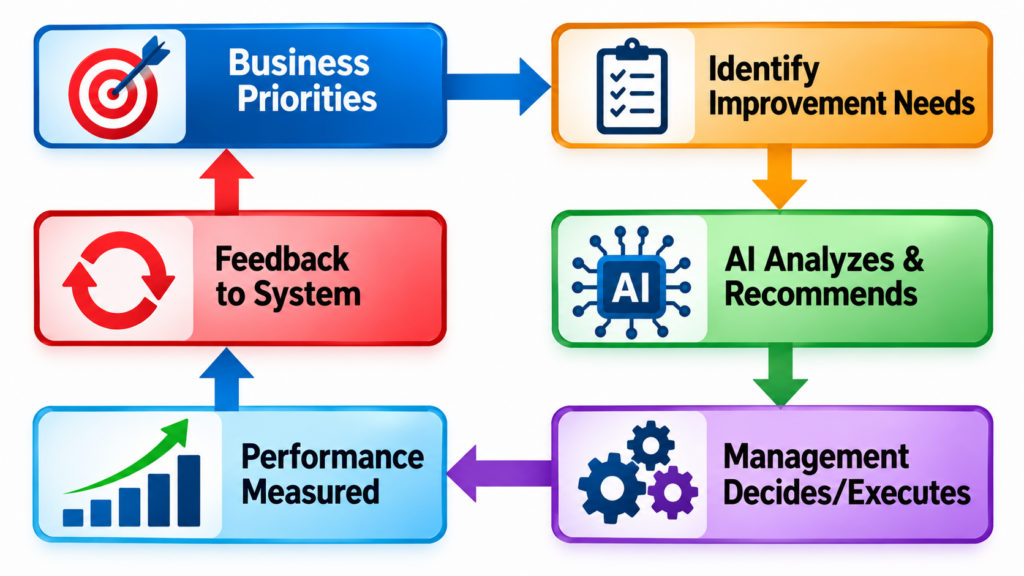
In an integrated, closed-loop setup, corporate priorities dictate where operational help is needed.
The AI then reviews the data and suggests optimization paths. Leadership retains decision authority, updates are systematically rolled out, and the resulting performance changes are measured and fed right back into the engine.
This cyclical flow transforms corporate operations into an environment of continuous corporate learning and sustainable growth.