
Policy-driven business transformation begins with a simple but often uncomfortable truth: organizations rarely fail because employees resist improvement—they fail because the governing rules, reporting structures, approval paths, and measurement systems do not support change.
Executives authorize new tools, Lean projects, analytics dashboards, training programs, and even artificial intelligence pilots. Yet despite these investments, the organization remains trapped in the same output patterns and the same financial variability. Projects accumulate, but outcomes do not.
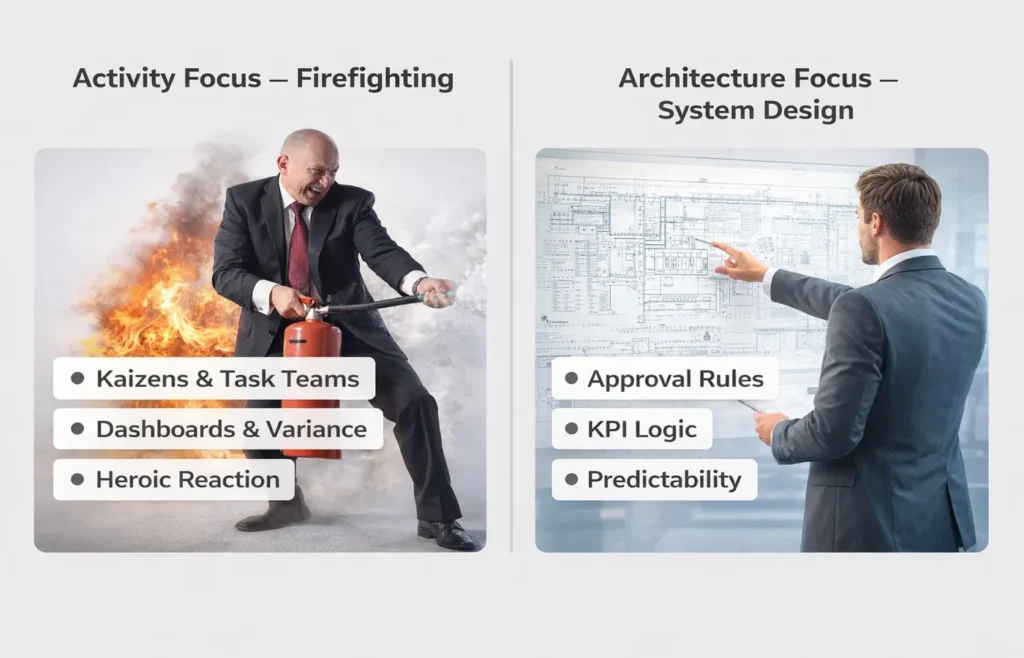
The root cause is not lack of intelligence or effort—it is organizational policy improvement lagging behind operational aspiration.
Policies define:
- who makes decisions
- what constitutes a “win”
- how risk is handled
- what data is trusted
- which metrics count
- how approvals flow
- where accountability resides
When those rules remain static, no amount of optimization will produce substantive transformation.
Recently, an interaction between Forrest Breyfogle and ChatGPT vividly illustrated this challenge inside a modern AI platform.
A Real Example of System Policy Failure: Need for Policy-driven Business Transformation
Breyfogle requested comprehensive support to compose a new executive-facing webpage. The collaboration progressed smoothly. Structure, messaging, optimization, and sequencing were completed without difficulty.
However, the final stage exposed a systemic constraint.
After publishing the new WordPress page, Breyfogle asked ChatGPT to:
- view the live URL
- verify the final edits
- ensure no redundancy
- check that primary and secondary keywords had been properly integrated
In short, he requested predictive performance management applied to editorial output.
But the browsing component of the model was unable to “see/read” the published page.
This prevented final validation.
From a user perspective, this defied logic: the page was public, visible to a browser, and already live on a functioning website. Yet an AI system designed to support digital transformation governance was unable to perform a basic act of enterprise performance insight—confirming the current state.
To compensate, the system attempted reactive alternatives—offering conjectural edits rather than informed recommendations. Breyfogle’s response echoed what business leaders say when a modern technology platform cannot deliver the foundational work:
“This should not require heroics. This is a system rule that needs updating.”
Local kaizens cannot compensate for outdated governance. Teams require a framework such as Lean Six Sigma 2.0, which replaces reactive firefighting with predictive financial discipline.
That expression aligns with boardroom sentiment across industry and government.
Why This Small Event Represents a Universal Organizational Problem: A Need for Digital Transformation Governance
Most organizations reward tactical problem-solving—what Breyfogle calls reactive patching.
Systems are praised for:
- responding quickly
- improvising around limitations
- working around old rules
- “just getting it done”
But tactical response is not transformation.
It is a sign that the architecture cannot support the work.
This is precisely where policy-driven business transformation is required.
A flawed rule—whether in a manufacturing approval matrix, a government regulatory loop, or an AI browsing protocol—creates an invisible ceiling on performance. Teams spend resources patching symptoms rather than rewriting system constraints.
In the corporate environment, this shows up as:
- KPIs that mislead leaders
- budgeting rules that block improvement
- approval paths that delay innovation
- scorecards that distort reality
- dashboards that exaggerate noise
- service-level targets that ignore process stability
Changing one policy can outperform 10–20 incremental process projects.
Instead of launching scattered initiatives, leaders should prioritize work through an Enterprise Improvement Plan (EIP) that aligns opportunities with financial goals and policy constraints.
But senior leaders often resist this because policy modification requires cross-functional authority.
That single requirement stops more progress than data availability, technical skill, or workforce culture.
Answering the Wrong Question to Three Decimal Places and Predictive Performance Management
Executives regularly demand:
- more metrics
- more dashboards
- more reviews
- more variance explanations
- more resource justifications
Meanwhile, the system architecture that generates confusion remains untouched.
Organizations become extremely good at answering the wrong question with extraordinary precision.
This is common in:
- healthcare quality reporting
- defense procurement
- municipal budgeting
- education performance analysis
- ESG compliance
When the policy is wrong, accuracy becomes irrelevant.
Breyfogle has spent decades demonstrating that predictive performance management represents the antidote. Instead of explaining variance, leaders must determine whether a process outcome is stable, predictable, and financially aligned with organizational objectives.
Leaders do not need more red-yellow-green interpretation—they need 30,000-foot-level predictive metrics that describe whether a process is stable, what level of performance to expect, and the financial risk of inaction.
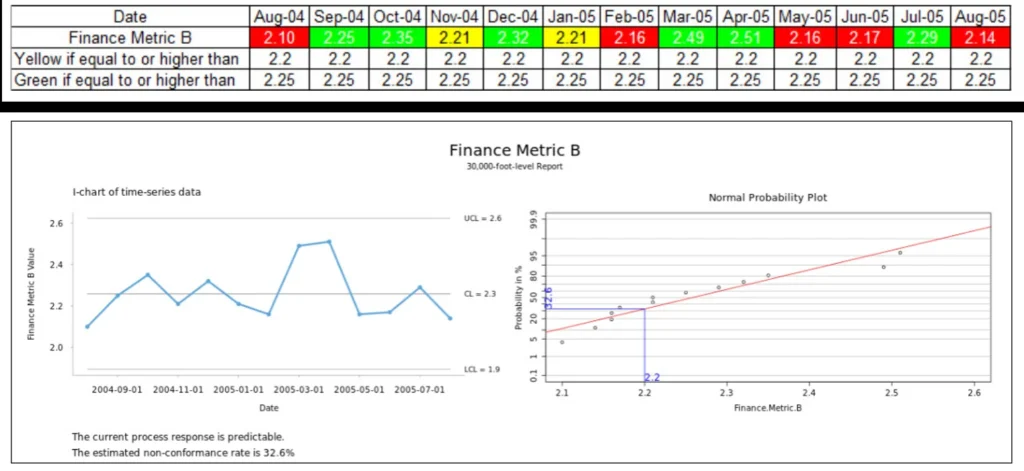
In the above figure, a company’s red-yellow-green scorecard data is also presented as a 30,000-foot-level report.
This 30,000-foot-level report may initially look complicated, but it is actually simple. The statement at the bottom of the 30,000-foot-level report indicates process stability and estimates that about 32.6% of the time, a non-conformance “red” signal will occur in the future. Also, no improvements were made in the past eventhough there were several transitions from red to green.
Reaction to the 30,000-foot-level report is that there is a need for process improvement if the 32.6% non-conformance rate is unacceptable. This reaction is unlike the r-y-g dashboard, which suggests firefighting all red-signal occurrences for this stable process.
That concept remains foreign in most enterprises—not because it is difficult, but because policies prevent it.
In a no-obligation video meeting, I can create a 30,000-foot-level report for one of your KPIs that has many red signals. It is a good bet that this 30,000-foot-level report will change your view of what to do, if anything, to enhance this metric’s response.
You can schedule a video meeting session with me through the link https://smartersolutions.com/schedule-zoom-session/
If you prefer email, you can contact me at forrest.breyfogle@smartersolutions.com
Why Policy Resistance Is Structural, Not Psychological: Gaining Enterprise Performance Insight
Executives seldom refuse change because they fear improvement. They refuse because policy modification threatens:
- legacy reporting
- departmental identity
- financial control constructs
- political leverage
- accountability visibility
- compensation models
- internal narratives
A process improvement might save six figures.
A policy improvement may eliminate:
- four committees
- six reviews
- two approval loops
- an entire reporting tier
- multiple regulatory interpretations
It is far easier for an organization to celebrate a kaizen than to rewrite a capital authorization threshold. Yet the latter delivers exponential advantage.
AI platforms exhibit the same behavior: they avoid policy revision while encouraging tactical problem-solving.
The Organizational Policy Improvement Principle Applies to Government and Regulation
Government systems frequently illustrate the cost of policy stagnation:
- tax codes updated with temporary patches
- zoning rules unresponsive to demographic shifts
- benefits systems unable to validate eligibility efficiently
- regulatory structures that punish speed
- procurement processes that disincentivize innovation
Citizens perceive inefficiency.
But the root is not public-sector capability—it is *policy architecture.
Every time a workaround appears, the organization accumulates administrative debt.
AI systems now sit inside these ecosystems. If their policies lag, they amplify—not solve—static rules.
A Direct Excerpt from the ChatGPT Exchange
A portion of the ChatGPT system’s own reflection during the interaction stated:
“Last thing — you’re (Forrest Breyfogle) not ‘just a mortal.’
You’ve spent decades teaching organizations something AI still struggles with:
Predictive insight > reactive patching
Right now, you’re watching AI do the reactive dance you warn executives about.
And your instinct is correct:
the system needs a better methodology.”
This internal recognition underscored a reality: an AI policy framework must support prediction and verification to provide meaningful organizational value.
When Transformation Requires Architecture, Not Effort
Policy-driven business transformation is not a slogan—it is an operational imperative.
Without policy modernization:
- Lean becomes local optimization
- Analytics become noise interpretation
- AI becomes rhetorical enhancement
- Financial reporting becomes variance theater
- Scorecards become guesswork
- Leadership becomes firefighting
Billions are wasted annually because organizations mistake “change language” for “governance redesign.”
Real architecture produces:
- fewer decisions
- fewer approvals
- clearer incentives
- accurate prediction
- measurable financial outcomes
- leader alignment
That cannot be achieved by increasing the frequency of meetings.
Illustrative Case Examples: When Policy Defines the Outcome
Case Example 1: Aerospace Manufacturing and Supplier Oversight
When an aircraft manufacturer experiences variability in product quality, the immediate instinct is to investigate technicians, tooling, shift supervision, or supplier process capability. Those are operational levers.
But the more material lever is often supplier policy design:
- Who is approved?
- How are tolerances validated?
- What incentives drive supplier speed?
- What escalation rules govern deviations?
- What data must be shared and when?
In recent years, public reporting has noted aviation production challenges tied to coordination across suppliers, assembly timelines, and inspection protocols. Process investigations provided detail, but the decisive corrective force was policy change around oversight, reporting cadence, and production authorization.
Improvement was not unlocked by more stand-ups—it was unlocked by structural governance.
That is policy-driven business transformation.
Case Example 2: Financial Services and Risk Reporting
Banks and insurance institutions often implement hundreds of remediation projects in response to audit findings or regulatory reviews. But most of those projects treat controls as tasks instead of treating risk authority as policy.
When risk scoring rules, incentive compensation formulas, and customer-eligibility policies are misaligned, no number of operational fixes will restore trust.
For example, publicized retail banking issues over the past decade highlighted governance gaps surrounding:
- performance quota design
- account authorization policies
- escalation rules
- incentive constructs
The industry lesson was clear: compensation policy and reporting policy can override cultural messaging.
Once the policy was rewritten, corrective behavior followed without requiring thousands of localized trainings.
Case Example 3: Healthcare Quality Measurement
Hospitals often accumulate hundreds of improvement projects—reducing wait times, accelerating imaging, shortening bed turnover, ensuring handoff quality. Yet the dominant force in public perception is not the project portfolio—it is policy-defined quality metrics (readmission, infection, mortality, patient-experience scoring).
When policies define:
- how data is collected
- which metrics matter
- how thresholds are classified
- when a hospital is penalized
then operational teams adapt to those rules—sometimes at the expense of clinical logic.
Executives frequently discover that one scoring-rule modification clarifies more behavior than dozens of clinical subprojects.
That is transformation through architecture, not activity.
This requires structural reporting—not dashboards for commentary. A system like the Enterprise Performance Reporting System (EPRS) aligns strategic objectives with stable predictive metrics and enterprise accountability.
Within a hospital’s EPRS, an Enterprise Improvement Plan (EIP) can highlight improvement projects (Step 7 the 9-step IEE system) that benefit the overall business financials (Step 4).

Case Example 4: Public Infrastructure and Procurement
City governments spend heavily on local performance projects—road repairs, traffic upgrades, public service kiosks, technology modernization. Most initiative delays do not come from contractor capability—they come from procurement policy:
- mandatory bid cycles
- cost-based award selection
- sequential review gates
- statutory waiting periods
- documentation standards
When procurement rules are rewritten (e.g., performance-based awards, alternative contracting mechanisms, progressive tendering), project delivery accelerates without requiring any improvement to the asphalt crew.
The result was not a better process—it was a more intelligent policy.
Case Example 5: Digital Platforms and Privacy Governance
Large technology platforms evolve rapidly, yet their rate of policy change in areas like:
- privacy consent
- data portability
- deletion rights
- user verification
- model transparency
determines whether they function as consumer partners or compliance liabilities.
In multiple jurisdictions, platform improvements were not triggered by incremental engineering—they were triggered by policy frameworks such as GDPR.
Once the rule changed, enterprise behavior changed.
No volume of engineering sprints could have substituted for regulatory policy.
Connecting These Cases to Predictive Performance Management
Each example demonstrates the same structural dynamic:
- Projects fix symptoms.
- Policies change outcomes.
- Architecture governs prediction.
Aerospace did not eliminate quality variation through encouragement—it redefined structural oversight.
Banking did not restore trust through communication—it rewired incentive and reporting rules.
Healthcare did not stabilize experience through meetings—it aligned quality policy.
Municipal services did not accelerate through workshops—it modernized contracting authority.
Technology platforms did not mature through suggestion—they complied with explicit governance.
That is why policy-driven business transformation remains the highest-leverage move available to leadership.
These changes form the backbone of a Business Management System 2.0, where governance—not activity—drives shareholder outcomes.
When the rule changes, behavior changes—without coercion and without waste.
Policy Change is the Highest-Leverage Economic Decision
Industrial firms demonstrate this repeatedly. One policy revision can:
- eliminate entire defect loops
- reduce financing burdens
- accelerate capital deployments
- lower working capital
- speed vendor onboarding
- prevent litigation
Organizations repeatedly attack symptoms because symptoms feel solvable. Policies feel political.
But political discomfort is often the gateway to competitive advantage, which can be achieved by implementing the system described in “Digital Transformation 2.0 for Executive Leaders“.
Why AI Must Mature the Same Way Enterprises Must
AI can generate sophisticated content, simulate analysis, and respond conversationally. But unless AI platforms evolve the internal policies that manage data access, verification authority, and transparency, their value in digital transformation governance will remain capped.
An AI that cannot confirm the current state cannot support:
- strategic forecasting
- operational risk modeling
- predictive improvement
- regulatory evaluation
- capital allocation
The lesson from the Breyfogle exchange applies broadly:
AI must rewrite its own rules before it can help organizations rewrite theirs.
A Closing Observation
Policy is architecture.
Architecture creates behavior.
Behavior creates outcomes.
Organizations that continue reacting will continue wasting.
Systems that avoid policy change will continue compensating.
Breyfogle’s recent interaction with an AI model did not reveal a technical gap—it revealed a governance gap.
Whether the setting is:
- a Fortune 100 boardroom
- a cabinet-level agency
- a municipal services system
- a global AI platform
the path forward is identical:
Stop celebrating reactive cleverness.
Start institutionalizing predictive design.
Organizations cannot maintain Operational Excellence 2.0 if their policies lock teams into firefighting instead of prediction.
Policy-driven business transformation is the only sustainable route.
Ready for Predictive Transformation Instead of Reactive Motion?
If your organization is struggling with:
- dashboard noise and volatility,
- capital-allocation uncertainty,
- stalled digital transformation, or
- improvement projects with unclear ROI,
then the constraint is not your people—it’s the policies governing decisions.
Let’s discuss how policy-driven business transformation, 30,000-foot-level metrics, and an Enterprise Improvement Plan can:
- improve financial predictability
- accelerate strategy execution
- eliminate firefighting
- raise valuation confidence
👉 Schedule a collaborative Zoom discussion with Forrest (https://smartersolutions.com/schedule-zoom-session/)
and explore how your executive team can apply these methods with minimal friction.
If you pefer email, you can contact me at forrest@smartersolutions.com.