
Traditional KPIs often fail to provide executives with the information needed for effective decision-making. Integrated executive performance management addresses this limitation by connecting business strategy, predictive performance metrics, and measurable financial results.
This limitation can lead executives to react to ordinary fluctuations, launch unnecessary improvement initiatives, or overlook persistent performance problems.
A more effective approach combines statistically based predictive performance reporting with an integrated business management system that connects operational results to enterprise strategy.
Executive KPI Reporting Limitations
Traditional executive dashboards frequently emphasize monthly results, year-over-year comparisons, targets, and red-yellow-green performance indicators.
These displays may appear informative, but they often leave important questions unanswered:
- Is the process performing consistently, or has something fundamentally changed?
- Does the latest result represent an unusual event or ordinary process variation?
- What range of performance can reasonably be expected in the future?
- Is the existing process capable of consistently meeting management’s objectives?
- Which performance gaps justify improvement investments?
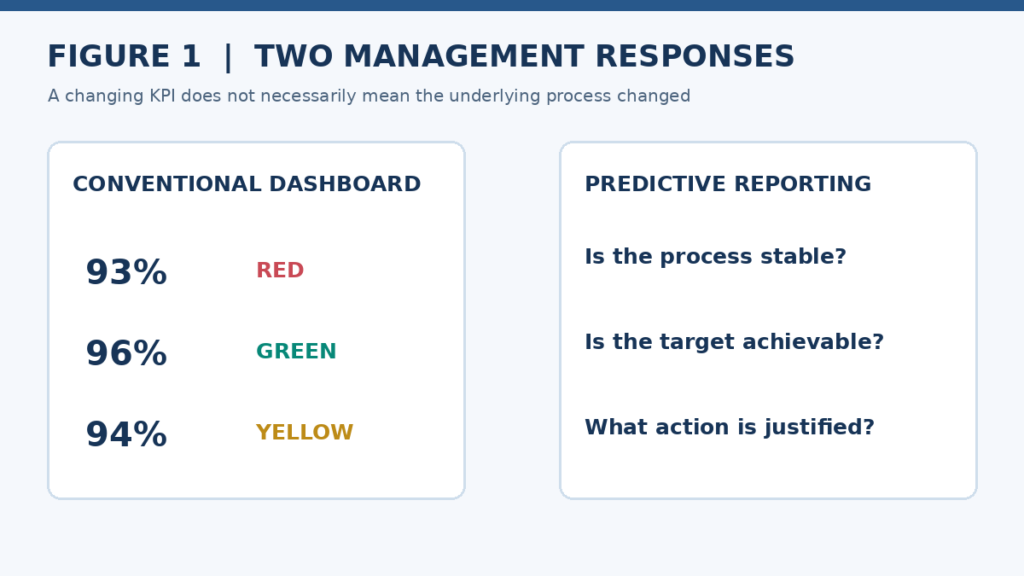
Consider an organization reporting monthly on-time delivery performance. One month the result is 93%, followed by 96%, then 94%.
A conventional dashboard might show a red indicator, followed by green, followed by yellow.
Management may interpret these fluctuations as evidence of deteriorating and improving operational performance.
However, if all three values reflect routine variation within a stable process, these reactions may be unwarranted.
A management system that treats every change in a KPI as meaningful can unintentionally encourage firefighting rather than systematic improvement.
The fundamental issue is not the availability of data. It is the method used to interpret that data.
For a more detailed discussion, see our article on executive dashboard decision making and why conventional dashboards can mislead leaders.
Watch: Why Traditional KPIs Fail Executives
In this Smarter Solutions video, Forrest Breyfogle explains why conventional KPI reporting can mislead executive decision-making and how predictive performance reporting provides a more useful alternative.
Predictive Performance Reporting for Executives
Predictive performance reporting for executives changes the conversation from what happened last month to what performance can reasonably be expected if the underlying process continues operating as it has.
Instead of relying exclusively on comparisons with arbitrary targets, this approach examines performance over time and distinguishes routine variation from evidence of meaningful process change.
When a process demonstrates statistical stability, its historical behavior can support a prediction of its future performance distribution, assuming the underlying conditions remain comparable.
This is different from simply extending a trend line into the future.
Predictive performance reporting helps executives determine whether the existing process is capable of consistently achieving organizational objectives.
Learn more about predictive performance metrics and how they provide executives with a statistically sound basis for management decisions.
For example, suppose a business has a target of 98% on-time delivery, but analysis of its stable process indicates that performance will typically remain between 92% and 96%.
The issue is not that employees need another reminder to achieve the target.
The existing process is not capable of reliably meeting management’s expectation.
This distinction changes the management response from reacting to individual results to improving the underlying process.
Executives can then focus attention on the business systems and operational constraints that prevent sustained improvement.
30,000-Foot-Level Performance Metrics
Smarter Solutions’ 30,000-foot-level performance metrics provide a statistically based method for examining business performance from an executive perspective.
The objective is to create reporting that communicates both historical process behavior and the implications of that behavior for future performance.
Unlike traditional scorecards that may encourage overreaction to individual observations, 30,000-foot-level reporting evaluates the underlying process.
This approach typically involves:
- Displaying performance in time order.
- Evaluating whether the process is statistically stable.
- Identifying evidence of meaningful changes in performance.
- Quantifying expected performance when the process is stable and an appropriate prediction model is available.
- Comparing expected performance with business requirements.
If the process is unstable, management should investigate the sources of instability rather than assume its historical performance distribution will continue unchanged.
If the process is stable but incapable of meeting business objectives, management should consider fundamental process improvement.
If the process is stable and capable, management may appropriately focus resources elsewhere.
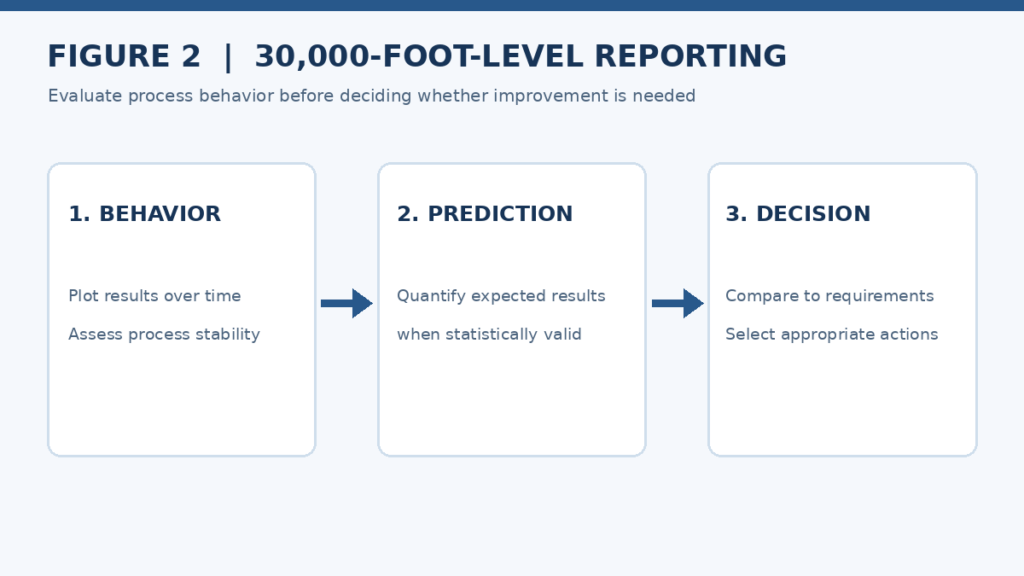
This reporting method provides executives with a more meaningful foundation for operational decisions and improvement priorities.
For another explanation of this methodology, read Why KPIs Don’t Predict Future Performance.
Integrated Executive Performance Management
Integrated executive performance management requires more than an improved dashboard.
Even a statistically sound performance report provides limited business value if it is disconnected from enterprise strategy, financial objectives, operational processes, and improvement execution.
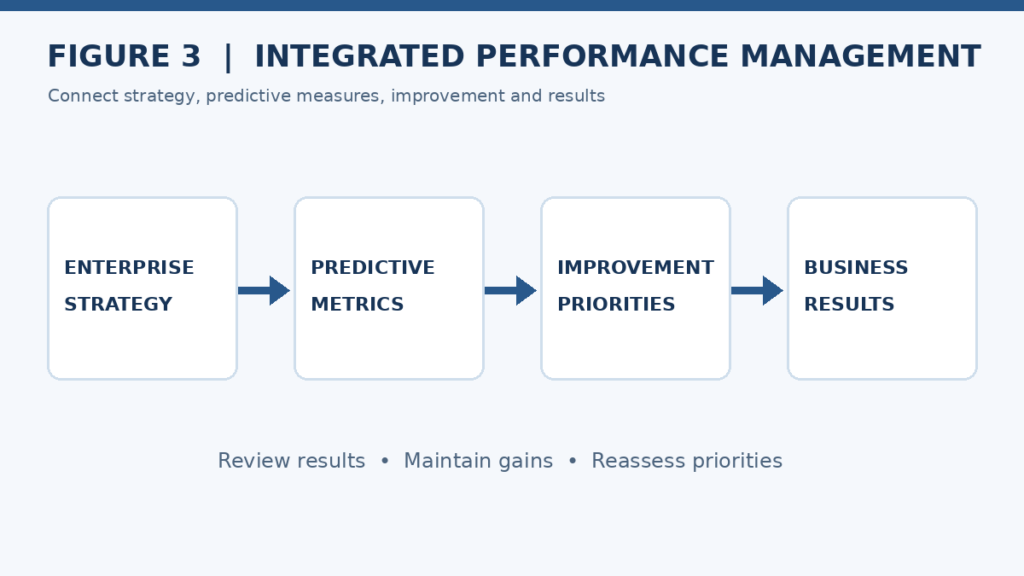
Smarter Solutions addresses this challenge through Integrated Enterprise Excellence (IEE), a nine-step business management system designed to connect strategy, performance measurement, and improvement activities.
Within this framework, executive leadership can:
- Establish a clear enterprise vision and mission.
- Understand the organization’s value chain.
- Evaluate operational and financial performance.
- Establish measurable financial objectives.
- Develop strategies aligned with business priorities.
- Identify high-potential improvement opportunities.
- Execute improvement initiatives.
- Assess their actual impact.
- Maintain improvements and reassess enterprise performance.
The objective is to avoid isolated improvement projects that generate local benefits without materially improving enterprise results.
A statistically sound performance reporting system helps identify where improvement is needed.
An integrated management system helps determine which improvements should be pursued and how their effects should be evaluated.
Discover how an integrated business management system connects enterprise strategy, predictive performance measurement, and improvement execution.
Moving Beyond Traditional Executive Dashboards
Executives should not have to choose between visually appealing dashboards and statistically meaningful performance information.
The objective should be to combine accessible reporting with sound analytical methods.
A more effective executive reporting system distinguishes routine variation from meaningful change, quantifies expected performance when justified, and connects improvement decisions to strategic and financial priorities.
Smarter Solutions’ Enterprise Performance Reporting System (EPRS) supports this approach through predictive performance reporting capabilities.
Schedule a Complimentary Executive Performance Reporting Review
Are your organization’s executive dashboards providing actionable performance insights—or encouraging unnecessary reactions to routine fluctuations?
Smarter Solutions offers a complimentary 30-minute Executive Performance Reporting Review to explore how your current reporting approach supports management decisions.
During this discussion, we can examine:
- How your organization currently interprets executive KPIs.
- Whether existing reports distinguish routine variation from meaningful performance changes.
- Opportunities to incorporate predictive performance reporting.
- How performance measures connect to strategic improvement priorities.