
AI Business Process Improvement offers organizations unprecedented opportunities to analyze data, identify inefficiencies, and recommend operational changes. But an important question is often overlooked: Is AI improving the processes that actually determine enterprise performance?
An AI initiative can achieve its technical objectives, reduce processing time, and increase departmental productivity while producing little or no meaningful financial benefit for the organization.
This disconnect occurs when businesses optimize individual processes without understanding how those processes contribute to overall enterprise performance.
Watch: AI Can Improve the Wrong Business Process
Why Enterprise Performance Optimization Matters More Than Local Efficiency
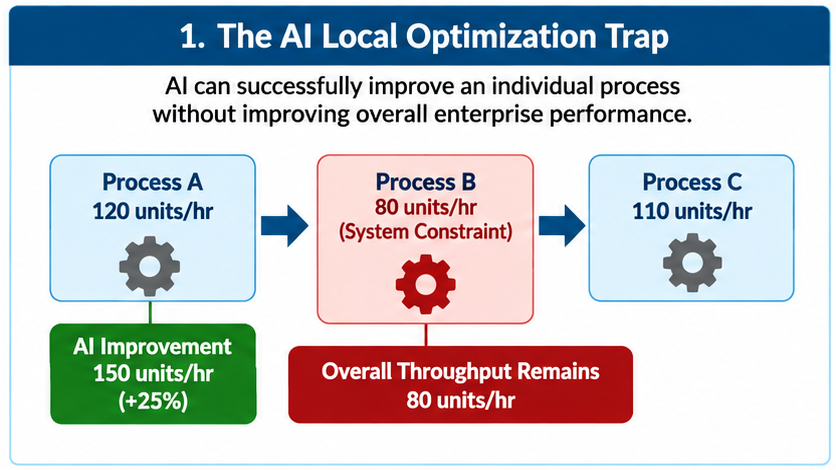
Consider an organization with three interconnected processes:
- – Process A produces 120 units per hour.
- – Process B produces 80 units per hour.
- – Process C produces 110 units per hour.
Assume each process must handle every unit, and there are no other limiting factors.
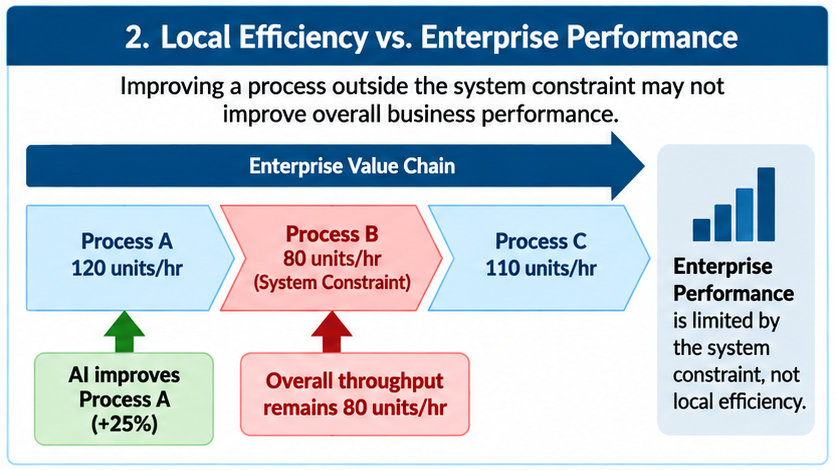
Process B is the system constraint, limiting overall throughput to approximately 80 units per hour.
Now suppose an AI initiative increases Process A’s capacity from 120 to 150 units per hour.
Management might celebrate a 25 percent capacity improvement in Process A. However, overall throughput remains limited by Process B.
The AI initiative improved local capacity without improving the enterprise’s ability to produce more output.
This illustrates a fundamental principle: Improving an individual process does not necessarily improve the overall business.
Before launching AI initiatives, executives should understand how their organization’s processes interact and where improvements have the greatest potential to affect business results.
AI Strategic Alignment: Choosing the Right Improvement Opportunities
Many organizations begin AI initiatives by asking:
- Where can we use artificial intelligence?
- Which activities can be automated?
- Where might AI reduce labor or processing time?
- Where can we use artificial intelligence?
- Which activities can be automated?
- Where might AI reduce labor or processing time?
These questions can identify opportunities, but they do not necessarily identify the opportunities that matter most.
A more effective approach begins with enterprise strategy.
Leadership should first establish business objectives, examine the organization’s value chain, assess process performance, and identify high-potential improvement opportunities.
Only then should management determine whether AI is the appropriate improvement method.
Smarter Solutions’ Integrated Enterprise Excellence (IEE) methodology provides a structured, nine-step business management approach that connects strategic objectives with operational improvement and performance measurement.
Within this system, AI becomes a potential means of achieving business objectives rather than an independent technology initiative.
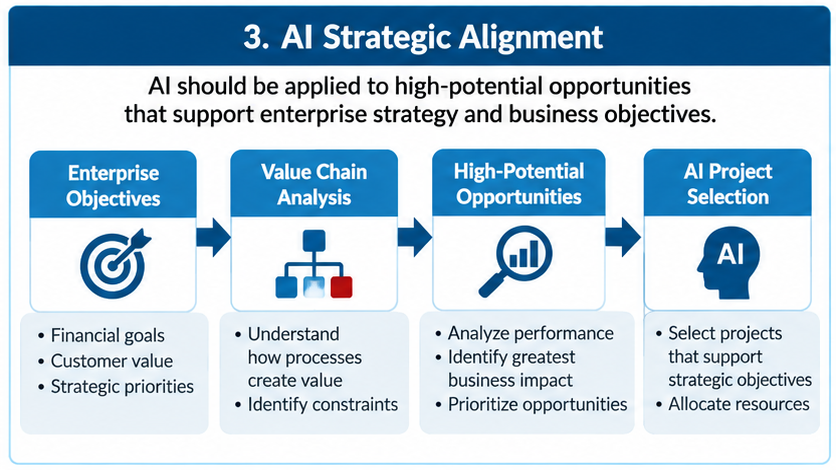
Effective AI decision governance helps ensure that technology recommendations are evaluated against enterprise priorities before resources are committed.
Predictive Process Performance Metrics Reveal What Is Really Changing
Traditional executive dashboards frequently emphasize targets, historical results, and red-yellow-green scorecards.
Although these reports can provide useful information, they may not distinguish routine process variation from meaningful performance changes.
For example, a process might exceed its monthly target and receive a green indicator even though its underlying performance has not meaningfully improved.
Alternatively, a process might miss a target because of routine variation rather than a deterioration in performance.
30,000-foot-level predictive performance metrics provide a different perspective.
By examining process behavior over time, management can evaluate whether a process is stable, whether a meaningful shift has occurred, and what performance can reasonably be expected if current conditions continue.
This distinction is particularly important when evaluating AI initiatives.
An apparent improvement in a monthly KPI is not sufficient evidence that AI has produced a sustained operational improvement.
Executives need to understand whether the underlying process has actually changed.
AI Business Impact Verification: Did the Enterprise Actually Improve?
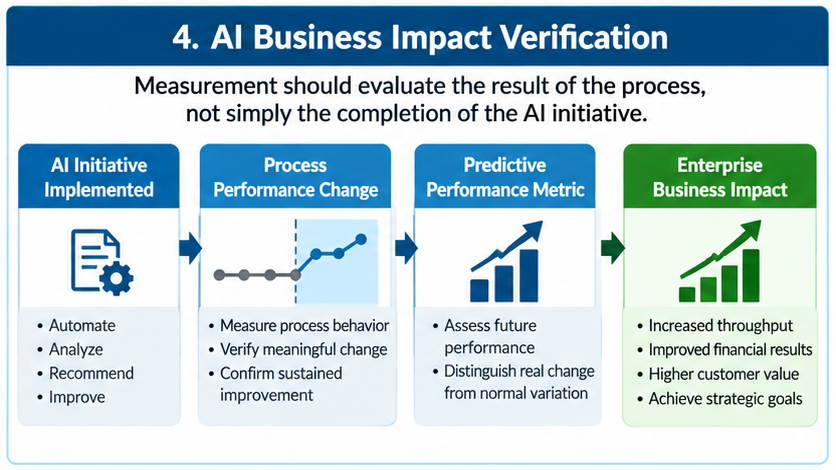
AI implementation should not be considered successful merely because the technology was deployed or a project team reported savings. There should be an AI Business Impact Verfication effort.
Management should examine three questions:
- Did the targeted process improve? Evaluate process behavior before and after implementation to determine whether a meaningful change occurred.
- Was the improvement sustained? Assess whether the new level of performance continues rather than reflecting a temporary fluctuation.
- Did the improvement benefit the enterprise? Determine whether the operational change contributed to financial objectives, customer outcomes, throughput, or other important business results.
A verified operational improvement may still produce limited enterprise value if it occurs outside a critical business constraint.
This is why project-level measurement must be connected to enterprise-level performance.
Integrating AI With an Enterprise Business Management System
AI can analyze information, identify patterns, and recommend actions. However, these capabilities alone do not constitute an enterprise business management system.
Executives also need a structured approach for establishing priorities, allocating resources, selecting improvement projects, measuring results, and maintaining gains.
Integrated Enterprise Excellence provides this management framework.
The Enterprise Performance Reporting System (EPRS) supports predictive performance reporting, helping management understand what processes are delivering and where meaningful changes have occurred.
Together, these capabilities can support better decisions about where AI should be applied and how its business impact should be evaluated.
The objective is not simply to implement more AI projects.
The objective is to improve overall enterprise performance.
Is Your AI Investment Improving What Matters Most?
Before investing in another AI initiative, consider these questions:
- Are AI projects selected because they support enterprise strategy?
- Do you know which processes are constraining overall business performance?
- Are your executive dashboards providing predictive insights or simply reporting historical results?
- Can you demonstrate that completed AI projects have produced sustained improvements?
- Are those improvements contributing to meaningful enterprise business outcomes?
If the answers are unclear, the issue may not be your AI technology. It may be the management system used to select, execute, and evaluate improvement initiatives.
Schedule a Conversation With Smarter Solutions
Smarter Solutions helps organizations connect enterprise strategy, predictive performance measurement, and improvement execution through Integrated Enterprise Excellence.
If you would like to explore how these concepts could improve your organization’s business performance, I invite you to schedule a conversation.
Learn more: https://smartersolutions.com