
The value chain model by Michael Porter has long served as a foundational framework for organizations seeking to understand how value is created, delivered, and sustained throughout their operations.
In today’s environment of rapid technological shifts, artificial intelligence (AI), and increasingly complex business ecosystems, organizations require a modernized approach that extends beyond the traditional model.
SmarterSolutions.com’s Integrated Enterprise Excellence (IEE) methodology provides a transformative enhancement to the classic value chain model by integrating predictive analytics, enterprise‑wide measurement systems, and AI-enabled prioritization.
This article introduces how an organization can benefit from a Value Chain Model by Michael Porter: An Enhancement Incorporating AI, while also highlighting how the IEE framework strengthens Michael Porter’s original concepts for modern competitiveness.
—
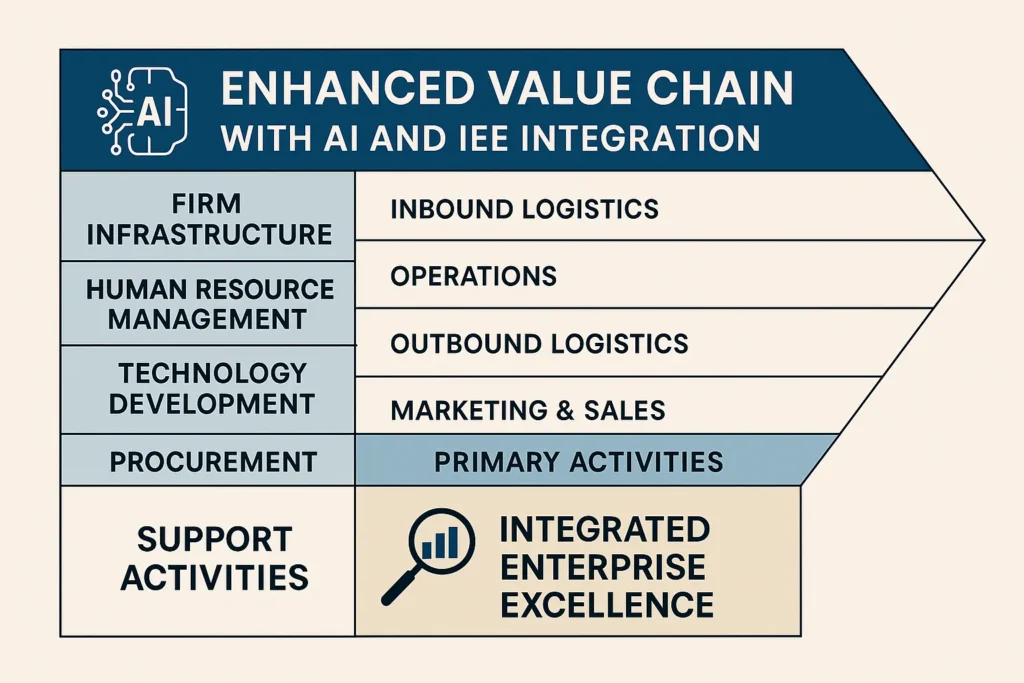
Value Chain Model by Michael Porter
The value chain model by Michael Porter outlines how primary and support activities contribute to customer value and competitive advantage.
However, organizations today struggle not because Porter’s model is flawed, but because they lack the measurement discipline and systemic insight needed to optimize their activities.
The IEE methodology provides a structure for objectively evaluating process performance across all segments of the value chain, using predictive analytics to reveal which activities are helping or hurting the enterprise’s long‑term financial outcomes.
The traditional value chain model by Michael Porter does not prescribe how organizations should measure and improve each link in the chain.
IEE fills this gap through a structured approach that aligns measurements, improvement efforts, and AI‑supported insights so leaders truly understand performance drivers. Today’s digital transformation landscape demands more than qualitative analysis — it demands predictive, data‑driven clarity. Through its 30,000-foot-level reporting, IEE provides organizations with a stable metric foundation that strengthens all stages of the value chain analysis.
This approach aligns closely with Business Process Management 2.0 , where processes are managed as interconnected systems rather than isolated functional silos.
Organizations adopting IEE therefore gain a clearer understanding of how disruptions in one part of the value chain affect downstream financial and operational outcomes.
—
Value Chain Analysis Michael Porter
Value chain analysis Michael Porter introduced gives organizations a method for evaluating the relative contribution of each activity.
However, traditional measurement methods — including red-yellow-green scorecards and table‑of‑numbers reporting — fail to guide effective decision‑making. They encourage reactive behavior, misinterpretation of normal process variation, and firefighting rather than systematic improvement.
IEE’s 30,000-foot-level reporting solves these problems by replacing conventional dashboard reporting with predictive metric statements. These statements describe expected future performance of a process, using control chart evaluation to determine whether the process is stable and whether the long-term output is acceptable.
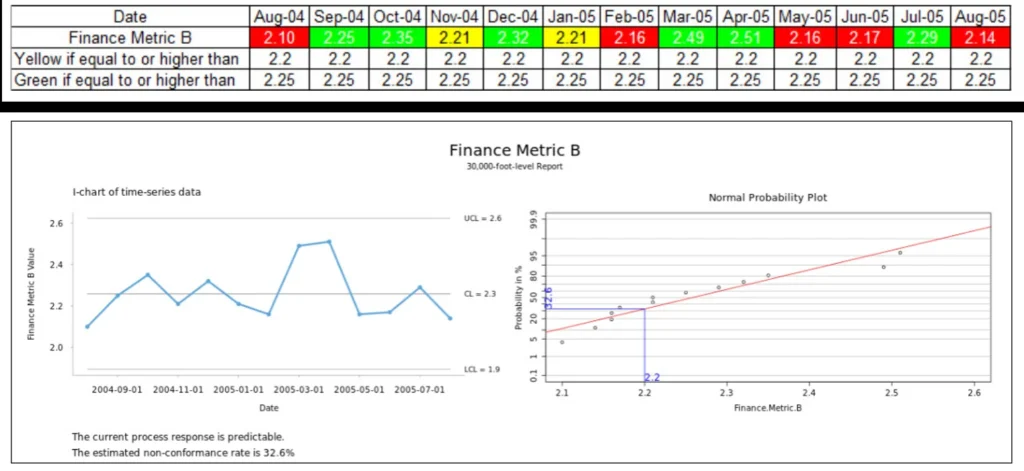
In the traditional red-yellow-green dashboard (top image), a red signal is interpreted as a warning that triggers immediate corrective action.
However, the 30,000-foot-level report shown in the lower graphic tells a different story. The individuals control chart on the left—based on the very same dataset—indicates that the process is operating consistently and is statistically stable.
The probability plot on the right provides additional insight. It estimates that about 32.6% of future outcomes will fall below 2.2, which corresponds to the red zone shown in the top chart.
This predicted long-term performance level is displayed in the summary statement at the bottom of the 30,000-foot-level chart.
If this forecasted performance is not acceptable, then the underlying process needs improvement.
When true process improvements occur, the individuals chart will show a visible step-change or staging effect, and the improved non-conformance rate will be reflected in the updated predictive statement at the bottom of the report.
The Integrated Enterprise Excellence (IEE) approach replaces conventional dashboards with 30,000-foot-level predictive metrics that clearly communicate:
- Whether a process is stable or exhibiting special-cause behavior
- Whether observed changes represent real improvement
- Whether performance is predictable
- What future results are likely to be
- Whether corrective action is actually warranted
Anyone can create these predictive charts for their own processes by using the free 30,000-foot-level reporting app, which allows users to paste in data, assess stability, and automatically generate predictive performance summaries for their Excel dataset.
This leads to greater organizational consistency by reducing firefighting, improving proactive decision-making, strengthening long-term visibility, and enabling enterprise-wide predictability.
Whether the response variable is normal or log-normal, the app guides users through generating a statistically valid predictive statement. This democratizes quality analytics across the organization, ensuring every department can understand whether its processes are performing acceptably or requiring optimization.
The video “Metric Reports that Lead to the Best Behaviors” provides a clear visual explanation of the importance of predictive scorecards. By incorporating these metrics into the organization’s value chain analysis Michael Porter model, leaders can link measurable outputs from each process to the broader system and identify process improvement opportunities that directly impact financial outcomes.
If the predictive statement indicates that long-term performance is undesirable, this signals the need for business process optimization for the process associated with that metric. This approach reduces firefighting behaviors, stabilizes operations, and aligns improvement efforts with strategic outcomes.
—
Competitive Strategy by Michael Porter
Competitive strategy by Michael Porter emphasizes differentiation, cost leadership, and focus. However, in the modern AI‑enabled environment, organizations face increased pressure to optimize internal operations continuously.
AI can assist in identifying improvement opportunities — but only when the organization employs stable, predictive measures that feed meaningful data into AI models.
Here is where IEE’s Enterprise Performance Reporting System (EPRS) software becomes essental:

EPRS allows 30,000-foot-level reports to be updated daily throughout the organization. This means leaders are not managing from outdated tables or subjective assessments but from objective predictive insights directly tied to processes and activities throughout the value chain.
This deployment provides the ideal foundation for leveraging AI in prioritizing process improvements. When AI receives reliable inputs — predictive Y outputs linked to process Xs in the relationship Y = f(X) — it becomes far more effective in guiding decisions. In this framework:
– Y represents a process output metric (e.g., defect rate, cycle time, customer wait time).
– X represents the controllable factors within the process that influence Y.
If the predictive Y output is undesirable, the organization can target improvements to the upstream Xs, ensuring optimized changes that improve financial results. This aligns perfectly with the competitive strategy by Michael Porter, where competitive advantage comes from superior internal capabilities and disciplined operational management.
—
Michael Porter Books
Michael Porter’s books — especially “Competitive Strategy” (1980) — revolutionized how leaders think about strategic advantage. But business environments have changed dramatically since then. Today’s organizations need systems thinking, predictive analytics, cross-functional visibility, and AI-enabled action prioritization.
Two books that offer enhanced methodologies aligned with these modern needs are:
These novel-written books build upon the foundational logic of the value chain model by Michael Porter by providing actionable frameworks that integrate modern quality practices, enterprise-level measurement systems, and process improvement pathways.
They help organizations reduce firefighting, create stable operations, and improve bottom-line financial performance by transforming the value chain into a predictive, AI-enabled system.
Organizations that apply the principles from these Michael Porter books alongside the IEE methodology benefit from a more disciplined execution system. Every improvement effort is justified by predictive metrics, tied to financial expectations, and aligned with enterprise strategy — eliminating the disconnected projects that plague many Lean Six Sigma and BPM programs.
—
What is Strategy Michael Porter
What is strategy Michael Porter taught the world? Strategy is about making choices. It is about selecting the activities that differentiate the organization and enable sustained advantage. But without clear measurement systems, organizations cannot evaluate whether their strategic choices are paying off.
Smarter Solutions, founded in 1992, has decades of experience helping organizations link strategy to operations through an enhanced value chain model. By incorporating IEE’s structured methods, AI-enabled prioritization, and predictive measurement, organizations can ensure they are executing strategy in a way that achieves the 3Rs of business:
- Doing the Right things
- Doing them Right
- At the Right time
This is the essence of effective strategy execution. Without predictive insight, strategy becomes guesswork. With IEE, strategy becomes measurable, actionable, and financially impactful.
This IEE system provides the means to orchestrate an organization
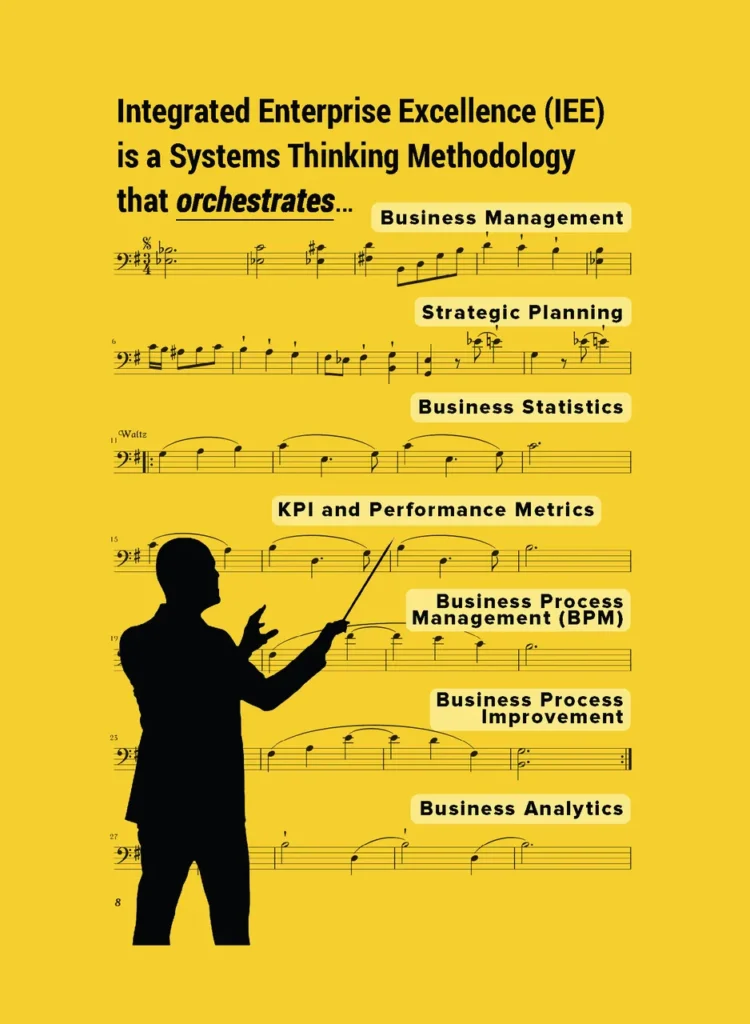
The Value Chain Model by Michael Porter: An Enhancement Incorporating AI ensures that every activity — from procurement to customer service — is continuously evaluated through predictive metrics.
Combined with BPM 2.0 systems thinking, the organization becomes far more agile and capable of maintaining competitive advantage.
Next Step
For a full enterprise framework on building AI-enabled business systems, see our AI-Enabled Business System Transformation Guide.
Let’s have a discovery call to investigate how you and your organization could benefit from An Enhancement Michael Porter Value Chain Model Incorporating AI.