
AI enterprise performance improvement requires more than deploying artificial intelligence across departments. Although AI can reduce costs, increase productivity, and accelerate individual processes, these gains do not automatically translate into better overall business performance.
Many organizations are investing heavily in AI without establishing a management system that connects these investments to enterprise strategy, predictive performance metrics, and measurable financial outcomes.
The result can be an organization that becomes more efficient in isolated areas without becoming more successful as a whole.
The solution is not simply more artificial intelligence. It is integrating AI into a business management system that guides executive decisions, prioritizes the right improvements, and verifies actual enterprise impact.
Watch: Why AI Alone Cannot Improve Enterprise Performance
In this video, Forrest Breyfogle, founder of Smarter Solutions and creator of Integrated Enterprise Excellence (IEE), explains why AI investments often fail to deliver enterprise-wide benefits and how a structured management system can help executives achieve better results.
The AI Optimization Trap: Local Improvements Do Not Guarantee Enterprise Success
Artificial intelligence is particularly effective at analyzing data, identifying patterns, automating activities, and recommending improvements.
For example, AI may help a department:
- Reduce operating costs.
- Increase production throughput.
- Improve resource utilization.
- Accelerate administrative processes.
- Identify opportunities for automation.
Each improvement may appear beneficial when evaluated independently.
However, a department can improve its own performance while unintentionally creating problems elsewhere in the organization.
Increasing production output may generate additional inventory if customer demand has not increased. Improving one department’s efficiency may shift work or delays to another department. Reducing an operating expense may negatively affect product quality or customer satisfaction.
These examples illustrate a fundamental management principle: Optimizing individual processes does not necessarily optimize the enterprise.
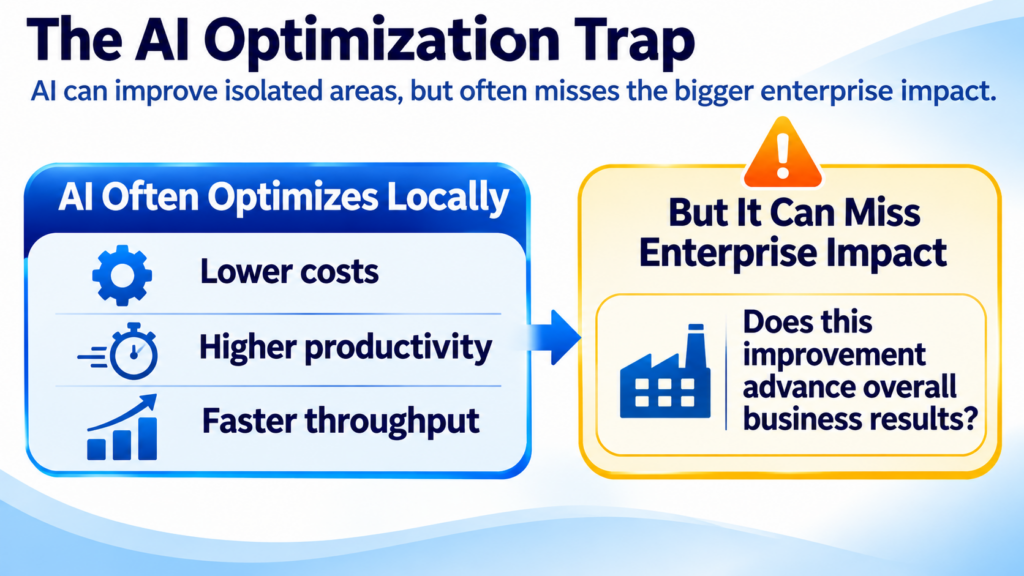
Executives need a management system that evaluates improvement opportunities based on their contribution to overall organizational objectives, rather than isolated operational gains.
Why Traditional KPI Dashboards Can Mislead Executives
Many organizations manage performance through dashboards containing red, yellow, and green indicators.
These dashboards communicate whether performance targets have been met, but they frequently fail to distinguish routine process variation from meaningful changes in performance.
A red indicator does not necessarily mean that something unusual has happened. Similarly, a green indicator does not establish that future performance will remain satisfactory.
When leaders react to every unfavorable result, they may initiate unnecessary investigations, change priorities repeatedly, or launch improvement projects that do not address meaningful business problems.
This management behavior can create organizational firefighting rather than sustainable improvement.
A more effective approach is to evaluate performance over time, determine whether the process is stable, and assess what future performance can reasonably be expected.
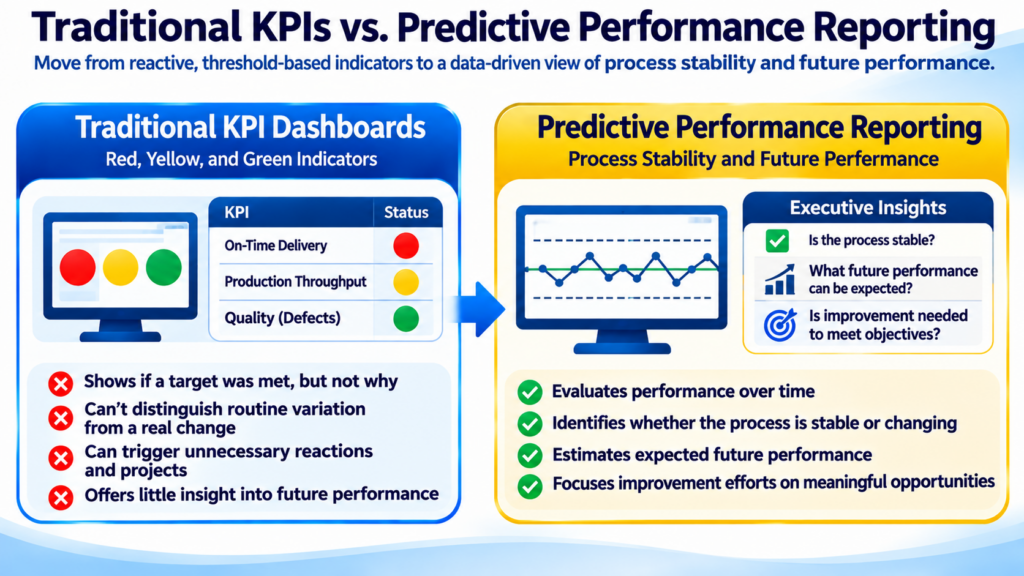
This is the foundation of thirty-thousand-foot-level predictive performance reporting.
Predictive Performance Metrics Provide a Better Foundation for AI Decisions
Predictive performance reporting evaluates performance over time rather than relying on isolated reporting-period results.
The approach helps executives answer three important questions:
- Is the process stable, or has a meaningful change occurred?
- What level of future performance can reasonably be expected if the current system continues?
- Is improvement necessary to meet organizational objectives?
When processes are stable, their historical performance can provide a basis for estimating future outcomes, subject to the assumptions and limitations of the analysis.
When meaningful changes occur, management can investigate the underlying causes rather than reacting to routine variation.
AI can strengthen this analysis by identifying patterns, supporting investigations, and evaluating potential improvement opportunities.
However, AI-generated recommendations must still be evaluated within the broader business context.
Predictive reporting helps executives distinguish where action is needed from where routine variation should not trigger unnecessary intervention.
Integrated Enterprise Excellence Connects AI to Business Strategy
Integrated Enterprise Excellence is a business management approach that connects performance measurement, enterprise strategy, improvement project selection, and management governance.
Rather than treating AI initiatives as independent technology projects, IEE provides a structure for evaluating how these initiatives contribute to organizational objectives.
Four interconnected elements are particularly important:
- Predictive performance reporting: Evaluate process stability, expected future performance, and gaps between current performance and business objectives.
- Enterprise strategy alignment: Connect improvement opportunities to the organization’s strategic priorities and financial objectives.
- Improvement project selection: Identify and prioritize initiatives based on their potential contribution to enterprise performance, rather than simply their technological appeal or local efficiency gains.
- Management governance: Establish accountability and a recurring management review process to monitor results, evaluate changing conditions, and adjust priorities.
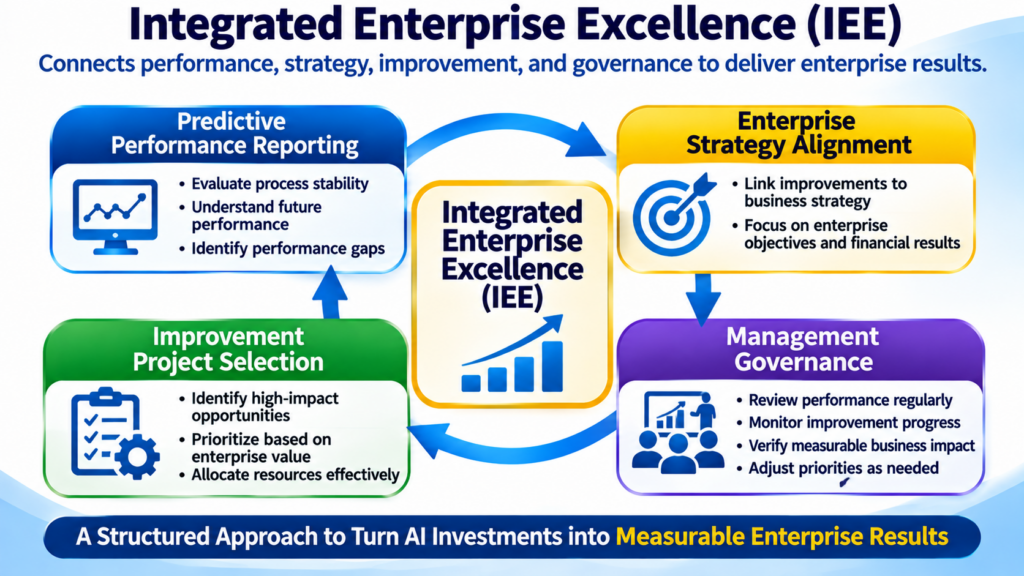
AI can enhance each of these activities. But the management system provides the structure needed to coordinate them.
How to Verify Whether AI Investments Are Delivering Business Results
A successful AI initiative should be evaluated based on more than implementation milestones, automation rates, or the number of employees using the technology.
Executives should ask whether the initiative has produced measurable improvements in the performance indicators that matter to the enterprise.
Examples include:
- Reduced operating costs without adverse effects elsewhere.
- Improved customer delivery performance.
- Increased throughput that contributes to profitable business results.
- Reduced quality failures and associated financial losses.
- Improved working capital and cash flow.
- More predictable performance against strategic objectives.
- The key is to establish appropriate baseline measures, evaluate changes over time, and determine whether observed improvements can reasonably be attributed to the initiative.
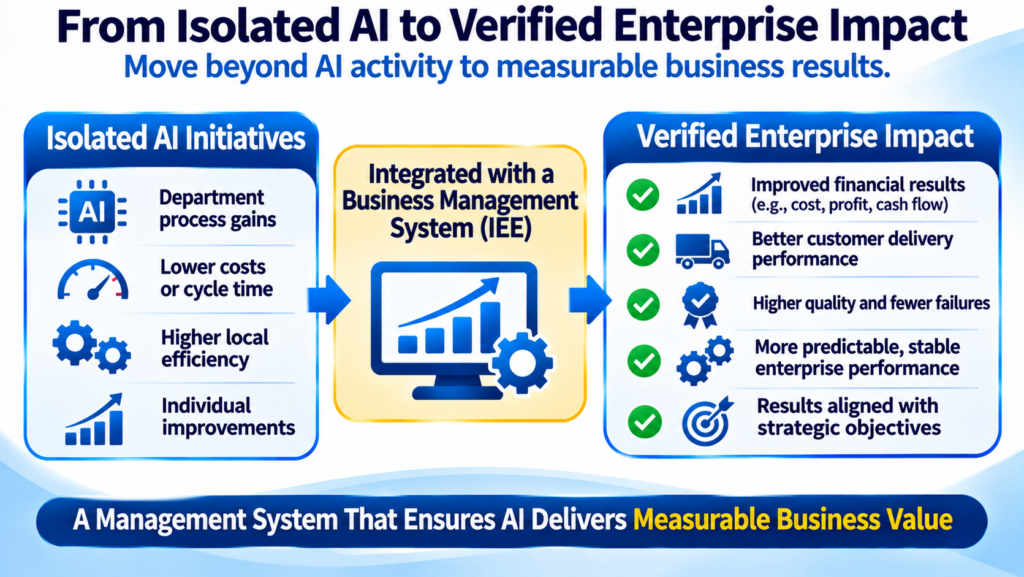
Without this verification, organizations risk celebrating AI activity without demonstrating actual business value.
Moving from AI Activity to Sustainable Operational Excellence
Organizations do not need to abandon their existing AI investments to achieve better results.
Instead, they should establish a management framework that determines where AI can contribute the greatest enterprise value.
This means beginning with organizational objectives and performance gaps, rather than starting with technology and searching for applications.
Predictive metrics help identify meaningful improvement needs. Enterprise strategy guides project selection. AI supports analysis and execution. Management governance ensures that improvement efforts remain aligned and that business outcomes are verified.
This integration creates a more disciplined path toward sustainable operational excellence.
Schedule a Complimentary Executive Performance Reporting Review
If your organization is investing in AI but struggling to connect those investments to measurable business results, I welcome the opportunity to discuss how Integrated Enterprise Excellence could help.
During a complimentary video meeting, we can explore how your organization currently measures performance, selects improvement projects, and evaluates whether AI investments are producing meaningful enterprise benefits.
The discussion does not require you to share confidential company data.
Contact Forrest Breyfogle
Founder, Smarter Solutions, Inc.
Email: [email protected]
Phone: 512-695-4424
Schedule your complimentary video meeting: https://smartersolutions.com/schedule-zoom-session/
Better enterprise performance requires more than better technology. It requires a management system that connects information, decisions, and actions to measurable business results.