
AI-Enabled Business System Transformation is rapidly becoming a strategic priority for organizations worldwide.
Yet most corporate AI deployment efforts struggle or fail—not because of poor technology, but because the underlying business systems are not designed to support AI-enabled decision‑making.
Smarter Solutions’ Integrated Enterprise Excellence (IEE) methodology provides a proven blueprint for building a business architecture where AI can thrive, drive meaningful improvement, and improve enterprise-wide financial performance.
This webpage presents a holistic guide to AI‑Enabled Business System Transformation, highlighting the organizational benefits of using IEE to avoid the failures that plague traditional corporate AI initiatives.
It also connects to Smarter Solutions’ complementary resource: AI Implementation 2.0: A Better Way to Achieve Holistic Business Transformation.
———————————————————————
AI-enabled Enterprise Transformation Overcomes Corporate AI Implementation Failure
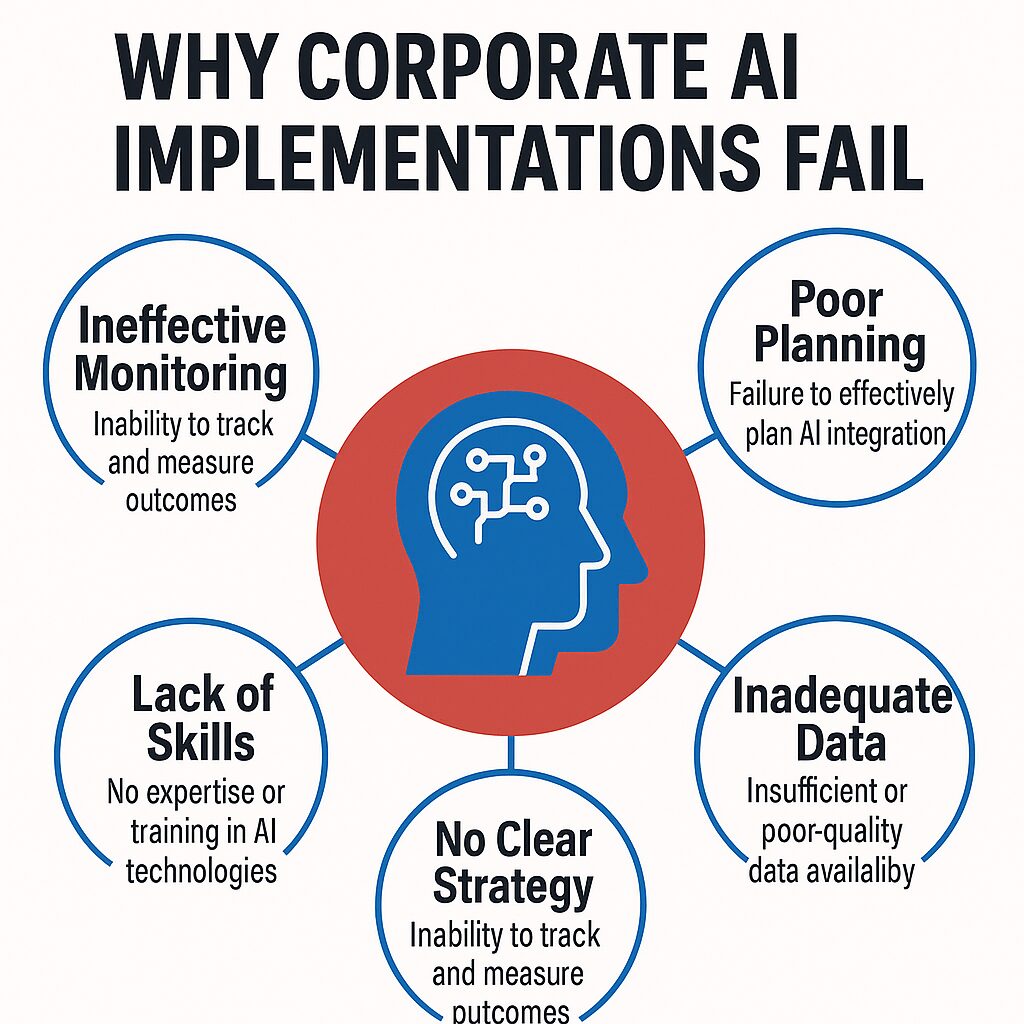
Corporate AI implementation failure is a widespread issue across industries. Organizations invest heavily in AI tools—but see little financial return. AI-enabled enterprise transformation through the IEE system overcomes these issues.
The problem is not the algorithms; it is the lack of a stable, predictive measurement system that guides where AI should be deployed and why. Why AI fails without proper metrics.
Most organizations rely on:
- red‑yellow‑green scorecards
- table-of-numbers reports
- reactive KPI reviews
- leadership opinion wars about priorities
These reporting methods distort behaviors, create firefighting, and prevent leaders from seeing whether a process is stable or improving.
AI applied on top of unstable processes simply accelerates confusion.
How IEE 30,000-foot-level reporting prevents failure in an AI-Enabled Business System Transformation system
A core solution is the IEE 30,000-foot-level metric—a predictive, statistically sound reporting method that reveals the true performance of a process.
Anyone can create a 30,000-foot-level report directly from an Excel spreadsheet containing a continuous response (normal or log‑normal), using a free 30,000-foot-level metric creation app.
The app generates:
- an individuals control chart
- a probability plot
- a predictive performance statement
This shows whether a process is stable and what its future output is likely to be.
If the predictive output is undesirable, the organization knows—with statistical confidence—that the root issue lies in the underlying process (the Xs in Y=f(X)), not in people or tools.
This eliminates argument-based decision‑making and clarifies where AI should be used for maximum business impact.
The benefits of predictive reporting over traditional dashboards are summarized in the video: Metric Reports that Lead to the Best Behaviors
Organizational benefits
With 30,000-foot-level reporting deployed enterprise‑wide:
- AI is applied only where processes are stable and ready
- Failure modes are identified before costly AI development begins
- Improvements become financially verifiable
- Leaders stop reacting to noise and start acting on predictive insights
The result of IEE AI-enabled enterprise transformation is measurable, financially aligned success.
———————————————————————
AI-enabled Business Systems Example: How to Implement AI in Electronics Manufacturing
An AI-enabled Business Systems example is answering the question of how to implement AI in electronics manufacturing, which is central to its competitiveness. However, factories typically struggle because:
- WIP levels fluctuate unpredictably
- Non-conformance rates behave erratically
- Lead times vary from shift to shift
- Traditional dashboards obscure systemic variation
Using software to deploy enterprise-wide 30,000-foot-level reporting
Smarter Solutions’ Enterprise Performance Reporting System (EPRS) software provides an automated, daily‑updated platform for organization-wide 30,000-foot-level reports.
EPRS allows electronics manufacturers (and all industries) to monitor predictive metrics for:
- non-conformance rates
- WIP movement
- lead time distributions
- scrap and rework
- throughput stability
Linking metrics to processes: Y=f(X)
Every 30,000-foot-level Y‑response metric in EPRS is automatically tied to the processes that created the output (the Xs). This creates a unified reporting model that AI can operate on.
How AI becomes more effective with IEE + EPRS
When AI tools analyze stable, meaningful metrics:
- predictive maintenance becomes accurate
- scheduling algorithms reduce lead time variability
- defect detection models target real root causes
- optimization tools generate financially aligned improvements
This is the missing foundation for AI in electronics manufacturing.
———————————————————————
AI Governance Implementation
AI governance implementation is only possible when an organization has clear systems for decision‑making, measurement, prioritization, and accountability. Without these, AI efforts remain scattered.
Two key books outline how to establish AI‑ready governance systems:

Governance benefits of IEE methodology
The methodologies in these books:
- eliminate firefighting
- create organizational alignment
- tie operations to financial results
- ensure AI projects have clear business cases
- provide a structured roadmap for optimization
- anchor AI decisions in stable, predictive metrics
The result is responsible, predictable, and scalable AI governance.
———————————————————————
AI-enabled Operating Model
An AI-enabled operating model requires more than ethics checklists.
It requires a business system that ensures AI supports enterprise-wide improvement rather than creating unintended consequences.
The Smarter Solutions experience
Since 1992, Smarter Solutions has helped organizations create business systems that drive the “3 Rs of business”:
- doing the Right things
- doing them Right
- at the Right time
This aligns the entire enterprise around predictable performance and financially beneficial decision‑making.
How IEE drives responsible AI
IEE ensures:
- AI tools are applied where they improve process stability
- Models are validated using predictive metrics
- Systems thinking replaces departmental silos
- Decisions are driven by data, not politics
- Financial impacts are transparent
This is responsible AI in action—AI that improves the enterprise as a whole.
———————————————————————
Conclusion: AI-Enabled Business System Transformation the Right Way
AI-Enabled Business System Transformation is not about technology—it is about creating the conditions where AI can work effectively.
Smarter Solutions’ IEE methodology provides:
- a unified Y=f(X) improvement system
- governance frameworks
- enterprise‑wide visibility through EPRS
- responsible, financially aligned AI deployment
This is the foundation for AI‑Enabled Business System Transformation done the right way.
Let’s have a discovery conversation to see how you and your organization could benefit from these techniques.