
Systems Thinking in Digital Transformation: Why Faster Can Be Slower
Artificial intelligence and automation promise faster processes, greater productivity, and lower operating costs. Yet many organizations discover that making individual operations more efficient does not necessarily improve overall business performance.
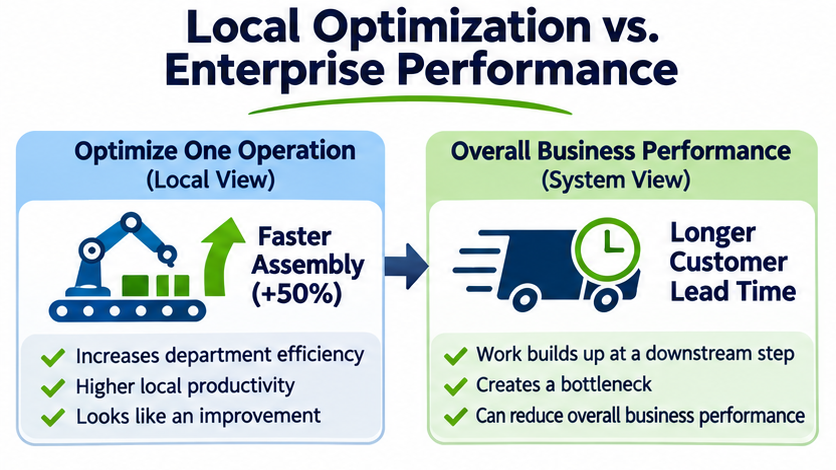
Consider a manufacturing company that invests in AI-enabled automation to increase production capacity by 50%. Management celebrates the improvement, but customers continue experiencing delivery delays.
How can faster production result in slower delivery?
The answer illustrates why systems thinking in digital transformation is essential for achieving sustainable business results.
Technology investments must be evaluated according to their effects on the entire business system—not simply the productivity of an individual department.
Applying systems thinking in digital transformation helps executives identify constraints before committing resources to AI and automation initiatives.
Watch the Video: Why AI Automation Can Make Business Performance Worse
In this video, Forrest Breyfogle, founder of Smarter Solutions, explains how AI automation can improve one operation while creating unintended consequences elsewhere in the business.
The example demonstrates why executives should evaluate end-to-end performance before investing in new technologies.
Systems Thinking in Business: Why Local Improvements Can Fail
Systems thinking in business involves understanding how interconnected activities collectively influence organizational performance.
A business is not simply a collection of independent departments. Sales, order processing, production, quality assurance, distribution, and customer service operate as components of a larger value chain.
An integrated business management system helps executives understand these relationships and align improvement activities with enterprise objectives.
An improvement in one department can affect other departments in unexpected ways.
For example, increasing assembly capacity might appear beneficial when measured by units produced per hour. However, if downstream operations cannot accommodate the additional output, the result may be increased inventory, congestion, and longer customer lead times.
This distinction is fundamental:
- Local optimization does not necessarily produce enterprise optimization.
- Executives need performance measures that reflect the results of the entire business system, including customer delivery reliability, quality, throughput, and financial outcomes.
Theory of Constraints in Manufacturing: Understanding the Bottleneck
Theory of Constraints in Manufacturing: Understanding the Bottleneck
The theory of constraints in manufacturing provides a useful way to understand why improving one operation may not increase overall throughput.
The American Society for Quality explains how the theory of constraints focuses improvement efforts on the weakest link in a process rather than optimizing every operation independently.
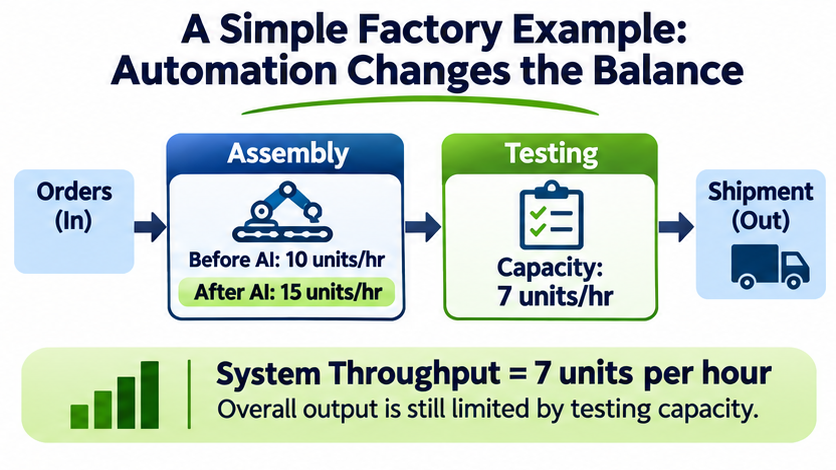
Consider a factory with three major activities:
- Customer orders enter the production system.
- Assembly produces up to 10 units per hour.
- Final testing can process only 7 units per hour before shipment.
Although assembly can produce 10 units per hour, the testing operation limits the system’s maximum sustainable throughput to 7 units per hour.
Now suppose management introduces AI-enabled automation that increases assembly capacity from 10 to 15 units per hour.
Assembly capacity improves by 50%.
However, testing capacity remains unchanged at 7 units per hour.
The factory has invested in automation without increasing its overall throughput capacity.
An effective operational excellence strategy focuses improvement efforts on constraints that affect enterprise results rather than isolated departmental efficiencies.
What Happens to Work in Process?
If assembly continuously produces 15 units per hour while testing completes only 7 units per hour, unfinished products accumulate between the two operations.
Without effective production controls, the consequences can include:
- Increased work-in-process inventory.
- Greater congestion on the production floor.
- More material handling and expediting.
- Longer customer lead times.
- Additional operating costs without increased shipments.
The problem is not that automation failed to improve assembly. It is that management improved a process without adequately considering the performance of the entire system.
A more effective improvement strategy would address the testing constraint, regulate upstream production, or redesign the overall workflow.
Digital Transformation Strategy: Start With Enterprise Outcomes
A successful digital transformation strategy should begin with business objectives rather than technology selection.
Recent research reinforces this concern. PwC’s 2026 Digital Trends in Operations Survey, involving 767 U.S. operations and supply chain leaders, found that 89% reported their technology investments had not fully delivered expected results. Integration complexity, data quality, and user adoption were among the leading challenges.
These findings reinforce the importance of systems thinking in digital transformation. Rather than implementing AI and automation as isolated departmental initiatives, organizations need to evaluate how technology investments affect the entire value chain and whether they produce measurable enterprise-level improvements.
The survey findings and sample size are verified directly from PwC.
A successful digital transformation framework connects technology investments with enterprise performance measures and strategic business objectives.
Organizations frequently evaluate automation investments using departmental productivity improvements, expected labor savings, or increased equipment capacity.
The National Institute of Standards and Technology emphasizes that smart manufacturing systems require coordinated design, measurement, and analysis across connected operations.
These measures may be useful, but they do not establish whether the investment will improve enterprise results.
Executives should begin by asking:
- What business outcome are we trying to improve?
- Which part of the value chain currently limits that outcome?
- How will the proposed technology affect upstream and downstream operations?
- What unintended consequences could occur?
- How will we verify that the investment produces measurable business benefits?
These questions shift the emphasis from implementing technology to improving organizational performance.
Why Traditional KPI Reporting Can Be Misleading
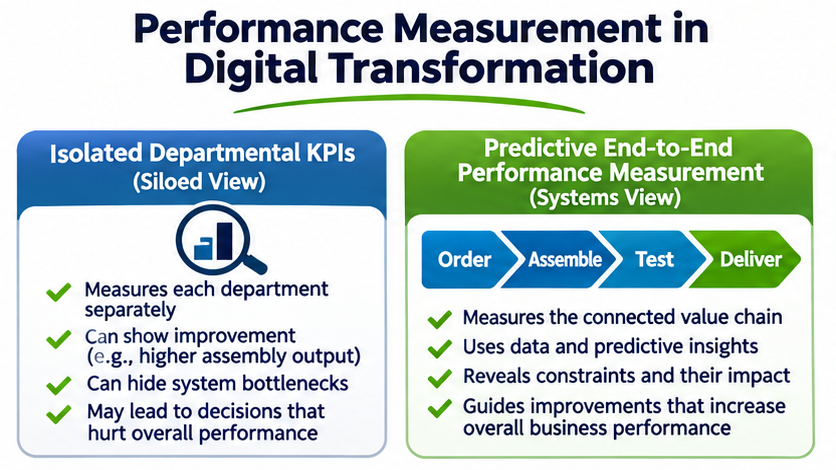
Traditional key performance indicators often focus on departmental targets and comparisons with arbitrary thresholds.
A department may report favorable productivity results while the overall organization experiences deteriorating customer delivery performance.
An alternative is to use predictive performance metrics that distinguish routine process variation from meaningful changes and provide insight into likely future performance when the process remains stable.
These predictive performance metrics help management distinguish routine variation from meaningful performance changes and assess likely future outcomes.
For example, management can monitor end-to-end order lead times, delivery reliability, and other operational measures using statistically appropriate time-series reporting.
This approach helps executives determine whether a technology investment has produced a meaningful and sustained change in business performance.
AI in Operational Excellence: Improving the Entire Value Chain
AI in operational excellence offers significant opportunities when technology is applied within a well-designed business management system.
OECD research indicates that realizing the full productivity benefits of AI requires complementary investments in management capabilities, digital infrastructure, and workforce skills—not technology adoption alone.
Artificial intelligence can help organizations analyze operational data, identify emerging constraints, evaluate improvement alternatives, and monitor changes in performance.
Effective AI business process improvement requires evaluating proposed changes according to their effects on the entire enterprise rather than individual operations.
For example, AI-supported analysis might identify patterns associated with testing delays, equipment downtime, rework, or changing demand.
Simulation models can help management evaluate alternatives before making major investments.
However, an AI recommendation that improves one operation should not automatically be considered beneficial to the enterprise.
The appropriate question is not whether AI makes a process faster. It is whether the resulting changes improve overall business performance.
Integrating AI With Integrated Enterprise Excellence
Smarter Solutions’ Integrated Enterprise Excellence (IEE) approach connects enterprise performance measurement, business management, and process improvement.
Rather than treating AI as an isolated technology initiative, IEE provides a management framework for determining where improvements are needed and how their results should be evaluated.
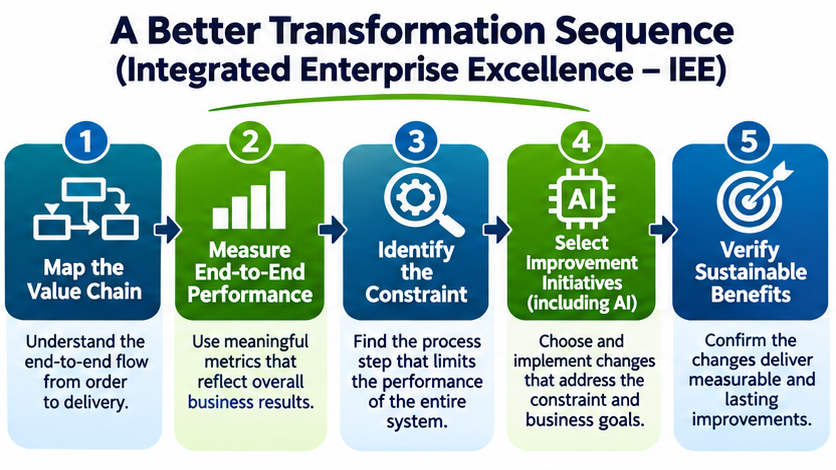
A practical transformation sequence includes five activities:
- Map the value chain. Understand how the organization’s interconnected processes create value for customers.
- Establish meaningful performance measures. Evaluate end-to-end results using appropriate predictive reporting methods.
- Identify the most important constraints. Determine which limitations have the greatest effect on enterprise performance.
- Select improvement initiatives. Evaluate process redesign, operational improvements, and AI applications according to their expected business impact.
- Verify sustainable benefits. Determine whether implemented changes produce meaningful, lasting improvements in customer and financial outcomes.
This sequence helps organizations avoid investing in technologies that deliver impressive local results without improving the business as a whole.
[INSERT FIGURE 4 — INTEGRATED ENTERPRISE EXCELLENCE TRANSFORMATION SEQUENCE]
The Executive Leadership Implication
Digital transformation should not be judged by the number of AI applications implemented, the amount invested in automation, or the productivity gains reported by individual departments.
Systems thinking in digital transformation provides a framework for evaluating whether individual improvements contribute to measurable enterprise-wide results.
Its success should be judged by measurable improvements in enterprise performance.
Executives should establish a management process that connects technology decisions with customer outcomes, operational performance, and financial results.
Systems thinking provides the perspective needed to understand organizational interdependencies. Predictive performance measurement provides a basis for evaluating results. Integrated Enterprise Excellence connects these capabilities to a structured approach for business improvement.
Together, these elements can help organizations achieve more meaningful and sustainable benefits from digital transformation.
Conclusion: Faster Operations Do Not Always Mean Better Results
AI automation can dramatically increase the capacity of an individual process while leaving the organization’s overall throughput unchanged.
In some circumstances, it can even contribute to increased work in process and longer customer lead times.
The lesson is straightforward:
- Successful digital transformation requires improving the entire business system—not simply making individual operations faster.
- Organizations that combine systems thinking, meaningful performance measurement, and strategically selected AI applications are better positioned to achieve sustainable enterprise improvements.
Let’s Discuss Your Business System
At Smarter Solutions, we help organizations connect business management, predictive performance measurement, and process improvement through Integrated Enterprise Excellence.
If your organization is investing in AI, automation, or digital transformation, consider whether those investments are improving overall enterprise performance.
I welcome the opportunity to discuss how these concepts might apply to your organization.
Email: [email protected]
Phone: 512-695-4424