
Artificial intelligence is rapidly transforming how organizations make decisions. One of its most promising applications is AI project selection—using AI to determine which improvement initiatives will deliver the greatest enterprise-wide financial benefit instead of simply optimizing isolated processes.
Curious about AI’s capabilities in this area, I asked ChatGPT a straightforward question:
How can I use AI to determine the best project to undertake in a business?
The response was insightful and surprisingly aligned with what I have advocated for many years through the Integrated Enterprise Excellence (IEE) methodology. Rather than merely optimizing existing processes, AI should help organizations identify the enterprise improvement projects that will produce the greatest impact on overall business performance.
That distinction is significant.
Unfortunately, many organizations continue to select projects using criteria that optimize only portions of the business rather than the enterprise as a whole.
Examples include:
- A department has poor KPIs.
- Customer complaints increase.
- A process owner requests resources.
- Equipment downtime rises.
- AI identifies inefficiencies within one workflow.
While these initiatives may improve local performance, they frequently have little measurable effect on revenue growth, profitability, or overall enterprise performance.
ChatGPT recognized this limitation and concluded that AI should instead analyze enterprise-wide information, determine cause-and-effect relationships, estimate financial impact, evaluate project dependencies, and optimize an entire portfolio of improvement opportunities.
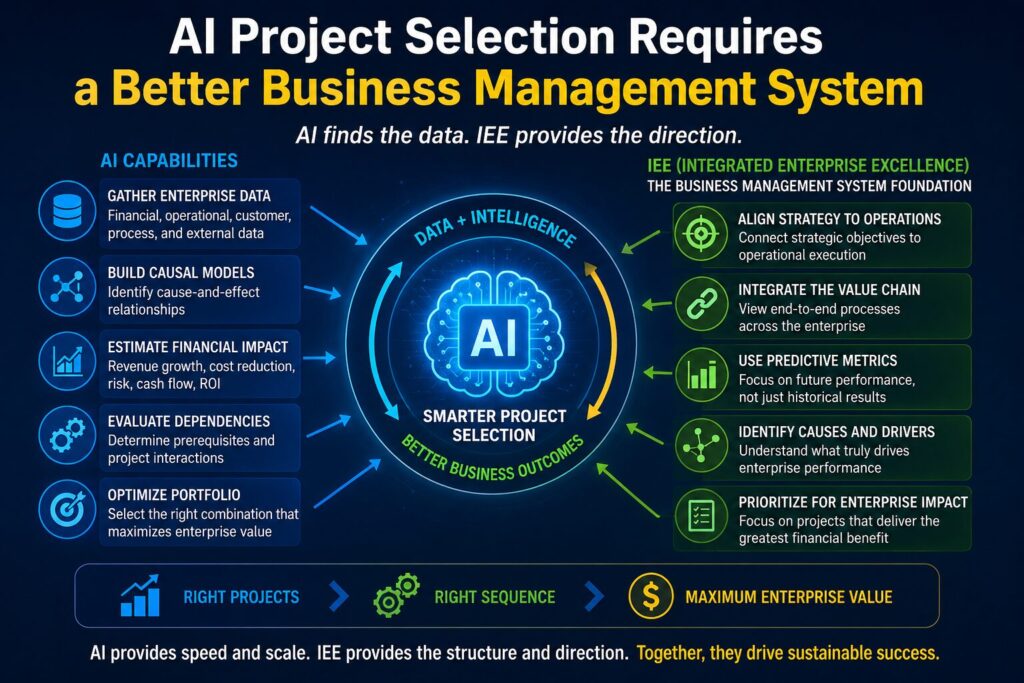
AI Project Selection Should Focus on Enterprise Value
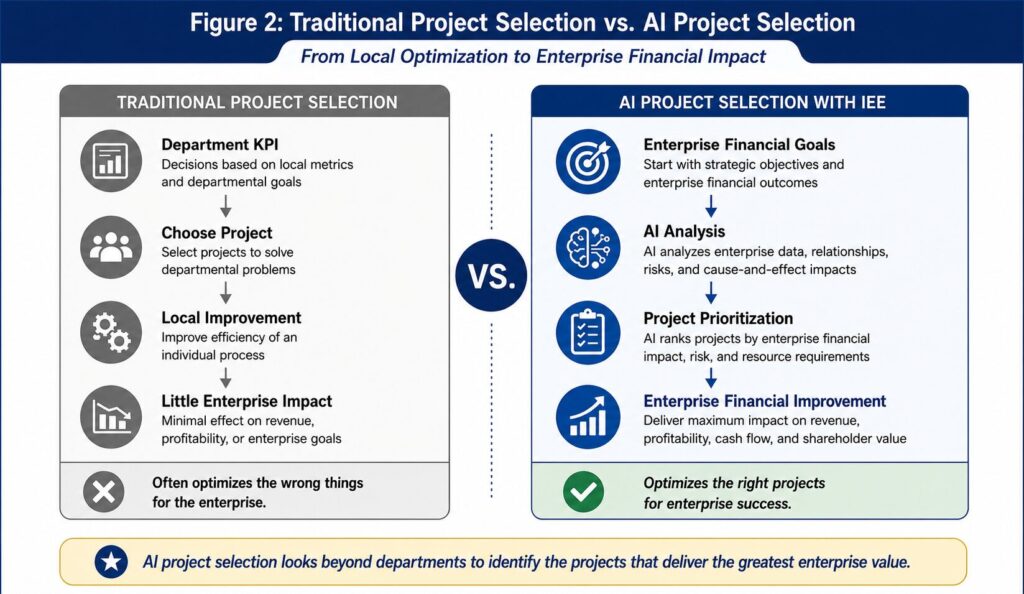
The greatest opportunity for AI project selection is not helping organizations improve individual processes—it is helping executives determine which projects will create the greatest enterprise-wide financial return.
Rather than asking AI,
How can we improve this process?
Organizations should ask,
Which enterprise improvement projects will most improve financial performance over the next twelve months?
Answering this question requires AI to evaluate relationships across finance, operations, quality, supply chain, customer satisfaction, sales, and strategic objectives instead of examining departments independently.
This broader perspective allows AI to recommend projects that maximize enterprise value instead of local efficiency.
Why AI Business Improvement Often Optimizes the Wrong Processes
Many organizations believe they are pursuing AI business improvement, yet they deploy AI primarily to automate departmental activities or optimize isolated workflows.
Examples include:
- reducing invoice processing time,
- improving warehouse picking,
- minimizing machine downtime,
- accelerating customer service responses.
These improvements may be valuable, but they do not necessarily improve enterprise profitability.
True AI business improvement requires understanding how local process changes influence financial results throughout the enterprise.
Improving one department while creating constraints elsewhere rarely produces sustainable business improvement.
Without understanding these enterprise relationships, AI simply becomes a faster method of local optimization.
Business Management System AI Needs More Than Data
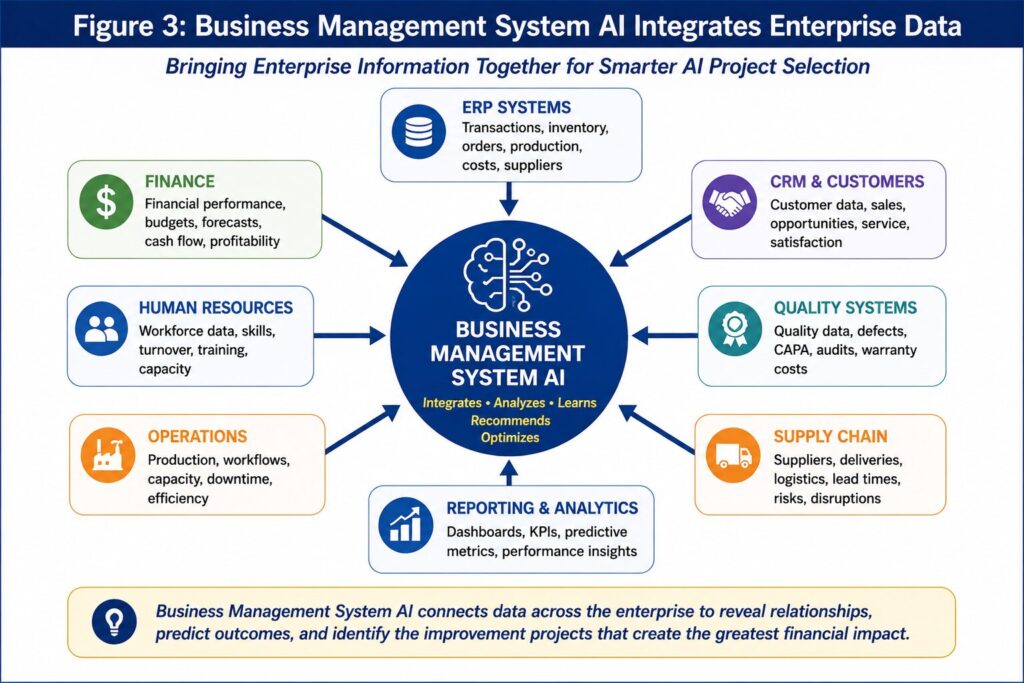
This is where many organizations encounter a major obstacle.
A successful business management system AI requires much more than large quantities of data.
Artificial intelligence cannot consistently recommend the best enterprise improvement projects unless it operates within a management system that connects operational activities to strategic objectives and financial outcomes.
Without that enterprise framework, AI simply analyzes disconnected information.
Most organizations already possess valuable systems:
- ERP systems manage transactions.
- CRM systems manage customer relationships.
- Quality systems manage compliance.
- Lean Six Sigma improves individual processes.
- Dashboards report departmental KPIs.
Each system performs an important function.
However, few organizations possess a comprehensive business management system that enables AI to determine which improvement initiatives will maximize overall business performance.
How Integrated Enterprise Excellence Improves Enterprise Improvement Projects
Integrated Enterprise Excellence (IEE) was specifically designed to overcome this limitation.
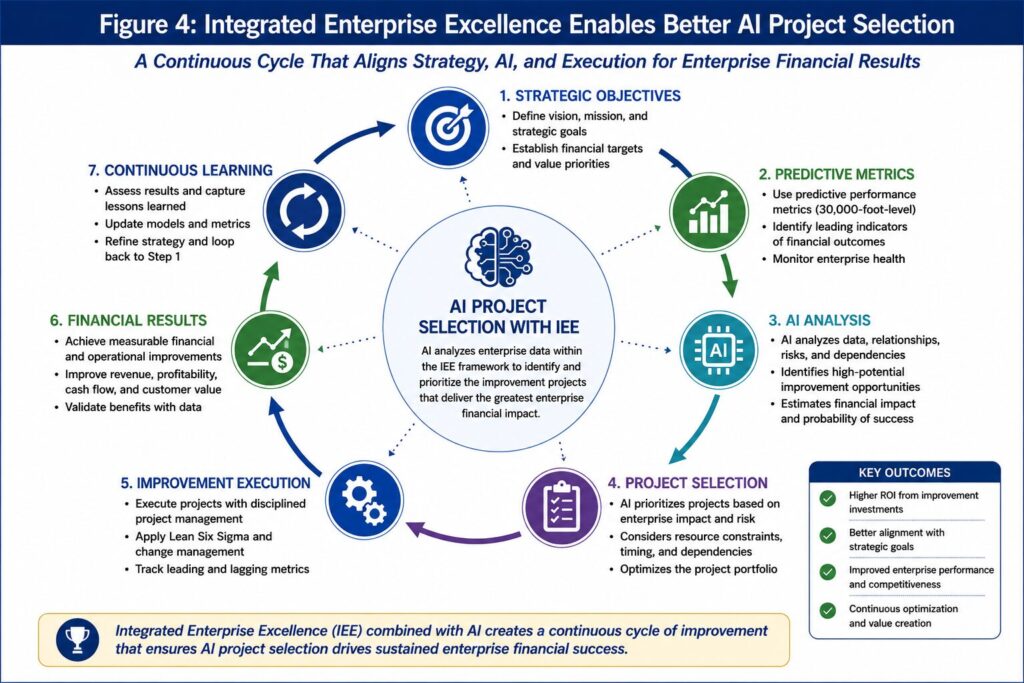
Rather than beginning with isolated metrics or departmental objectives, IEE aligns every improvement initiative with enterprise financial goals.
Its integrated framework:
- Links strategic objectives with operational execution.
- Connects processes throughout the enterprise value chain.
- Uses predictive performance metrics instead of static scorecards.
- Identifies cause-and-effect relationships across the organization.
- Prioritizes enterprise improvement projects based upon enterprise impact.
- Continuously reassesses priorities as business conditions change.
These capabilities closely mirror the enterprise workflow ChatGPT identified as necessary for effective AI project selection.
Instead of asking AI to optimize isolated activities, IEE provides the enterprise structure AI requires to recommend projects that improve overall financial performance.
AI for Operational Excellence Requires an Enterprise Framework
Organizations frequently ask whether artificial intelligence will replace Lean Six Sigma, Business Process Management, or traditional Operational Excellence initiatives.
A more valuable question is:
How can AI for operational excellence become part of a business management system that continuously identifies, prioritizes, and optimizes the projects that deliver the greatest enterprise value?
That is precisely the role fulfilled by Integrated Enterprise Excellence.
AI for operational excellence should not merely automate existing work.
It should continuously evaluate strategic objectives, predictive performance metrics, financial goals, resource constraints, implementation risks, and organizational dependencies before recommending improvement priorities.
When AI operates within an enterprise-wide framework, improvement efforts become significantly more effective and financially meaningful.
AI Project Selection Is Far More Powerful with Integrated Enterprise Excellence
Artificial intelligence can process enormous amounts of operational, financial, and customer information far faster than people.
However, AI still requires a framework that defines:
- which information matters,
- how business processes interact,
- which metrics predict financial performance,
- how projects influence enterprise objectives,
- how improvement opportunities should be prioritized.
Integrated Enterprise Excellence provides precisely that framework.
Rather than replacing management, AI becomes an enterprise decision-support engine capable of continuously recommending the highest-value improvement opportunities.
Organizations combining IEE with AI gain far more than process automation.
They gain an intelligent capability for AI project selection that continually identifies the improvement portfolio most likely to maximize enterprise-wide financial performance.
Frequently Asked Questions About AI Project Selection
What is AI project selection?
AI project selection is the use of artificial intelligence to identify and prioritize improvement initiatives that provide the greatest enterprise-wide financial benefit rather than simply optimizing isolated processes.
How is AI business improvement different from traditional process improvement?
Traditional improvement often focuses on local efficiency. AI business improvement evaluates enterprise relationships, financial outcomes, and strategic objectives to recommend projects that maximize overall business performance.
Why do enterprise improvement projects frequently fail?
Many projects are selected using departmental KPIs instead of enterprise financial objectives. As a result, local improvements often fail to improve overall business results.
Can AI replace Lean Six Sigma?
No. AI enhances Lean Six Sigma by helping organizations determine which projects should be undertaken first. It does not replace structured problem solving or organizational leadership.
Why does business management system AI require an enterprise framework?
Without an enterprise framework, AI cannot understand how strategic objectives, financial performance, operational processes, and customer outcomes interact. A comprehensive management system enables AI to make recommendations that optimize the business as a whole rather than individual departments.
References
- Business Management System 2.0
- Integrated Enterprise Excellence (IEE)
- Predictive Performance Metrics
- AI Implementation 2.0
- Operational Excellence 2.0
- Business Process Management 2.0
- KPI Reporting 2.0
- Lean Six Sigma Program 2.0
Conclusion
Organizations investing in artificial intelligence should ask one critical question before launching another improvement initiative:
Does our current business management system provide AI with the enterprise-wide structure necessary for effective AI project selection?
If the answer is no, the challenge may not be the AI.
It may be the management system directing it.
Artificial intelligence alone cannot consistently identify the best enterprise improvement projects. Sustainable AI business improvement requires a business management system AI can use to connect operational activities with enterprise financial objectives.
Integrated Enterprise Excellence provides that foundation.
When combined with AI for operational excellence, IEE enables organizations to move beyond isolated process improvements toward continuous optimization of enterprise performance, strategic objectives, and long-term financial success.
Learn Whether AI Is Optimizing the Right Improvement Projects
If your organization is investing in AI, digital transformation, Lean Six Sigma, or Operational Excellence initiatives, the most important question may not be how to implement AI but whether AI is helping you select the improvement projects that will create the greatest enterprise-wide financial impact.
The Integrated Enterprise Excellence (IEE) methodology provides the business management framework that enables AI to prioritize improvement opportunities based on enterprise objectives rather than isolated departmental metrics.
Learn more about the IEE business management system and discover how organizations can combine predictive performance metrics with AI to make better enterprise decisions.
Ready to Move Beyond Traditional AI Implementations?
Many AI initiatives fail to improve enterprise financial performance because they optimize individual processes rather than the business as a whole.
If your organization wants AI to identify the improvement projects that will have the greatest strategic and financial impact, the Integrated Enterprise Excellence methodology provides the missing business management framework.
Whether your interest is executive consulting, leadership education, software, or keynote presentations, Smarter Solutions can help your organization transform AI into a true enterprise decision-support capability.
About the Author
Forrest W. Breyfogle III is the founder and CEO of Smarter Solutions, Inc. and the creator of the Integrated Enterprise Excellence (IEE) business management system. He has authored numerous books on enterprise improvement, Lean Six Sigma, predictive performance metrics, and business management systems. His work focuses on helping organizations improve financial performance through enterprise-wide management and data-driven decision-making.